What a Good Monthly SEO Report Looks Like (and How to Spot a Vanity Report)
A good monthly SEO report answers four questions on the first page: what happened, why it happened, what it produced in leads and revenue, and what happens next. If your report...
A good monthly SEO report answers four questions on the first page: what happened, why it happened, what it produced in leads and revenue, and what happens next. If your report can’t do that, you have a data dump wearing a report’s clothes.
I’m Mike Villar, CEO of Growth Rocket, and I’ve spent close to two decades building and reading SEO reports. These days, a big part of my job is reviewing the reports new clients received from their previous agencies. I’ve seen 40-page PDFs that said nothing and one-page summaries that drove real budget decisions. The difference was never the number of metrics. It was whether the person reading it could act on it.
This article walks through the anatomy of a report your leadership team can actually use, puts a vanity report next to a decision-ready one, and gives you a scorecard to grade whatever your agency sends you this month.
What a monthly SEO report is actually for
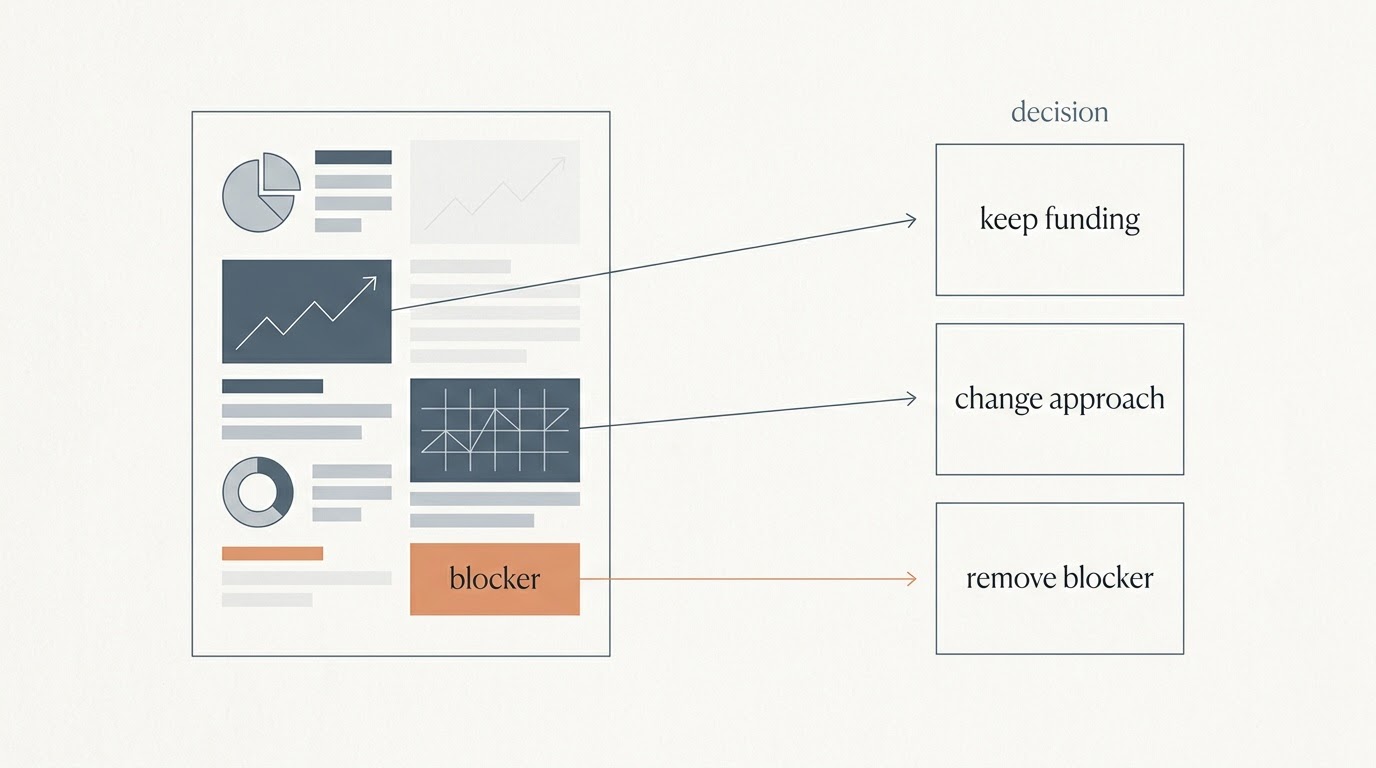
A monthly SEO report exists to support a decision, not to prove activity. For a non-technical leader, that decision is usually one of three: keep funding this, change the approach, or remove a blocker. Every page in the report should feed one of those outcomes.
The one-question test: can you make a decision from it?
Here’s the test I use when a client hands me their current agency’s report: after reading it once, can you decide something? Approve a budget, kill a tactic, greenlight a content push, chase a developer for a fix. If the honest answer is “no, but it looked busy,” the report failed its only job.
Many agencies build reports to justify the retainer, not to inform the client. That’s how you end up with screenshots of every keyword and a traffic graph with no explanation. Judge the report by what it lets you do, not by how much it contains.
Vanity metrics vs. actionable metrics in plain English
Practitioners who study SEO client reporting recommend capping a report at roughly five KPIs tied to business goals, because readers skim past everything else. I’d go further: if a metric doesn’t connect to leads, revenue, or a decision, it belongs in an appendix, not the summary.
What should an SEO report include? The anatomy of a decision-ready report
When people ask me what should an SEO report include, I give them six sections. This structure has held up across hundreds of client campaigns at Growth Rocket.
Executive summary: result, cause, business impact, next move
The opening section states the headline result, the business impact in leads or sales, the main cause, and the next move for the coming 30 days, a structure recommended across current SEO reporting templates. Four to six sentences, no charts. If your CEO reads nothing else, this is what they read.
Leads and revenue attribution from organic search
This is the section most agency reports skip, and it’s the one your CFO cares about. It should show form fills, calls, and sales that came from organic search, split from paid and referral channels, with a dollar value attached where possible. If your report shows traffic but never leads, you’re paying for visibility you can’t bank.
Ranking movement on money pages (not every keyword)
Rankings still matter, but only for the keywords that lead to revenue: your service pages, product categories, and high-intent comparison terms. Some practitioners now argue keyword rankings alone have become vanity metrics because they ignore traffic quality and conversions. I agree with the caution, not the funeral. Track movement on your money pages and tie it to what those pages produced.
Traffic context: branded vs. non-branded clicks and conversions
Branded searches (people Googling your company name) grow because of everything your business does, not because of SEO. Non-branded clicks on commercial terms are where organic search earns its keep. A useful report splits the two and shows conversions from each, so you can see whether the agency is growing demand or just taking credit for your reputation.
Work completed: the change log that proves activity
Every month should list what the team actually did: pages published, titles rewritten, technical fixes shipped, links earned, with dates. This isn’t busywork. When results move three months later, the change log is how you trace the cause. No change log means you’re being asked to trust output you can’t verify.
Next month’s priorities, blockers, and what you need to approve
A report that only looks backward wastes your time. The closing section should name the top three to five priorities for next month, flag anything blocking progress (a slow developer, missing content approvals, an unreviewed draft), and list decisions you need to make. Blockers sitting in a report for three straight months tell you something about the agency, or about you.
SEO KPIs for leads: connecting search to revenue
The hardest part of SEO reporting is attaching money to it. Here’s the method I walk clients through, and it’s simpler than most people expect.
Setting a value per lead (close rate times average deal size)
For a lead-gen business, take your close rate and multiply by average deal size. Say your sales team closes 20% of qualified leads and your average contract is $10,000: each qualified lead is worth roughly $2,000. If organic search produced 15 qualified leads last month, that’s about $30,000 in expected pipeline value. You then compare that value against your SEO cost over a suitable timeframe to see ROI. Ecommerce businesses can skip the math and track organic revenue directly.
Call tracking, form fills, and CRM closed-loop reporting
Attribution only works if the plumbing is connected. Form fills need source tracking, phone leads need call tracking numbers, and both should flow into your CRM so a lead can be followed to a closed deal. In my experience, this closed loop is where most reporting falls apart. The agency reports “conversions,” sales reports “no good leads,” and nobody reconciles the two. Insist on one number both sides agree on.
Leading indicators vs. bottom-line results
SEO compounds, so a healthy report tracks two layers. Bottom-of-funnel results are leads and revenue. Top-of-funnel leading indicators are impressions, rankings, and clicks on pages that historically convert. The leading indicators tell you whether results are coming; the bottom line tells you whether they’ve arrived. A report with only the first layer is a promise. A report with only the second can’t explain its own numbers.
Vanity report vs. decision-ready report: a side-by-side example
Same month, same data, two very different documents. This composite is based on real reports I’ve reviewed during agency transitions.
What the vanity version shows (and hides)
Organic sessions: 12,400, up 8% month over month
Keywords in top 10: 47, up from 41
Total impressions: 1.2 million
Domain authority: 34, up 1 point
Backlinks built this month: 12
Every number is up, and none of them tell you anything. Which keywords entered the top 10, and do any of them sell something? What did those 12,400 sessions do? What work did the agency perform, and what happens next? The report hides the absence of answers behind the volume of numbers.
The same month, reported so the boss can act
Organic leads: 38 qualified form fills and calls, up from 31, worth an estimated $76,000 in pipeline at our standard lead value
Cause: three service pages moved from positions 8 to 12 into the top 5 after last month’s content rewrites; non-branded clicks to those pages rose 34%
One product category page dropped from position 4 to 9 after a template change; fix submitted, needs your dev team to deploy
Work completed: six page rewrites, internal linking pass on 20 posts, four links earned
Next month: rewrite the remaining four service pages; approval needed on two drafts sitting in the shared doc
Now you can act: deploy the fix, approve the drafts, and hold the agency to next month’s pipeline number.
Does the first page state the headline result in leads or revenue?
Does it explain the cause, not just the outcome?
Are organic leads separated from other channels?
Is branded traffic split from non-branded?
Are rankings limited to money pages, with context?
Is there a change log of work completed, with dates?
Can you verify the numbers in your own analytics and Search Console access?
Are next month’s priorities named?
Are blockers and pending approvals flagged?
Could you make one decision from this report today?
Score 8 to 10: your agency is doing its job. Score 5 to 7: the bones are there, but push for the missing sections. Score 0 to 4: you’re paying for decoration.
Red flags that should trigger a conversation
Some problems go beyond a low score. The recurring red flags in agency evaluation guides match what I’ve seen firsthand: reports that show rankings but never organic revenue, no client access to Search Console, and no change log of work performed. Add two more from my own list: lead numbers you can’t reconcile with your CRM, and the same “next steps” recycled month after month. Any one of these warrants a direct conversation, not another quarter of patience.
Using an SEO reporting template to reset expectations with your agency
You don’t have to fire your agency to fix the report. Send them the six-section anatomy from this article, or a published SEO reporting template, and ask them to restructure next month’s report around it. Frame it as a format change, not an accusation: “I need leads and revenue on page one, a change log, and next month’s blockers, so I can make decisions faster.”
A good agency will welcome this. Clear reporting expectations make their work easier to defend. Resistance to it tells you the reporting was never really for you.
Bring your report to a strategy call
If you’ve scored your current report and the number stings, bring it to us. On a strategy call, I’ll go through your agency’s report with you, section by section, and show you exactly what’s missing, what’s inflated, and what a decision-ready version of your own data would look like. No obligation, no pitch deck. After nearly twenty years of reading these things, I can usually tell you within one call whether you have a reporting problem or an agency problem.
The most common SEO agency red flags are guaranteed rankings, vague deliverables, no admin access to your own accounts, reports that stop at traffic, long contracts with no exit,...
The right choice in the SEO agency vs in-house vs freelancer decision depends on four things: your team size, your lead goals, how fast you need results and how many hours a month...
How much does SEO cost for a small business? The short answer Most small businesses pay between $1,500 and $3,500 per month for SEO, and the right number depends on how competitive...