
Does AI content hurt your SEO? What Google really says
The short answer No. Google does not penalize AI content just because a model wrote it. It demotes low-quality, unoriginal pages made to manipulate rankings, however they were...
Mike VillarTo audit an SEO agency report, check whether it shows leads from organic search, split into branded and non-branded, tied to specific pages, and verifiable in your own analytics....
 Mike VillarChief Executive Officer
· 9 min read
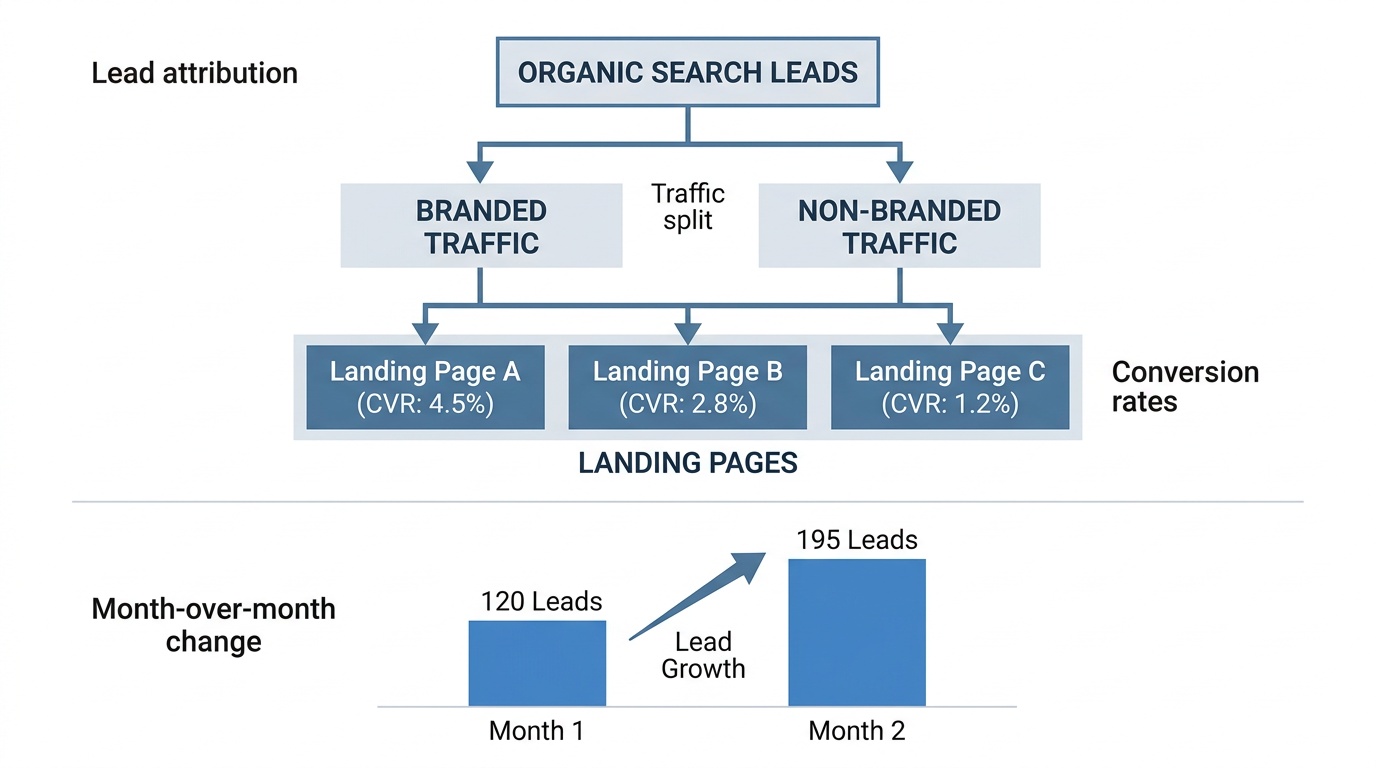
To audit an SEO agency report, check whether it shows leads from organic search, split into branded and non-branded, tied to specific pages, and verifiable in your own analytics. If the report leads with rankings, impressions, and a list of tasks, it shows activity and tells you nothing about results. Below are ten questions I use to test any monthly SEO or AI search report, plus the red flags that tell you to push back.

Most advice on whether your SEO agency is working tells you to watch rankings, organic traffic, backlinks, and ROI. That’s a reasonable start, and checklists like this one from Local SEO Va cover it. But those metrics are inputs and side effects. A business pays for SEO to get inquiries, calls, and customers.
In my almost two decades in this industry, the pattern I see most often is a client holding a handsome report with every arrow pointing up and a sales team saying the phone is quiet. Practitioners say the same thing in public. A thread on r/b2bmarketing describes impressions, traffic screenshots, and rankings all looking good while revenue stays flat.
So evaluate SEO agency performance by starting at the end of the funnel and working backward. Did organic search produce leads? Which pages produced them? Did the work done last month cause any of it? The ten questions below follow that order.
You can ask these in a meeting or send them as an email. A good agency answers them without fuss, often with a screenshot from your own accounts. A weak one gets vague or redirects you to the ranking chart.
You need one number, and it must come with a definition. A lead might be a form fill, a tracked phone call, a chat, or a booked appointment. Ask whether spam, existing customers, and job applicants are filtered out.
Then ask for the actual lead list with dates, so you can match it against your CRM or inbox. If the agency’s count and your sales team’s count don’t match, the report is not worth trusting yet.
Attribution decides whether a lead gets credited to organic search or to another channel. In GA4, conversion attribution shows how organic works alongside paid, email, referral, and social. The Traffic acquisition report shows where sessions come from.
Ask which attribution model the report uses and why. Then check that you hold admin access to your GA4 property and Search Console, with the agency added as a user. If the agency owns the accounts, you can’t verify anything, and you could lose your history when you leave.
Branded traffic comes from queries that contain your company or product name. Those people already know you. Growth there often reflects your reputation, referrals, or offline marketing, not the agency’s acquisition work.
Search Console query data lets you separate the two segments. A report that lumps them together can hide a flat or falling non-branded line behind a healthy total. Ask for both lines, for traffic and for leads.
Sitewide conversion rate hides the story. You want a table of landing pages with organic sessions, leads, and conversion rate for each. It shows which pages earn their keep and which draw visitors who never act.
You can also build this yourself in a GA4 exploration with landing page as the row, filtered to organic search. If the agency can’t produce it, or won’t, ask why.
Money pages are the service, product, and location pages that bring in leads or sales. Blog traffic can climb all year without a single inquiry. One agency, Mettevo, uses a simple rule: SEO is working when non-branded clicks to pages that bring leads or sales rise for three consecutive months.
It’s one agency’s benchmark, not a law, but I like it because it is strict and easy to check. One good month can be noise. Three in a row is a trend.
Every report should explain movement, up or down. Look for a specific cause: a page was updated, a technical fix went live, a competitor moved, Google rolled out an update. “Rankings improved” is not an explanation.
Watch the comparison periods too. Comparing a seasonal peak to a trough, or a 28-day window to a calendar month, creates false wins. SEO Site Checkup lists inappropriate comparisons among the common reporting pitfalls. Year over year is usually the fairer view for seasonal businesses.
Ask for a list of completed work with URLs: pages published, pages rewritten, technical fixes shipped, links earned and where. A line like “ongoing optimization” proves nothing.
I’d also ask who did each piece, because strategy, writing, and development often sit with different people. When no one owns the outcome, problems get passed around instead of fixed. A named owner per task makes accountability possible.
For many local and service businesses, the best leads arrive by phone. Ask whether calls are tracked, how a call becomes a lead (a minimum length? a qualified conversation?), and whether the same person calling and filling out a form counts twice.
Then ask about the last step. Booked jobs and closed revenue live in your CRM or job software, not in GA4. The best agencies ask for that data, because without it they are guessing at quality. If yours has never asked, that tells you something.
AI search reporting is new, and standards are still loose. A typical method, described by AI Advisors, runs a fixed set of roughly 10 to 30 prompts across ChatGPT, Perplexity, and Gemini on a recurring schedule and logs how often each engine cites the brand. A whole market of AI visibility tools now sells this.
So any AI visibility figure is a sample, not a ranking. Ask these before you accept it:
Answers from AI tools can change from one run to the next, so a small move in a citation count may be noise. In the client campaigns I’ve seen, citation reporting works best as a directional signal next to lead data, never in place of it.
A useful report ends with decisions. What should be scaled because it works? What should be changed because it doesn’t? What is the top priority for the next 30 days?
The plan should name pages and a reason, such as “we’re improving the three service pages that convert best but sit on page two.” If next month’s plan could be pasted into any client’s report, nobody is thinking about your business.
You don’t need all ten questions to spot trouble. These four patterns show up again and again, and any one of them is enough to ask for a different report.
If the first page is keyword positions and impression counts, the report is built around what is easy to measure, not what you care about. Impressions mean people saw your listing. They say nothing about whether anyone called. Rankings matter only for terms that bring buyers.
Screenshots from the agency’s proprietary dashboard, with numbers that don’t match your GA4 or Search Console, are a serious accountability problem. Reports built on third-party estimates of your traffic are a related red flag. Your own accounts are the source of truth, and any claim should survive a check there.
“You’re cited in 40% of AI answers” means nothing without the prompt list, engines, dates, and definition of a citation. A number without a method is marketing copy. Ask for the method in writing, and ask them to repeat it next month the same way, or trends mean nothing.
A baseline is where you started, so progress has something to be measured against. Signs of a weak agency include no starting point, no explanation of what moved and why, and no plan for what comes next. B Thrust’s list of warning signs puts the baseline first for good reason. Without it, every month looks like progress and none can be proved.

Sometimes you ask all ten questions and still can’t tell if the answers are good. That’s normal. You’re paying for expertise you don’t have, so judging the output is hard. A second opinion from outside the relationship can settle it quickly, whether the result is “keep going,” “fix these three things,” or “this isn’t working.”
I built this audit around the same ten questions, applied to your real data. Here’s what we look at:
You get a plain-language read on what’s working, what isn’t, and what to ask your agency or freelancer next. It’s not a pitch to replace anyone. Sometimes the right answer is to stay put with better reporting.
If you want a straight answer on whether your SEO is producing leads, book a strategy call with Growth Rocket. Bring your latest report and access to your analytics, and we’ll walk through it together.
The short answer No. Google does not penalize AI content just because a model wrote it. It demotes low-quality, unoriginal pages made to manipulate rankings, however they were...
Mike VillarGEO priorities for small teams: what to do first (and what to skip) If you run marketing with one to three people, your GEO priorities for small teams come down to this: make sure...
Mike VillarKey Takeaways: Optimizing Average Order Value (AOV) consistently delivers faster, more measurable ROI than scaling paid traffic spend. Bundling, upsells, cross-sells, and...
Mike VillarStart your brand's success journey today with a conversation. Share your goals and objectives with us and let's set up a discovery call.