SEO Agency Red Flags: 12 Warning Signs Before You Sign or Renew
The most common SEO agency red flags are guaranteed rankings, vague deliverables, no admin access to your own accounts, reports that stop at traffic, long contracts with no exit,...
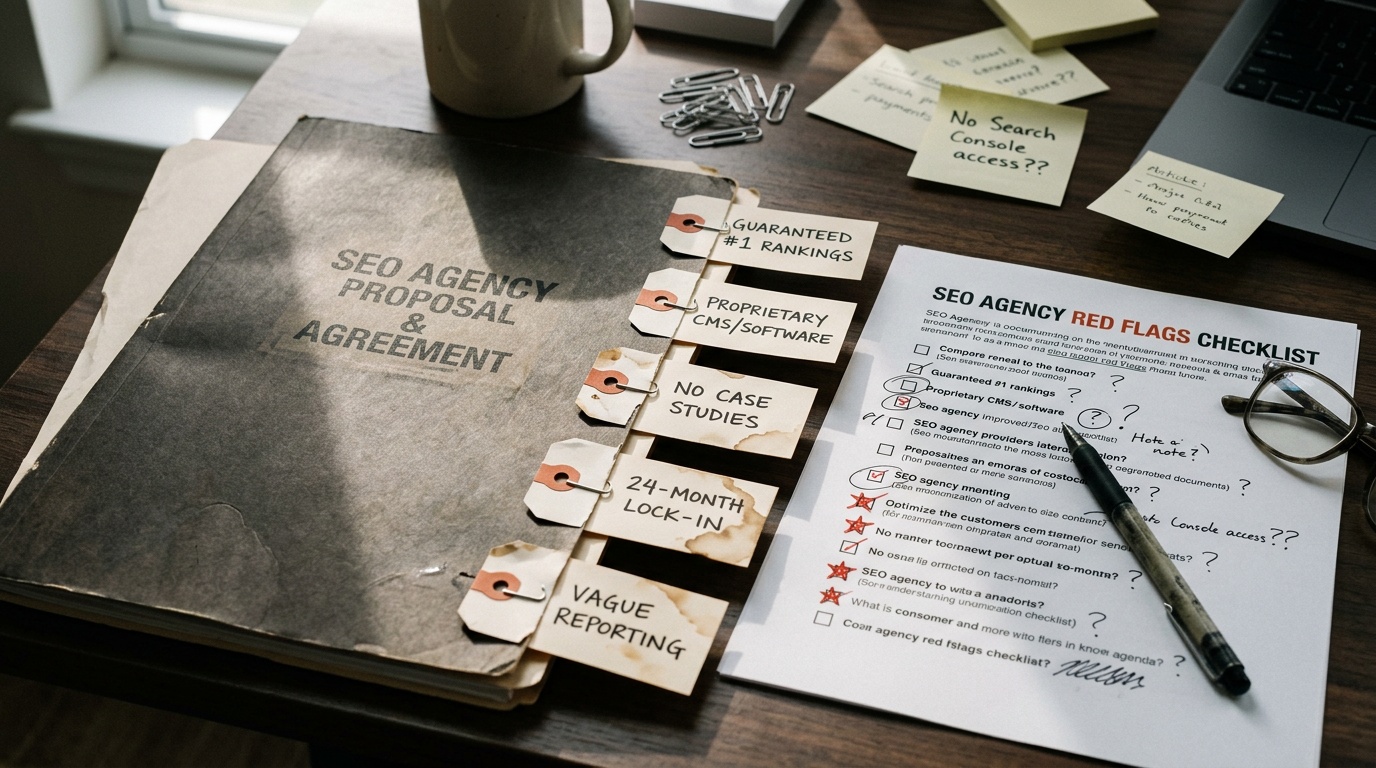
The most common SEO agency red flags are guaranteed rankings, vague deliverables, no admin access to your own accounts, reports that stop at traffic, long contracts with no exit, and bought links. If you see any of them in a proposal or a current retainer, ask questions before you sign or renew. After almost two decades in SEO, I can tell you the agencies that do the most damage usually show these signs early.
How to use this SEO agency red flags checklist
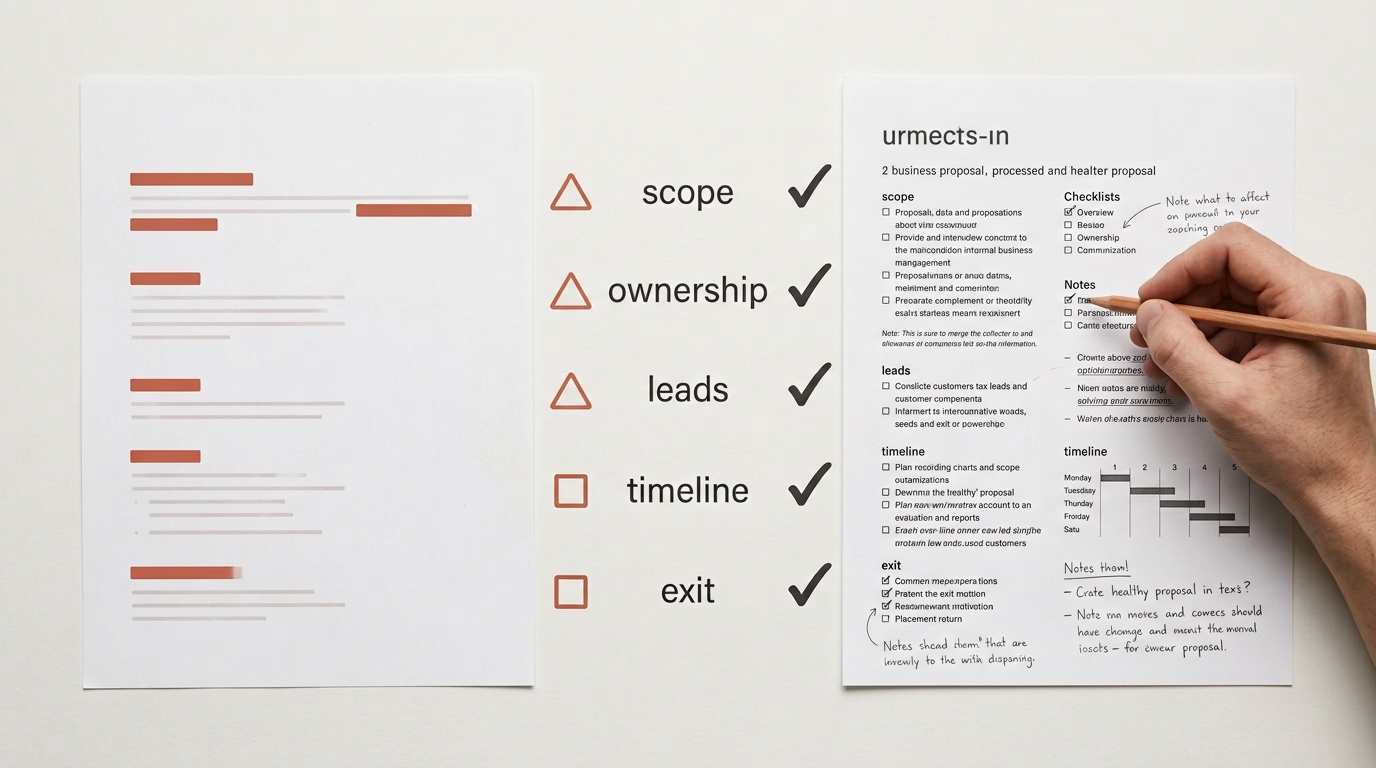
Run each flag below against a proposal or the agency you already pay. Every flag comes with what a healthy agency does instead and one of the questions to ask an SEO agency. Together they work as a way to vet an SEO company, whether you’re about to sign or deciding on a renewal.
One warning: a single flag isn’t always fatal. A badly worded proposal can be fixed with a conversation. Two or three flags, or an agency that gets defensive when you ask, is a different story.
Red flags in promises and pricing
1. They guarantee #1 rankings (or a “special relationship” with Google)
Nobody controls Google’s results. Google’s guidance on hiring an SEO says no one can guarantee a number one ranking, and it warns against anyone claiming a special relationship with Google. This is the clearest of all the SEO scam warning signs.
A healthy agency gives you forecasts as ranges, explains the assumptions, and ties the goal to leads rather than positions.
Ask: “What is this forecast based on, and what happens if we miss it?”
2. The proposal lists vague deliverables with no real scope
“Strategy, on-page optimization and link building” tells you nothing. You can’t hold anyone to it, which is the point. In my experience, vague scopes are where retainers quietly drift into low-effort work.
A solid proposal names the number of pages to be fixed or created, the technical work planned, and what lands in months one, three and six.
Ask: “What exactly will I have in hand at the end of month one?”
3. The price is too low for the work promised
Good SEO takes skilled hours. When the fee is far below what the promised work would cost, the gap gets filled by templates, automation, bulk-bought links, or one person juggling too many accounts.
A healthy price maps to named people and their time. You don’t need the cheapest quote or the priciest, just one where the math works.
Ask: “What does this fee include, and what does it leave out?”
Red flags in transparency and ownership
4. They hide behind a “proprietary process”
Real expertise survives being explained. If an agency won’t tell you what it’s doing, you can’t tell good work from no work. A firm that shows you exactly what it’s doing is a good sign, and one that won’t is not.
A healthy agency walks you through its reasoning and gives recommendations you can follow, even if you never touch the work yourself.
Ask: “Can you walk me through the next three things you’d do on our site, and why those first?”
5. You don’t have admin access to your own accounts
Some agencies set up your analytics, Search Console, ad accounts or hosting under their own logins. If you leave, your history goes with them. This “data hostage” setup is one of the clearest bad SEO agency signs.
You should own and be admin on everything from day one: analytics, Search Console, Google Business Profile, your CMS and your domain. The agency gets access, not ownership.
Ask: “Who owns each account, and will I be admin on all of them?”
6. Reporting is all traffic and rankings, never leads or revenue
Traffic can climb while leads stay flat. A report full of impressions, rankings and sessions can look busy and prove nothing about your business. Across Growth Rocket’s client campaigns, the numbers that matter come from organic leads, split between branded and non-branded searches and tied to specific pages. I’ve covered that audit in more detail on the Growth Rocket blog.
A healthy report connects activity to outcomes you can check in your own analytics.
Ask: “Which numbers here tie to leads or revenue, and where can I verify them myself?”
Red flags in tactics
7. They buy links or use private blog networks
Google’s spam policies cover buying or selling links for ranking purposes, excessive link exchanges, automated link creation, and paid articles that pass ranking credit. Private blog networks (PBNs) are sites built only to produce ranking links, so they fall under the same rules. The risk is a penalty that costs far more than the retainer you wasted.
Healthy link building looks like digital PR, useful content other sites want to cite, and real partnerships. It’s slower, and each link has a reason to exist.
Ask: “Where will our links come from, and will you show me every one?”
8. They publish thin or mass-produced content at scale
Volume is easy to sell and easy to report. It is also the kind of scaled, low-value content Google’s spam systems go after. Fifty generic posts will not beat five that show real knowledge of your field.
A healthy agency interviews your people, adds original detail, and publishes fewer pieces that someone has fact-checked.
Ask: “Who writes and reviews the content, and how do you check it’s accurate?”
9. They chase rankings for keywords that don’t matter to your business
Ranking first for a term nobody buys on is a nice screenshot and a useless result. This is common when an agency picks keywords for easy wins rather than for your revenue.
Healthy keyword research starts from what you sell and who buys it, then sorts terms by buying intent.
Ask: “How does each target keyword connect to something we sell?”
Red flags in the relationship
10. The contract locks you in with no exit clause
SEO takes months, so some commitment is fair. A long term with no way out is something else, especially paired with no account access.
Look for a reasonable initial term, a clear notice period, and a promise that you keep all content, accounts and data if you leave.
Ask: “What happens if I cancel, and what do I keep?”
11. The senior team pitches, then juniors (or no one) do the work
You meet the impressive strategist in the sales call and never see them again. The bait-and-switch is common enough that you should plan for it.
A healthy agency names who will work on your account and lets you meet them before you sign.
Ask: “Who does the day-to-day work, and how much senior time is on my account?”
12. They never ask questions about your business
If the pitch could be sent to any company in your industry unchanged, the work will read the same way. Good SEO depends on knowing your margins, your best customers, your sales cycle and what your team can handle.
A healthy agency asks hard questions early, sometimes ones that feel like an interview.
Ask: “What have you learned about our business so far that changes your plan?”
Is my SEO agency worth it? A 10-minute self-audit
If you’re already paying an agency, score each statement below. Give yourself one point for every “yes.”
I can name the person who does the work on my account.
I’m admin on my analytics, Search Console, CMS and domain.
My last report showed leads or revenue from organic search, not just traffic.
I can say what the agency did last month and why.
I know where our links come from, and I’ve seen examples.
Our target keywords connect to services or products we sell.
I can leave with notice and keep my content and data.
The agency has never guaranteed rankings or a ranking date.
They have told me something I didn’t want to hear, such as a page that needs rewriting.
I never have to chase them for answers.
With 9 or 10, you probably have a healthy relationship. A score of 6 to 8 means you should take the questions above to your next call. At 5 or below, you have enough warning signs to get an outside opinion before the next payment or renewal.
What to do if you spot these bad SEO agency signs
How to raise concerns with your current provider
Put your concerns in writing and keep them specific. Ask for account access, a clear scope of work, and a report that includes leads. Give them a deadline, such as 30 days, to respond.
Watch how they react. A good agency welcomes the scrutiny and fixes the gaps. A bad one gets vague, defensive, or sends a longer report.
When to get a second opinion before you renew
Get one if you scored 5 or below, if you found two or more flags, or if you simply can’t tell whether the work is helping. The review should cover account ownership, your backlink profile, content quality, keyword targeting and whether the reporting ties to revenue. It is far cheaper than finding a link penalty after the fact.
If you’re unsure about your current agency, book a second-opinion call with Growth Rocket. Bring your latest report and contract, and I’ll tell you what I see.
The right choice in the SEO agency vs in-house vs freelancer decision depends on four things: your team size, your lead goals, how fast you need results and how many hours a month...
How much does SEO cost for a small business? The short answer Most small businesses pay between $1,500 and $3,500 per month for SEO, and the right number depends on how competitive...
For in-house vs agency AI search optimization, the honest answer is a split. A generalist on your team can own content restructuring, review and listing profiles, and basic...