SEO Agency vs Freelancer vs In-House: Which Fits a Growing Business?
SEO agency vs freelancer vs in-house: which fits a growing business? The right choice depends on how much skill coverage you need and how much management time you can spare. An...
SEO agency vs freelancer vs in-house: which fits a growing business?
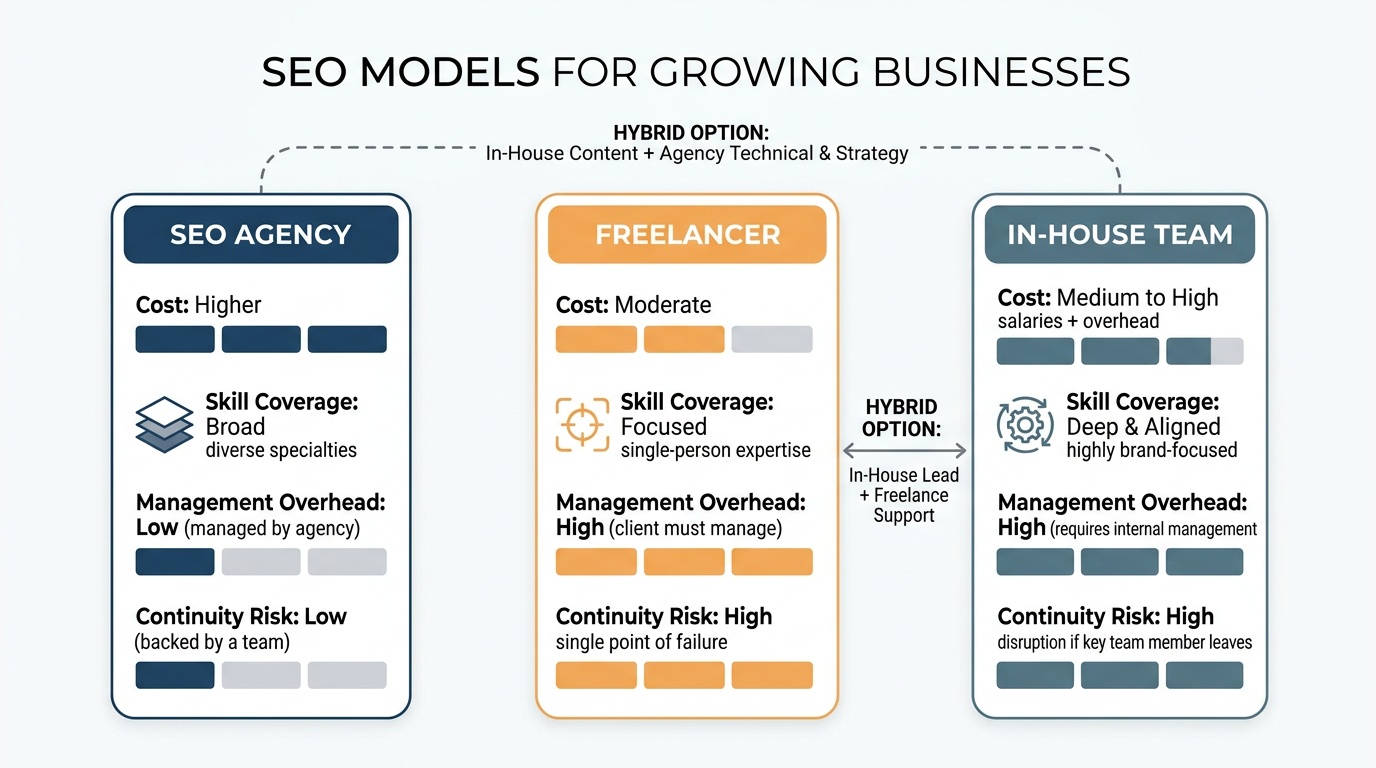
The right choice depends on how much skill coverage you need and how much management time you can spare. An agency gives you a full bench of specialists for a monthly retainer, a freelancer gives you focused expertise at a lower cost with more of your attention required, and an in-house hire gives you close alignment with your business but only one person’s skills. In the SEO agency vs freelancer vs in-house decision, most growing businesses end up with a mix of the three, not a single winner.
This guide compares the three models on cost, skills, management, reporting and risk. It then maps each to a real situation, covers the hybrid setups teams actually run, and ends with a short self-assessment.
SEO agency vs freelancer vs in-house: the three models at a glance
Each model buys you something different, and the differences matter more than the headline price.
An agency is a team. You get strategists, technical specialists, writers and link builders under one contract, with project management and reporting included.
A freelancer is one specialist, usually strong in one or two areas such as technical audits or content strategy. You pay for hours or a flat project fee, and you do most of the coordinating.
An in-house hire is an employee who knows your product, your customers and your colleagues. They are also one person, with one person’s gaps and one person’s holidays.
Before you compare prices, answer one question: how many different jobs does your SEO need done each month? Technical fixes, content, links and analytics are separate skills. Women in Tech SEO notes that agency-side SEOs generally have access to a more defined hierarchy of roles, while in-house teams are often limited to a generalist. That difference drives most of what follows.
What each model actually costs
Sticker prices are easy to find. The real comparison is what you get per dollar and what you have to add on top.
SEO agency retainers
In Ahrefs’ poll of 439 SEO providers, agencies averaged $3,209 per month on retainer, and 63% of businesses spent between $500 and $5,000 per month on SEO. That retainer buys a shared team, not one person’s time. A strategist, a technical lead and a content producer may each spend a few hours on your account.
Budget for the work the retainer does not cover. Content production and development hours are sometimes billed separately, and someone on your side still has to approve work and push changes live.
Freelance SEO rates
The same Ahrefs poll found freelancers averaged $71.59 per hour. At 20 hours a month, that is roughly $1,430, well below the average retainer. For a defined job such as a technical audit, a migration check or a content plan, that rate is hard to beat.
The catch is capacity. A freelancer with several clients can give you a set number of hours, and anything beyond that has to wait or cost more. You also supply the direction, so the price assumes you know what to ask for.
In-house SEO salary and the fully loaded cost
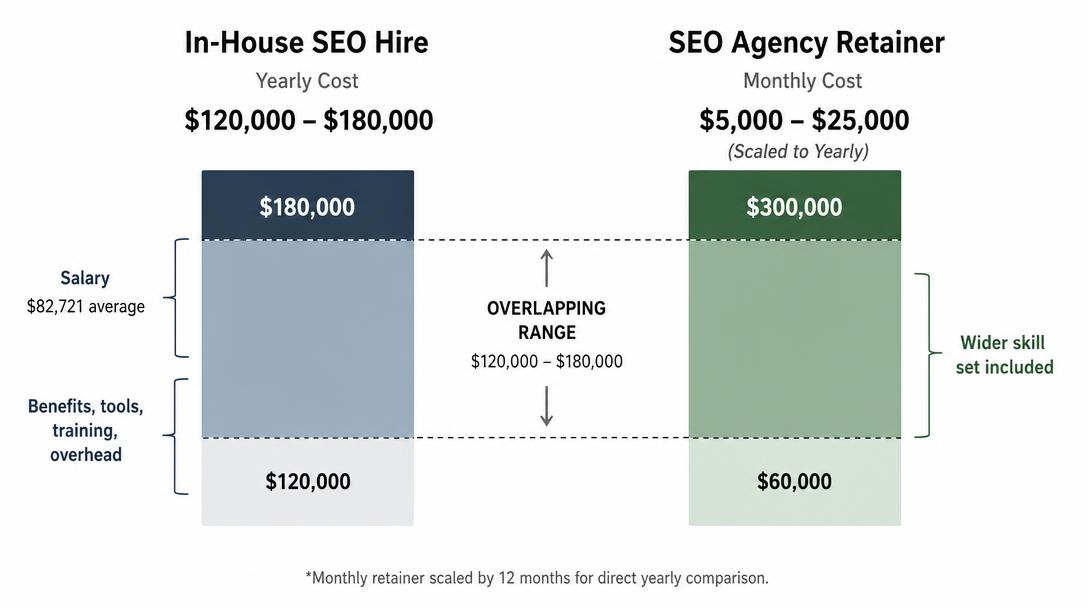
Indeed reports an average US SEO specialist salary of $82,721, based on 891 salaries from job postings. Salary is only part of the bill. Authority Magnet’s cost math puts a fully loaded in-house hire at $120,000 to $180,000 a year once you add benefits, tools, training and overhead. It compares that with $5,000 to $25,000 a month for an agency.
Those figures overlap more than most people expect. A mid-range agency retainer can cost less than one loaded hire, and it comes with more skills. An in-house hire starts to pay off when the work is steady enough to keep one person busy and your site is complex enough to reward deep familiarity.
Skill coverage: technical SEO, content, links and analytics
SEO is not one skill. It touches site infrastructure, content, link acquisition, user experience signals and analytics, and each moves on its own schedule. Few people are strong in all of them.
Here is how the models usually stack up:
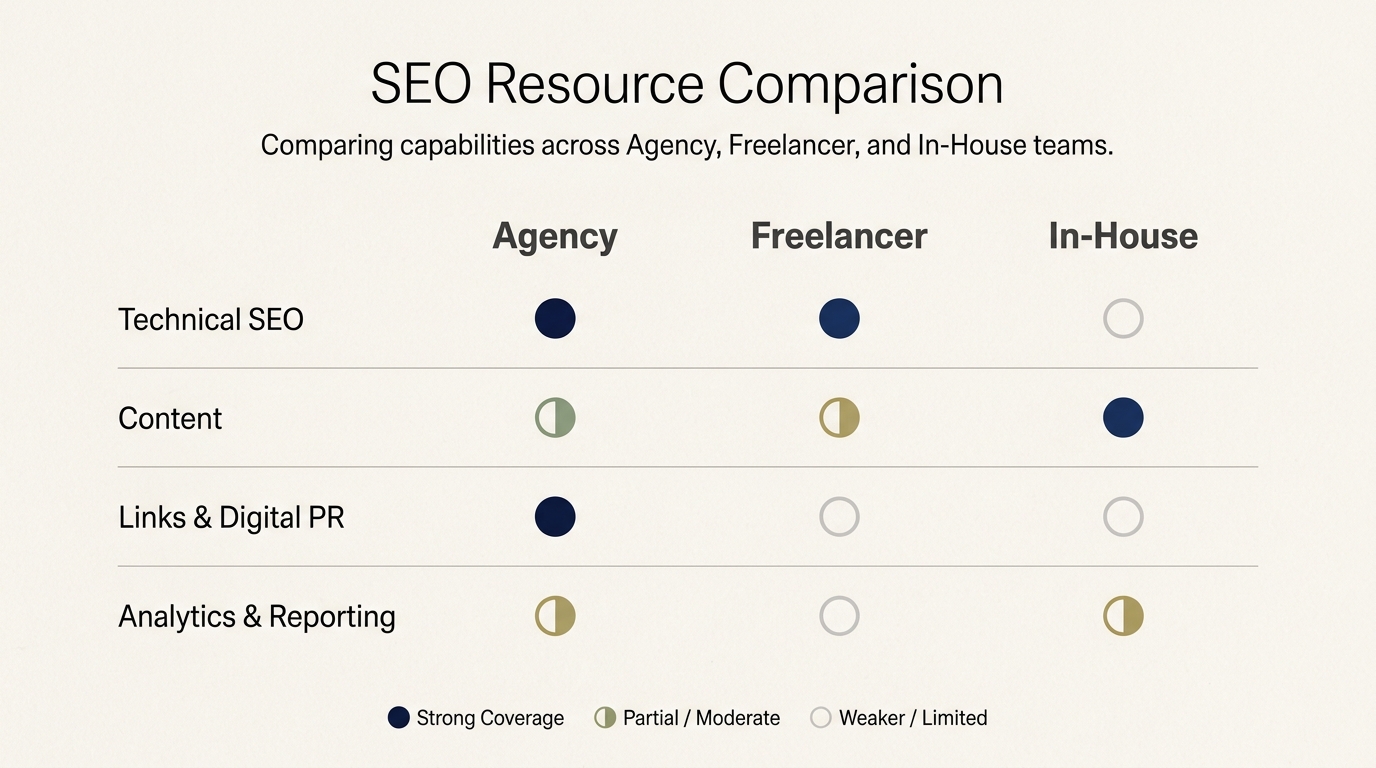
Technical SEO (crawling, indexing, site speed, structured data, migrations): agencies usually have a dedicated specialist, and good freelancers often specialize here. In-house generalists can handle the basics but may struggle with a platform change or a large crawl problem.
Content (research, briefs, writing, updates): this is where in-house teams shine, because they know the product and the customer. Agencies and freelancers can plan and produce at volume, but they need access to your subject experts.
Links and digital PR: this is the hardest to do with one person. Outreach takes time, relationships and a track record, so agencies tend to have the edge.
Analytics and reporting: any model can do this well if someone owns it. The risk is a setup where nobody connects rankings to leads or revenue.
If your SEO needs lean on one skill, a freelancer or a specialist hire can cover it. If it needs three or four at once, you are looking at either several people or an agency.
Management overhead, communication and reporting
The cost nobody quotes is your own time. WebFX describes in-house SEO as giving you more direct day-to-day control, while agency SEO requires a more collaborative workflow. That matches what most teams experience.
With an in-house hire, you manage a person: priorities, career growth, tools, and the daily negotiation for developer time. With a freelancer, you manage a scope. You write the brief, review the output and chase the next deliverable. With an agency, you manage a relationship. There is usually an account lead and a regular cadence, so the day-to-day load is lighter, but you still have to give timely approvals and access.
Reporting differs too. Agencies typically bring structured reporting as part of the contract. Freelancers report in whatever format you agree on. In-house reporting is as good as the person doing it and the data they can reach.
Whichever model you pick, insist on reporting that shows outcomes such as qualified traffic, leads and revenue from organic search. A report that leads with keywords tracked and links acquired measures activity, and it makes honest conversations about performance harder. SEO also takes time to pay off. Work done today may take three to six months to show measurable impact, so agree on leading indicators up front and do not judge a new setup by month two.
Continuity risk: what happens when one person leaves
Most comparison posts skip this, and it is where the three models differ most.
When a freelancer disappears, you can lose more than the work in progress. If they own the analytics logins, the keyword research files or the redirect map, you may have to rebuild from scratch. When your only in-house SEO resigns, the institutional knowledge leaves with them: why the site is structured the way it is, which experiments failed, which pages are fragile. The gap before a replacement is hired and trained can run for months, and rankings can slide during it.
Agencies carry this risk in a different form. A good one spreads context across a team, so one departure does not stop the work. A weak one builds everything around a single senior strategist, and you are back to key-person risk with a bigger invoice. Ask any agency who else knows your account.
Whatever you choose, protect yourself:
Own every login, including Search Console, analytics, your CMS and any rank tracking tools.
Keep documentation in a shared space you control, covering audits, keyword maps, redirect lists and a change log.
Write the handover terms into the contract or job description.
Make sure at least two people on your side can explain what the SEO plan is and why.
Which model fits your situation
Here is how the choice plays out in practice.
Should you hire an SEO agency?
If you are asking “should I hire an SEO agency?”, the answer is usually yes when three things are true. You need several skills at once, you lack the time or experience to manage specialists yourself, and you want results faster than a new hire could deliver. A business with a technical problem, such as a replatform or a crawl budget issue, plus a content gap and no link profile, is the classic case.
The decision also depends on speed. TripleDart’s own analysis claims in-house setups average 35% longer time-to-scale, measured as the first 50% traffic uplift, than agencies, citing resource constraints. Treat that as one vendor’s view, but it fits the logic: a team that is already set up can start sooner than a person who has to be recruited and onboarded.
When a freelance SEO hire is enough
A freelancer fits when you know what is wrong and need an expert to fix it or guide you. Typical examples are a one-off technical audit, a content strategy for a new section, or a few hours a month of senior advice for a marketer already doing the work. You get strong skills at a modest cost, as long as you accept that capacity is limited and you do the coordinating.
It works less well as a full replacement for a team. If the plan needs weekly technical, content and link work, one person will become the bottleneck.
Build in-house when SEO is a permanent, daily workload, and plan to support the hire with outside specialists for the skills one person cannot cover.
Hybrid SEO team structures for small businesses
Few growing companies pick one model and stay with it. Teams that already do some SEO themselves usually end up with a hybrid, and a sensible SEO team structure for a small business often looks like one.
In-house content with agency technical and strategy support
This is the most common setup that works. Your team writes and updates content because they know the product and the customers. The agency handles the pieces that need specialist depth: technical audits, site architecture, keyword and topic strategy, link building and reporting.
The split plays to each side’s strength. Your writers do not need to learn crawl diagnostics, and the agency does not need to learn your industry from scratch. The agency’s strategy gives your writers a clear brief, so content stops being a list of keywords with no plan behind it. To make this work, agree who approves what, how briefs reach writers, and how technical fixes get to your developers.
Other outsourcing SEO combinations that work
Outsourcing SEO does not have to mean handing over everything. Three other arrangements are worth considering:
In-house lead with freelance execution: one employee owns strategy and priorities, and freelancers handle technical fixes, writing or outreach as needed. This keeps costs flexible, but it depends heavily on the lead.
Freelance strategist with in-house doers: a senior freelancer sets the plan and reviews progress monthly, while your marketing team carries it out. It suits small teams with some SEO skill and no direction.
Agency for a defined project, then in-house: bring in an agency for a migration, rebuild or catch-up phase, then hand steady-state work to an internal hire with full documentation.
The decision framework: budget, speed, skill coverage and management time
Score your own situation against four questions. Each one points toward a model.
Budget: if you have under roughly $1,500 a month to spend, a freelancer or part-time help is realistic. Between that and a mid-range retainer, you can choose an agency or a hybrid. A fully loaded hire only makes sense if the work fills their week.
Speed: if you need to move in weeks, start with an agency or freelancer. Recruiting an in-house specialist takes time before any SEO gets done.
Skill coverage: count how many of technical, content, links and analytics you need this quarter. One or two points to a freelancer or a generalist. Three or four points to an agency or a hybrid.
Management time: if nobody can spare a few hours a week for direction and approvals, pick the model that needs the least of your attention, which is usually an agency with a dedicated account lead.
When your answers point in different directions, such as a small budget but wide skill needs, that is a sign you need a hybrid and a clear priority order.
Self-assessment: which model fits your growing business?
Answer yes or no to each statement, then count your yeses.
Nobody on my team can spend at least half a day a week on SEO.
We need work in three or more areas this quarter: technical, content, links and analytics.
If our SEO person left tomorrow, we would lose logins, files or knowledge we could not easily recover.
Our site needs developer-level changes that nobody here can specify, such as a migration, speed fixes or structured data.
We cannot clearly connect organic traffic to leads or revenue today.
We need results faster than one person could deliver them.
If you answered yes to zero or one, a freelancer for direction or a focused in-house hire will probably cover you. With two or three, a hybrid is the better fit: keep what you do well, such as content, and bring in outside help for the gaps.
With four or more yeses, the answer is that you need more than one person can cover. That is where an SEO agency earns its fee, because the job calls for several specialists working to one plan. If that sounds like you, book a strategy call with Growth Rocket. We will look at what you already do in-house, tell you which gaps matter most, and show you what a hybrid or full-service setup would look like for your budget.
It seems that Growth Rocket has a new achievement to feel festive about this Yuletide season (and it’s just on the heels of Google’s birthday): We’re now a Preferred Facebook...
One of the core values of Growth Rocket (GR) is “Grow or GTFO.” Over the past year that I’ve been a writer here, I’ve realized that real growth happens by taking a step...
If you’re a start-up or small business, you might be caught up with customer acquisition, sales, overhead costs, and other technicalities. As a result, you may end up putting...