Key Takeaways:
- Automation transforms customer lifetime value by creating consistent, personalized touchpoints that nurture relationships over time rather than focusing solely on initial conversions
- Modern platforms like Make.com, GPT-powered workflows, and no-code AI agents enable sophisticated marketing automation previously reserved for enterprise-level budgets
- The most impactful automation strategies focus on behavioral triggers and predictive scoring rather than simple time-based sequences
- Successful automation requires balancing efficiency gains with authentic customer experiences through strategic human intervention points
- Multi-channel automation workflows that span email, social media, and direct outreach can increase customer lifetime value by 30-50% when properly implemented
After nearly two decades in digital marketing, I’ve witnessed the evolution from basic email autoresponders to sophisticated AI-driven customer journey orchestration. The fundamental shift isn’t just technological advancement but a complete reimagining of how automation enhances customer lifetime value beyond simple lead generation tactics.
Most agencies are stuck thinking about automation as a cost-cutting measure or efficiency play. This myopic view misses the transformative potential of intelligent automation systems that actively nurture and expand customer relationships over time. The real opportunity lies in creating self-optimizing workflows that continuously learn from customer behavior and adapt accordingly.
The Strategic Foundation of Customer Lifetime Value Automation
Customer lifetime value isn’t just about retention; it’s about creating compound value through every interaction. The most successful automation strategies I’ve implemented focus on three core pillars: behavioral intelligence, predictive engagement, and value acceleration.
Traditional automation follows linear paths based on predefined triggers. Modern CLV-focused automation systems use dynamic decision trees that adapt based on real-time customer data, engagement patterns, and predictive scoring. This shift from reactive to proactive automation fundamentally changes how customers experience your brand throughout their lifecycle.
The key insight that many agencies miss is that automation enhances customer lifetime value not by reducing human touch but by ensuring no valuable interaction opportunity is ever missed. Every automated touchpoint should either gather intelligence, provide value, or advance the customer relationship toward the next meaningful milestone.
Platform Architecture for Scalable CLV Automation
Make.com has emerged as the backbone for sophisticated marketing automation workflows that extend far beyond traditional email sequences. The platform’s visual workflow builder enables complex logic chains that can orchestrate multi-channel campaigns based on intricate behavioral triggers.
For agency workflows, I recommend building automated brief generation systems that trigger when new leads reach specific qualification scores. This automation pulls data from multiple sources including social media analysis, website behavior, and CRM history to generate comprehensive client briefs before the first discovery call. The result is dramatically improved sales conversion rates and faster project kickoff timelines.
GPT integration amplifies these capabilities exponentially. By connecting OpenAI APIs through Make.com, you can create dynamic content generation workflows that personalize messaging at scale while maintaining authentic voice and relevance. The most effective implementations I’ve seen use GPTs to analyze customer communication patterns and automatically adjust messaging tone, complexity, and focus areas based on individual preferences.
Advanced Lead Scoring and Behavioral Triggers
Lead scoring automation has evolved beyond simple demographic and firmographic data points. Modern systems incorporate real-time behavioral signals, engagement velocity, and predictive intent modeling to create dynamic scores that trigger specific nurture sequences.
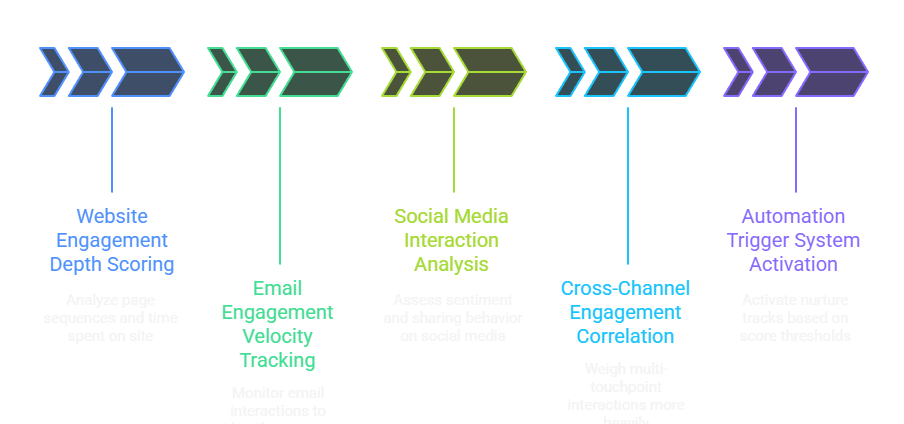
Here’s a practical implementation framework for behavioral lead scoring automation:
- Website engagement depth scoring based on page sequences, time spent, and content consumption patterns
- Email engagement velocity tracking that identifies warming prospects before they reach decision-making stages
- Social media interaction analysis that reveals buying intent through comment sentiment and sharing behavior
- Cross-channel engagement correlation that weights multi-touchpoint interactions more heavily than single-channel activities
The automation trigger system should activate different nurture tracks based on score thresholds and behavioral combinations. For example, high-engagement prospects who consume technical content might trigger automated case study delivery and subject matter expert introductions, while early-stage browsers receive educational content sequences and social proof elements.
CRM Integration and Lifecycle Stage Management
CRM automation extends beyond basic data entry and follow-up reminders. The most sophisticated systems I’ve implemented use CRM triggers to orchestrate complex multi-department workflows that ensure consistent customer experience across all touchpoints.
Account-based automation workflows can monitor multiple decision-makers within target organizations, tracking engagement patterns across various content types and channels. When collective engagement scores reach predetermined thresholds, the system automatically triggers personalized outreach sequences tailored to each stakeholder’s demonstrated interests and influence level.
For existing customers, lifecycle stage automation focuses on expansion opportunities and retention signals. Automated monitoring of usage patterns, support ticket themes, and engagement decline can trigger proactive intervention workflows before churn risk becomes critical. These systems don’t just identify problems; they automatically initiate solution delivery through appropriate channels.
Full-Funnel Campaign Execution Architecture
Full-funnel automation orchestrates multiple marketing channels in coordinated sequences that adapt based on customer response patterns. This approach maximizes customer lifetime value by ensuring optimal message delivery timing and channel selection for each individual prospect or customer.
The most effective full-funnel automation architecture I’ve developed includes these interconnected components:
- Awareness stage automation that identifies ideal customer profile matches and initiates multi-channel introduction sequences
- Consideration stage workflows that deliver progressive value while gathering preference intelligence
- Decision stage automation that provides social proof, addresses objections, and facilitates purchase decisions
- Post-purchase onboarding sequences that ensure successful implementation and identify expansion opportunities
- Advocacy automation that transforms satisfied customers into active referral sources
Each stage includes feedback loops that inform and optimize subsequent interactions. Customer behavior data continuously refines segmentation, messaging, and channel selection to improve both immediate response rates and long-term relationship quality.
AI Agent Development for Customer Experience Enhancement
No-code AI agent development platforms enable sophisticated customer interaction automation without requiring extensive technical resources. These agents can handle complex multi-turn conversations, gather qualification information, and route customers to appropriate human team members when necessary.
The most successful AI agent implementations focus on specific use cases rather than attempting to automate entire customer service operations. Specialized agents for lead qualification, appointment scheduling, and technical support initial triage provide immediate value while learning from interactions to improve performance over time.
For agencies, AI agents can automate client reporting, project status updates, and routine communication while maintaining personalized interaction quality. These agents access project management systems, analytics platforms, and communication histories to provide contextually relevant responses that enhance rather than replace human relationships.
Personalization at Scale Through Intelligent Automation
True personalization automation goes beyond inserting names into email templates. Advanced systems analyze behavioral patterns, communication preferences, and engagement history to customize not just content but interaction timing, channel selection, and message complexity.
Dynamic content generation workflows use customer data to create relevant case studies, testimonials, and educational materials that align with specific prospect challenges and industry contexts. This automated personalization ensures every touchpoint provides genuine value while advancing the relationship toward conversion and expansion opportunities.
The key is balancing automation efficiency with authentic relationship building. The most effective implementations use automation to gather intelligence and prepare personalized experiences while preserving meaningful human interactions at critical decision points.
Measuring and Optimizing Automation Impact on CLV
Measuring automation’s impact on customer lifetime value requires tracking metrics beyond traditional conversion rates and email open rates. The most meaningful indicators include engagement progression rates, lifecycle stage advancement velocity, and long-term value realization patterns.
| Metric Category |
Key Indicators |
Automation Impact |
| Engagement Quality |
Content consumption depth, multi-channel interaction rates |
Improved targeting and relevance through behavioral analysis |
| Conversion Velocity |
Time from awareness to purchase, decision stage duration |
Optimized nurture sequences and timely intervention triggers |
| Customer Expansion |
Upsell conversion rates, additional service adoption |
Automated opportunity identification and value demonstration |
| Retention Strength |
Churn prediction accuracy, proactive intervention success |
Early warning systems and automated retention workflows |
Optimization requires continuous testing of automation elements including trigger conditions, message sequences, and channel selection. A/B testing automated workflows provides insights into which approaches drive the strongest lifetime value outcomes across different customer segments.
Advanced Implementation Strategies for Maximum Impact
The most sophisticated automation implementations I’ve developed integrate multiple platforms and data sources to create comprehensive customer intelligence systems. These implementations require strategic planning and phased rollout to ensure successful adoption and measurable impact.
Start with high-impact, low-complexity automations that provide immediate value and build confidence in the system’s capabilities. Lead qualification automation and basic nurture sequences establish foundation functionality while generating data for more advanced implementations.
Progressive enhancement adds behavioral triggers, predictive scoring, and multi-channel orchestration as teams become comfortable with automation management and optimization. The goal is creating systems that continuously improve performance while reducing manual intervention requirements.
Future-Proofing CLV Automation Strategies
The automation landscape continues evolving rapidly with advancing AI capabilities and changing customer expectations. Future-proof strategies focus on flexible architectures that can adapt to new platforms and capabilities without requiring complete system rebuilds.
Privacy regulations and data protection requirements increasingly influence automation design decisions. Building consent management and data usage transparency into automation workflows ensures compliance while maintaining personalization effectiveness.
The most successful long-term automation strategies balance technological sophistication with human relationship building. As automation capabilities expand, the human touch becomes more valuable and differentiated rather than less important.
Customer lifetime value automation represents a fundamental shift from campaign-based marketing to relationship-centric customer experience design. The agencies and businesses that embrace this evolution will build sustainable competitive advantages through deeper customer relationships and more predictable revenue growth.
The opportunity is immediate and substantial. The platforms exist, the methodologies are proven, and customer expectations are evolving toward more personalized, valuable interactions. The question isn’t whether to implement automation that enhances customer lifetime value but how quickly you can build systems that transform customer relationships into long-term value creation engines.
Glossary of Terms
- Behavioral Triggers: Automated responses activated by specific customer actions or behavior patterns rather than time-based scheduling
- Customer Lifetime Value (CLV): The total worth of a customer to a business over the entire period of their relationship
- Dynamic Decision Trees: Automation logic that changes paths based on real-time data and customer responses rather than following predetermined sequences
- Engagement Velocity: The speed at which prospects move through engagement stages and respond to marketing touchpoints
- Make.com: Visual automation platform that connects apps and services to create complex workflows without coding
- Multi-Channel Orchestration: Coordinated automation across multiple communication channels with unified messaging and timing
- No-Code AI Agents: Artificial intelligence tools that can be created and deployed without programming knowledge
- Predictive Scoring: Using historical data and machine learning to forecast customer behavior and value potential
- Progressive Enhancement: Gradually adding more sophisticated features to automation systems over time
- Workflow Automation: Streamlining business processes through technology to reduce manual tasks and improve efficiency
Further Reading