
Why Average Order Value Optimization Beats Chasing New Traffic
Key Takeaways: Optimizing Average Order Value (AOV) consistently delivers faster, more measurable ROI than scaling paid traffic spend. Bundling, upsells, cross-sells, and...
Mike VillarIf you search "check if ChatGPT mentions my business," the answer is to ask the questions your buyers ask, repeat each one several times, and log whether your name appears. Do the...
 Mike VillarChief Executive Officer
· 7 min read

If you search “check if ChatGPT mentions my business,” the answer is to ask the questions your buyers ask, repeat each one several times, and log whether your name appears. Do the same in Perplexity, Gemini and Google AI Mode, because each engine answers differently. A spreadsheet and about 30 minutes give you a first read. This guide covers the method and its limits.
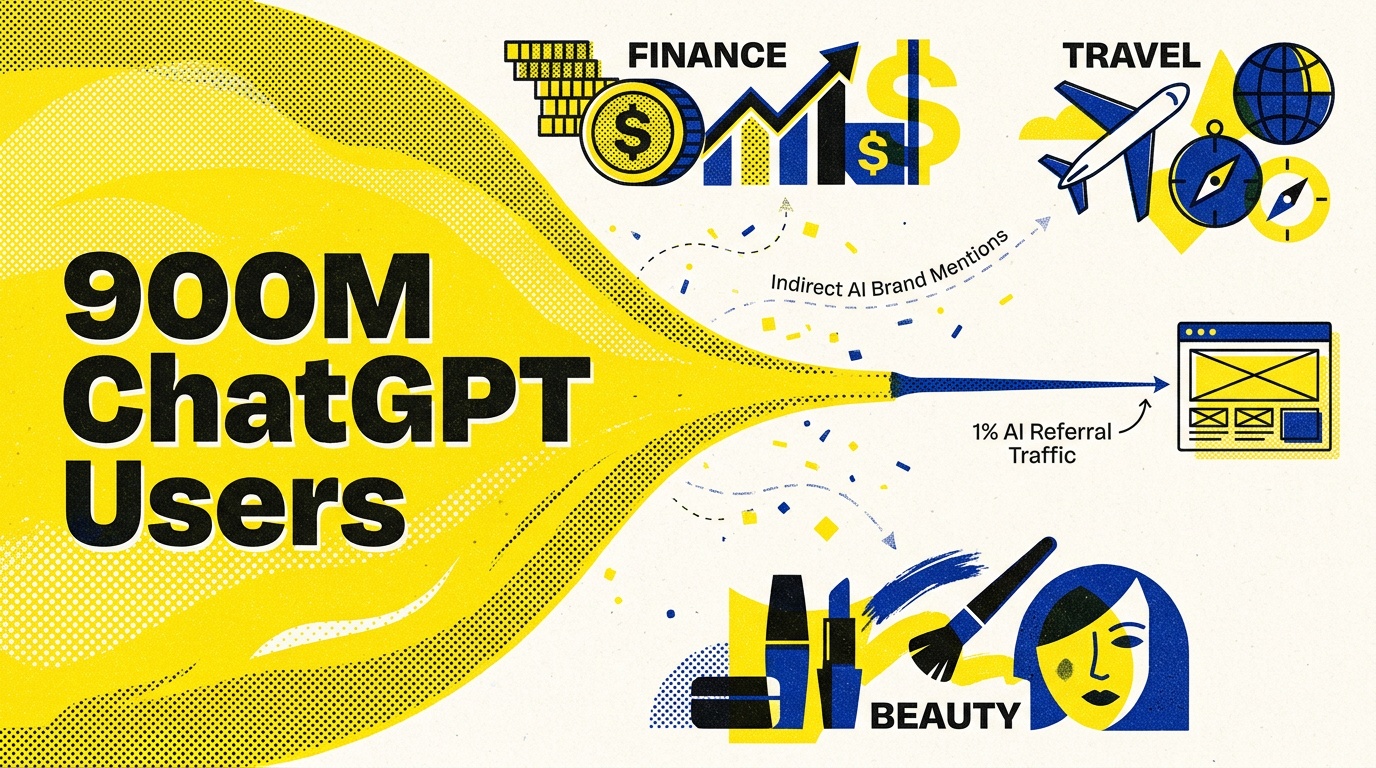
People now ask AI tools who to hire and what to buy. One 2026 roundup of AI search statistics reports that ChatGPT passed 900 million weekly active users in early 2026. The same roundup puts AI referral traffic at only about 1% of total site traffic.
That small click share hides part of the picture. Similarweb research, summarized by SparkToro, looked at finance, travel and beauty brands and found that AI brand mentions influence direct visits and branded search queries. A buyer may never click from the chat. They may just search your name later.
So “is my brand showing in ChatGPT?” is worth a free test. The result tells you where to focus next.
A manual AI visibility check shows a rough pattern, not a precise score. Two things limit it: AI answers change from run to run, and they change from person to person.
AI models generate each answer fresh. SparkToro ran 2,961 prompts and found the tools highly inconsistent. Fewer than 1 in 100 identical prompts returned the same list of brands, and fewer than 1 in 1,000 returned them in the same order.
That is why a single screenshot proves little. Search Engine Land went further and called “ranking position” in AI answers a meaningless metric. Treat position as a loose note and track how often you appear instead.
Your own account works against you. If you are logged in, ChatGPT may draw on past chats and saved memory, and you have probably talked about your own company more than once. The answers you see may lean toward you in a way a stranger’s would not.
Test in a logged-out window or a fresh chat, and turn memory off if your account has it. Ask a colleague or a friend in another city to run a few prompts too. Location, language and settings all shift results, so treat your numbers as one sample.
Your prompt list drives the whole test, so spend the first 10 minutes here. Aim for 15 to 20 prompts, enough to cover your services without making the test unmanageable.
Pull wording from sales calls, support tickets, reviews and emails from prospects. Real phrasing beats what you would type yourself. Mix a few types:
Keep your brand name out of most of them. Add a location, budget or customer type where buyers would.
Typing your company name into ChatGPT only checks whether it can describe you. SearchEye makes the same warning: that tests description, not recommendation. A polite “yes, they are a company that does X” tells you nothing about whether you get named when a buyer asks for options.
Use one or two brand-name prompts at the end, only to check accuracy. The other 15 or more should be unbranded.
Each engine pulls from different sources, so one tool can name you while another ignores you. Plan 30 minutes for the prompts, the sheet and a first pass on ChatGPT. The other engines and repeat runs take longer, so spread them over a few days.
With web search off, ChatGPT leans on what it learned in training. With it on, it pulls live pages and often cites them. Run your prompts both ways and log which mode produced each result. A mention in one mode only points to a different fix than a mention in neither.
Perplexity shows its sources next to the answer, which makes it the easiest place to see why a competitor won. Copy the cited URLs into your sheet. Gemini gives a cleaner conversational answer, so note its tone and the brands it names, and check whether it points to sources at all.
Open the AI Mode tab in Google Search, where it is available in your country, and run the same prompts. This is the engine closest to how many buyers already search. If you also want to test brand visibility in AI search for local queries, run these prompts from the area you serve.
One row per run, one tab for the whole test. A mention you did not write down is a mention you will argue about later.
Set up these columns:
The accuracy column catches problems a yes/no misses. An answer can name you and still call you a different kind of business, or cite an old address.
This is where most do-it-yourself checks go wrong. One run is an anecdote. Repeats turn it into a rate.
Practitioner guides agree on the minimum. MaxAEO advises running each prompt two to three times, and Beamtrace suggests five to ten runs per phrasing for anything you care about. My suggestion for a free test: three runs for every prompt on ChatGPT, and five or more for your five most valuable prompts.
Even then, you have a small sample. Three runs with no mention means you probably appear rarely. It does not prove you never will.
For each prompt, divide the runs that named you by total runs. Then average across prompts for each engine. A result like “named in 4 of 15 prompts on Perplexity, 1 of 15 on Gemini” is easy to repeat next quarter and compare.
Split the rate by prompt type as well. Strong results on comparison prompts and none on problem prompts say something specific about your content.
Your sheet points toward one of three situations. Start with the one that matches your data.
Look at the sources cited across all engines. If review sites, directories or “best of” lists show up again and again, getting listed or reviewed there comes before anything on your own site. SparkToro’s piece on how a brand can appear in AI answers is a good primary reference for what moves the needle.
Open the pages that were cited for them. Is it a comparison article, a customer review page, a publication feature? Whatever format keeps recurring is the gap. Pitch the publications, build the comparison page yourself, or ask customers for reviews on the platforms that get cited.
Wrong details mean the engines have conflicting or thin information about you. Fix your own site first: a clear homepage description, an about page and a short fact sheet with your name, services, location and pricing approach. Then match your directory profiles and bios to it, so every source says the same thing.
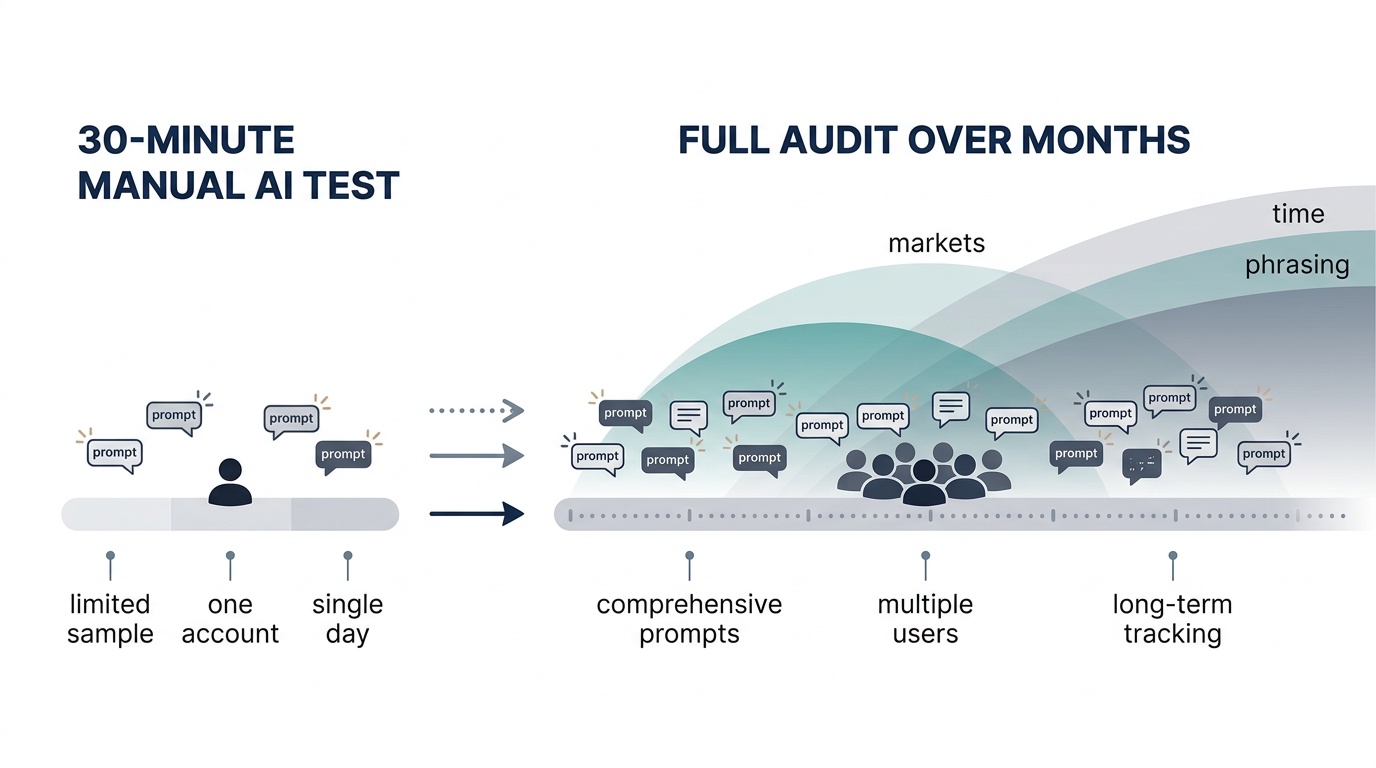
This test is a starting point. It gives you a rough sense of whether AI tools recommend your company, but it samples only a few dozen prompts, from your account, on one day. It cannot cover every market you serve, every phrasing buyers use, or how results drift over months.
If your results show gaps, or you need a larger prompt set, competitor benchmarks and a prioritized fix list, book a strategy call with Growth Rocket. We will run the full audit and show you what to change first.
Key Takeaways: Optimizing Average Order Value (AOV) consistently delivers faster, more measurable ROI than scaling paid traffic spend. Bundling, upsells, cross-sells, and...
Mike VillarKey Takeaways: Statistical significance is widely misunderstood and misreported in marketing tests, leading to decisions based on faulty data. Peeking at test results before...
Alvar SantosKey Takeaways: Looker Studio is the best budget-friendly option for marketing teams already embedded in the Google ecosystem, offering free access and solid connector support. Domo...
Amanda Bianca CoStart your brand's success journey today with a conversation. Share your goals and objectives with us and let's set up a discovery call.