Key Takeaways:
- Google’s AI Overviews and Search Generative Experience are fundamentally shifting search from click-driven to response-driven interactions
- Agencies must pivot from traditional SEO tactics to Generative Engine Optimization (GEO) strategies that prioritize content surfacing within AI responses
- Brand visibility will increasingly depend on becoming the authoritative source that AI systems reference and cite
- Content strategy must evolve to answer questions comprehensively while maintaining topical authority and entity relationships
- Future-proofing requires building direct audience relationships beyond search dependency
The seismic shift happening in search isn’t just another algorithm update that agencies can weather with minor tactical adjustments. What we’re witnessing is the complete restructuring of how information gets discovered, consumed, and acted upon online. After nearly two decades in this industry, I can confidently say that the changes Google is implementing with AI-powered search represent the most significant disruption to digital marketing since the birth of AdWords.
The writing has been on the wall since Google introduced AI Overviews and began testing Search Generative Experience. Traditional click-through rates are plummeting as users increasingly get their answers directly from AI-generated responses without ever visiting the source websites. For agencies still clinging to outdated playbooks, this represents an existential crisis. For those willing to adapt, it’s the opportunity to separate themselves from the pack.
The Death of Click-Dependent Strategy
Let’s be brutally honest about what’s happening. Google’s AI search future isn’t designed to send more traffic to websites. It’s designed to keep users within Google’s ecosystem by providing comprehensive answers that eliminate the need to click through to external sources. This isn’t a bug in the system; it’s the entire point.
Traditional SEO metrics like click-through rates, session duration, and pages per visit are becoming increasingly meaningless when AI provides complete answers before users even consider clicking. The agencies that continue to optimize solely for these metrics are essentially rearranging deck chairs on the Titanic.
What agencies need to understand is that search is transforming into a question-and-answer interface where Google’s AI acts as an intelligent intermediary. Users ask complex questions, and the AI synthesizes information from multiple sources to provide comprehensive responses. The winners in this new paradigm aren’t necessarily the sites that rank first for specific keywords, but the sources that consistently provide the most authoritative, comprehensive, and structured information.
Generative Engine Optimization: The New Frontier
Generative Engine Optimization represents a fundamental shift from optimizing for search engine crawlers to optimizing for AI comprehension and synthesis. This isn’t simply about adding schema markup or improving page speed. GEO requires agencies to think like AI systems: prioritizing context, authority, and comprehensiveness over traditional ranking factors.
The most successful agencies I’ve observed making this transition focus on three core principles:
- Authoritative Source Building: Establishing clients as the definitive experts in their domains through comprehensive, well-researched content that AI systems consistently reference
- Contextual Relationship Mapping: Creating content ecosystems where topics, entities, and concepts are interconnected in ways that AI can easily understand and utilize
- Response-Ready Content Architecture: Structuring information so it can be easily extracted and synthesized by AI systems for direct user queries
Strategic Content Architecture for AI Consumption
The content strategies that worked for traditional search optimization are woefully inadequate for AI-driven search. Google’s AI doesn’t just read content; it understands context, evaluates authority, and synthesizes information across multiple sources. This requires agencies to completely reimagine how they approach content creation and optimization.
Successful content architecture for AI consumption follows these principles:
Comprehensive Topic Clusters: Instead of creating isolated pieces targeting specific keywords, agencies must build comprehensive topic ecosystems. Each cluster should cover every angle of a subject matter, from basic definitions to advanced applications, industry trends, and future implications.
For example, a client in the renewable energy sector shouldn’t just have pages about “solar panels” and “wind turbines.” They need comprehensive coverage including installation processes, maintenance requirements, cost analyses, environmental impact studies, regulatory considerations, and emerging technologies. The AI needs to see your client as the complete authority, not just someone with surface-level information.
Entity-Based Content Strategy: AI systems think in terms of entities and their relationships. Content must clearly establish connections between people, places, concepts, and organizations. This means incorporating structured data extensively, but more importantly, it means writing content that explicitly explains these relationships.
When discussing renewable energy technologies, content should clearly connect industry leaders, research institutions, geographic markets, regulatory bodies, and technological innovations. The AI should understand not just what something is, but how it relates to everything else in that domain.
Question-Answer Architecture: Every piece of content should anticipate and answer the questions users might ask about that topic. This goes beyond traditional FAQ sections to comprehensive question coverage throughout the content.
Practical Implementation Strategies
Theory without actionable implementation is worthless. Here are the specific strategies agencies should implement immediately:
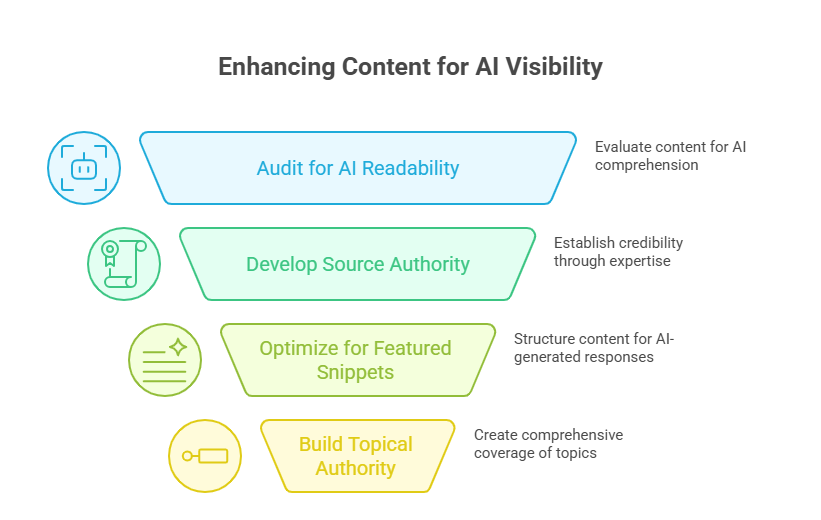
1. Audit Current Content for AI Readability
Evaluate existing content through the lens of AI comprehension. Can an AI system easily extract key facts, understand relationships between concepts, and identify authoritative sources? Content that’s difficult for AI to parse and understand will become invisible in search results.
- Use tools like Google’s Natural Language API to analyze how AI interprets your content
- Identify gaps where important information isn’t clearly stated or structured
- Restructure content with clear headings, bullet points, and logical information hierarchy
2. Develop Source Authority Signals
AI systems prioritize information from authoritative sources. This goes beyond traditional domain authority to include expertise signals that AI can identify and validate.
- Implement comprehensive author attribution with detailed expertise credentials
- Include extensive citations and references to authoritative sources
- Develop relationships with industry experts and thought leaders for collaborative content
- Create content that gets referenced and cited by other authoritative sources in the industry
3. Optimize for Featured Snippet Evolution
Featured snippets are evolving into AI-generated responses. Understanding how to optimize for this evolution is crucial for maintaining visibility.
- Structure content to directly answer specific questions with concise, comprehensive responses
- Use data tables, numbered lists, and step-by-step processes that AI can easily extract
- Include supporting context that helps AI understand why your answer is authoritative
4. Build Topical Authority Ecosystems
Instead of targeting individual keywords, build comprehensive coverage of entire topic areas. This requires significant content investment but creates sustainable competitive advantages.
- Map out every subtopic, related concept, and question within your client’s domain
- Create pillar content that comprehensively covers broad topics
- Develop supporting content that goes deep into specific aspects
- Ensure clear internal linking that helps AI understand topic relationships
Beyond Search: Building Direct Relationships
While optimizing for AI search is crucial, agencies that put all their eggs in the search basket are making a critical mistake. The most successful long-term strategy involves building direct relationships with audiences that don’t depend on search intermediaries.
This means developing comprehensive email marketing strategies, building engaged social media communities, creating valuable downloadable resources, and establishing thought leadership positions that drive direct traffic. When users know to come directly to your client for authoritative information, search algorithm changes become less threatening.
The agencies that will thrive in Google’s AI search future are those that view search optimization as one component of a comprehensive digital presence strategy, not the entire strategy itself.
Measuring Success in the AI Era
Traditional search metrics are becoming less relevant as AI reduces click-through rates. Agencies need new KPIs that reflect success in an AI-first search environment:
| Traditional Metric |
AI-Era Alternative |
Why It Matters |
| Click-through Rate |
AI Response Inclusion Rate |
Measures how often your content appears in AI-generated responses |
| Keyword Rankings |
Topic Authority Score |
Evaluates comprehensive coverage and authority within topic areas |
| Organic Traffic Volume |
Brand Visibility in AI Responses |
Tracks brand mention and citation frequency in search results |
| Session Duration |
Direct Relationship Building |
Measures email signups, social follows, and repeat direct visits |
The Competitive Advantage Window
Here’s what most agencies don’t want to acknowledge: there’s a limited window of opportunity to establish dominance in AI search before it becomes saturated with optimized content. The agencies that move aggressively now to implement GEO strategies will establish authority positions that become increasingly difficult to displace.
AI systems learn and adapt, but they also develop preferences for sources that consistently provide accurate, comprehensive, and authoritative information. Early movers who establish themselves as go-to sources for AI systems will benefit from compounding advantages as these systems continue to evolve.
This isn’t about gaming the system or finding shortcuts. It’s about genuinely becoming the most authoritative, comprehensive source of information in your clients’ domains. The agencies that understand this distinction will separate themselves from those still trying to manipulate their way to the top.
Preparing for What’s Next
Google’s AI search future isn’t a destination; it’s a journey. The search experience will continue evolving as AI capabilities advance and user behaviors adapt. Agencies that want to remain relevant must build adaptive strategies rather than rigid tactics.
This means investing in ongoing AI literacy, staying current with emerging search technologies, and maintaining flexibility to pivot strategies as the landscape changes. The agencies that view this transformation as an opportunity to provide more value to clients, rather than a threat to their existing business models, will emerge as industry leaders.
The future belongs to agencies that can help brands become indispensable sources of information that AI systems consistently rely on and reference. Everything else is just tactical noise that will become obsolete as the technology continues advancing.
What agencies need to know about Google’s AI search future is simple: adapt or become irrelevant. The choice is yours, but the window for making that choice is rapidly closing.
Glossary of Terms
- AI Overviews: Google’s AI-powered search feature that provides comprehensive answers to user queries by synthesizing information from multiple sources
- Search Generative Experience (SGE): Google’s experimental search interface that uses generative AI to provide conversational, detailed responses to search queries
- Generative Engine Optimization (GEO): The practice of optimizing content and websites to be easily understood, referenced, and cited by AI-powered search systems
- Entity-Based SEO: Optimization strategy focused on establishing clear relationships between people, places, concepts, and organizations that search engines can understand
- Topical Authority: The degree to which a website or brand is recognized as a comprehensive, authoritative source of information within a specific subject area
- Response-Driven Search: Search behavior where users receive complete answers directly from AI systems rather than clicking through to websites
- Topic Clusters: Content organization strategy that groups related content around central themes to establish comprehensive coverage of subject areas
- Source Authority Signals: Indicators that help AI systems identify and prioritize credible, expert sources of information
Further Reading