Key Takeaways
- AI democratizes certain capabilities but simultaneously increases the premium for genuine expertise and specialized knowledge
- Vertical specialization in industries like healthcare or fintech provides defensible positioning against AI commoditization
- Service specialization requires constant evolution to stay ahead of AI automation capabilities
- Generalist agencies must leverage AI for operational efficiency while building human-centric strategic consulting capabilities
- The optimal agency positioning depends on market maturity, competitive landscape, and internal capabilities rather than a one-size-fits-all approach
The artificial intelligence revolution has fundamentally altered the strategic landscape for marketing agencies, forcing a critical reassessment of positioning strategies that seemed settled just five years ago. The question facing agency leaders today isn’t whether AI will impact their business model, but how dramatically it will reshape the competitive dynamics between specialists and generalists.
After nearly two decades in digital marketing and strategic consulting, I’ve witnessed multiple technological disruptions reshape agency positioning. However, the AI transformation presents unique challenges and opportunities that demand a sophisticated understanding of where human expertise remains irreplaceable versus where automation creates commoditization pressure.
The Traditional Specialization Paradigm Under Pressure
Traditional agency positioning has long followed predictable patterns: vertical specialization by industry, horizontal specialization by service, or generalist approaches serving diverse client needs. This framework assumed that expertise accumulation created sustainable competitive advantages through knowledge barriers and relationship depth.
AI fundamentally challenges these assumptions by democratizing access to certain types of expertise while simultaneously raising the bar for truly differentiated value creation. Marketing strategy development, once the exclusive domain of senior practitioners, now faces competition from AI systems capable of generating sophisticated campaign frameworks and strategic recommendations.
Consider the evolution of SEO services over the past 18 months. Tasks that previously required specialized technical knowledge can now be executed by AI-powered tools with remarkable efficiency. Keyword research, content optimization, and technical audits have become largely automated, forcing SEO specialists to evolve toward higher-order strategic thinking or risk commoditization.
Vertical Specialization: The Defensible Expertise Moat
Vertical specialization by industry represents perhaps the most defensible positioning strategy in an AI-enabled world. Deep industry knowledge encompasses regulatory understanding, stakeholder dynamics, competitive landscapes, and cultural nuances that remain difficult for AI systems to replicate comprehensively.
Healthcare marketing agencies exemplify this defensive positioning. Success in healthcare requires navigating HIPAA compliance, understanding physician decision-making processes, and managing regulatory approval timelines. While AI can assist with content creation or data analysis, the strategic judgment required for healthcare marketing remains distinctly human.
Similarly, financial services marketing demands expertise in regulatory frameworks like FINRA guidelines, consumer protection laws, and fiduciary responsibilities. Agencies specializing in fintech or wealth management possess contextual knowledge that AI cannot easily replicate without extensive training on industry-specific scenarios.
| Industry Vertical |
Defensible Elements |
AI Vulnerability |
| Healthcare |
Regulatory compliance, clinical understanding, stakeholder complexity |
Content generation, basic research |
| Financial Services |
Regulatory frameworks, risk management, fiduciary requirements |
Market analysis, reporting automation |
| Legal |
Ethical guidelines, professional standards, referral networks |
Content creation, basic legal research |
| Manufacturing |
Supply chain complexity, B2B relationships, technical specifications |
Lead scoring, content optimization |
Service Specialization: Racing Against Automation
Service specialization presents a more complex strategic challenge in the AI era. While certain specialized services gain value from AI augmentation, others face direct replacement pressure. The key differentiator becomes the agency’s ability to evolve their service delivery faster than AI can replicate their core competencies.
Paid advertising specialists demonstrate this dynamic clearly. AI has revolutionized bid management, audience targeting, and creative optimization. However, agencies that evolved beyond tactical execution toward strategic planning and creative strategy continue thriving. The most successful paid advertising specialists now position themselves as strategic consulting partners who leverage AI for execution while focusing human expertise on strategic direction.
Content marketing agencies face similar pressures and opportunities. AI-generated content has reached quality levels that threaten basic content production services. However, agencies that specialize in content strategy, brand voice development, and strategic storytelling maintain strong positioning. These agencies use AI as a production accelerator while concentrating human expertise on strategic direction and creative conceptualization.
The critical success factor for service specialists lies in continuous evolution. Agency services must consistently migrate up the value chain, leaving commoditized tasks to AI while developing new specialized capabilities that require human insight and judgment.
The Generalist Renaissance: AI as the Great Enabler
Contrary to conventional wisdom suggesting AI favors specialists, generalist agencies may actually benefit from AI’s democratizing effects. AI enables smaller generalist teams to deliver specialized capabilities across multiple domains without maintaining large expert teams in each area.
Consider how AI transforms agency operations for generalists. A small team can now deliver sophisticated SEO analysis, paid advertising optimization, content creation, and social media management using AI-powered tools. The competitive advantage shifts from specialized knowledge accumulation to AI execution capabilities and strategic integration across multiple channels.
Generalist agencies that excel in AI adoption can offer clients comprehensive solutions without the traditional overhead costs associated with maintaining specialized teams. This creates opportunities to compete effectively against larger specialized agencies while offering clients the convenience of integrated service delivery.
The key to generalist success lies in developing superior AI execution capabilities and maintaining focus on strategic planning and client relationship management. Rather than competing on specialized knowledge, successful generalists compete on integration, efficiency, and strategic oversight.
Decision Framework for Agency Positioning
Choosing optimal agency positioning requires systematic evaluation of multiple factors beyond simple preference or historical positioning. The following framework provides structure for strategic positioning decisions:
Market Maturity Assessment:
- Evaluate AI adoption rates in your target industries
- Assess client sophistication regarding AI capabilities
- Identify gaps between AI capabilities and client needs
- Analyze competitive positioning among existing agencies
Internal Capability Evaluation:
- Audit current expertise depth versus breadth
- Assess team adaptability to AI tool adoption
- Evaluate client relationship strength and transferability
- Analyze financial resources for positioning investments
Competitive Landscape Analysis:
- Map competitor positioning strategies and AI adoption
- Identify underserved niches or oversaturated specializations
- Evaluate barriers to entry for chosen positioning
- Assess long-term defensibility of potential positions
Success Stories: Specialists Thriving in AI Era
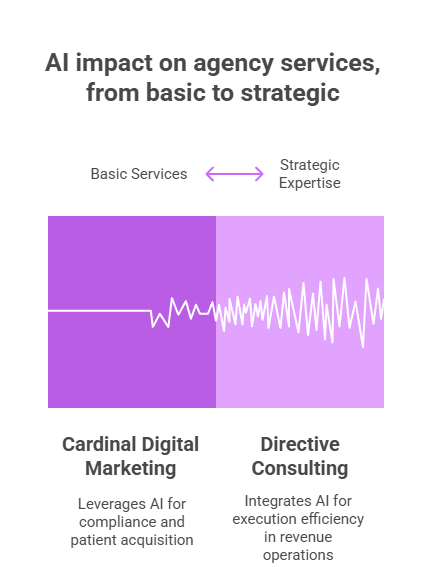
Several agencies demonstrate successful specialization strategies in the AI landscape. These examples provide actionable insights for positioning decisions.
Cardinal Digital Marketing exemplifies successful vertical specialization in healthcare. Rather than competing on basic digital marketing services, they’ve built deep expertise in healthcare compliance, patient acquisition strategies, and medical practice management. Their specialization creates natural barriers against AI commoditization while enabling premium pricing for genuine expertise.
Directive Consulting demonstrates service specialization evolution in B2B marketing. They’ve migrated from basic demand generation toward sophisticated revenue operations consulting. Their focus on strategic revenue architecture requires human insight that AI cannot easily replicate, while they leverage AI tools for execution efficiency.
Generalist Success Models
Successful generalist agencies demonstrate different strategic approaches to AI integration and positioning.
SmartBug Media represents the AI-enabled generalist model. They’ve invested heavily in AI tool adoption and process optimization, enabling delivery of specialized services across multiple domains. Their competitive advantage lies in integrated service delivery and superior AI execution rather than deep specialization.
WebFX showcases the scaled generalist approach, using proprietary AI tools and data analytics to deliver specialized results across diverse industries. Their positioning emphasizes technological capability and integrated analytics rather than industry-specific expertise.
The Strategic Consulting Evolution
Regardless of specialization choice, successful agencies share common evolution toward strategic consulting roles. AI’s commoditization of tactical execution forces agencies up the value chain toward strategic planning, creative direction, and business consulting.
This evolution requires developing new capabilities in business strategy, financial modeling, organizational development, and executive communication. Agencies must position themselves as strategic partners rather than service providers, regardless of their specialization focus.
The most successful agencies integrate AI as an operational accelerator while building differentiation through human-centric strategic capabilities. This approach applies whether pursuing vertical specialization, service specialization, or generalist positioning.
Implementation Strategies for Each Positioning
For Vertical Specialists:
- Invest in deep industry relationship building and regulatory expertise
- Develop proprietary insights through industry data collection and analysis
- Build partnerships with industry associations and regulatory bodies
- Create thought leadership content addressing industry-specific challenges
- Use AI to enhance service delivery while protecting industry expertise moats
For Service Specialists:
- Continuously evolve service offerings to stay ahead of AI capabilities
- Invest heavily in AI tool development and integration
- Focus on strategic consulting within your service domain
- Build proprietary methodologies that combine human insight with AI execution
- Develop training programs to keep teams ahead of automation curves
For Generalists:
- Invest in comprehensive AI tool adoption across all service areas
- Develop superior project management and integration capabilities
- Focus on client relationship management and strategic oversight
- Build proprietary platforms that integrate multiple AI tools
- Emphasize convenience and efficiency in client communications
The Future Landscape: Hybrid Approaches
The most sophisticated agencies are developing hybrid positioning strategies that combine elements of specialization and generalization. These approaches recognize that optimal positioning may vary by client segment, project type, or market conditions.
Some agencies maintain specialized teams for complex strategic work while using AI-augmented generalist teams for execution and ongoing management. Others develop multiple specialized capabilities that can be combined for comprehensive client solutions.
The key insight is that positioning choice need not be binary. Successful agencies develop portfolio approaches that provide flexibility while maintaining clear market positioning and operational efficiency.
Measuring Success in the New Paradigm
Traditional agency metrics require updating for AI-enabled positioning strategies. Success measurement should incorporate both financial performance and strategic positioning strength.
Key metrics include client retention rates, project scope expansion, pricing premium sustainability, and competitive win rates. Additionally, agencies should track AI adoption rates, operational efficiency gains, and strategic consulting revenue percentages.
The most important metric may be defensibility: how well the agency’s positioning protects against both AI commoditization and competitive pressure. This requires ongoing assessment of positioning sustainability and market evolution.
Conclusion: The Strategic Imperative
The AI transformation demands strategic clarity regarding agency positioning. Neither specialization nor generalization provides automatic advantages; success depends on execution quality and strategic alignment with market dynamics.
The agencies that thrive will be those that make deliberate positioning choices based on systematic analysis rather than historical precedent or industry conventional wisdom. They will leverage AI as an operational accelerator while building defensible advantages through human-centric strategic capabilities.
Most importantly, they will remain adaptable. The AI landscape continues evolving rapidly, and successful agencies must be prepared to adjust their positioning as new capabilities emerge and competitive dynamics shift.
The future belongs to agencies that combine technological sophistication with strategic clarity, regardless of whether they choose specialization or generalization as their primary positioning strategy.
Glossary of Terms
- AI Execution: The strategic implementation and operational use of artificial intelligence tools and systems to deliver marketing services and solutions
- Agency Positioning: The strategic market position an agency chooses to occupy, typically defined by service specialization, industry focus, or generalist approach
- Agency Services: The range of marketing, advertising, and consulting capabilities offered by an agency to its clients
- Commoditization: The process by which specialized services become standardized and compete primarily on price rather than differentiated value
- Defensible Positioning: A market position that creates barriers against competitive pressure and technological disruption
- Marketing Strategy: The comprehensive planning and decision-making process that guides marketing activities and resource allocation
- Service Specialization: Agency positioning focused on expertise in specific marketing disciplines rather than industry verticals
- Strategic Consulting: Advisory services that focus on high-level business strategy and planning rather than tactical execution
- Strategic Planning: The systematic process of defining organizational direction, making strategic decisions, and allocating resources
- Vertical Specialization: Agency positioning focused on serving specific industries or market segments with tailored expertise
Further Reading