
Why Average Order Value Optimization Beats Chasing New Traffic
Key Takeaways: Optimizing Average Order Value (AOV) consistently delivers faster, more measurable ROI than scaling paid traffic spend. Bundling, upsells, cross-sells, and...
Mike VillarKey Takeaways Marketing agency decisions require systematic evaluation of costs, capabilities, and strategic alignment rather than gut-level choices Total cost of ownership often...
 Alvar SantosFebruary 12, 2026

Key Takeaways
The make-versus-buy decision for marketing capabilities represents one of the most consequential strategic choices facing modern businesses. After nearly two decades of witnessing both spectacular successes and costly failures across enterprise and startup environments, I’ve developed strong opinions about when each approach delivers superior marketing results.
The traditional wisdom of “hire an agency until you can afford in-house” is dangerously oversimplified. I’ve seen $50M companies struggle with fragmented in-house teams while $2M startups achieve remarkable outsourcing ROI through strategic agency partnerships. The decision requires rigorous analysis, not revenue-based rules of thumb.
Today’s marketing landscape demands capabilities that didn’t exist five years ago. Generative engine optimization, AI agent development, and sophisticated attribution modeling require expertise that takes years to develop. The question isn’t whether you need these capabilities; it’s how to acquire them most effectively.
The complexity explosion in digital marketing has fundamentally altered the economics of team building. When I started in this field, a competent PPC manager and a creative designer could handle most digital marketing needs. Today’s equivalent team requires specialists in SEO, paid media, marketing automation, data analysis, content strategy, conversion optimization, and emerging AI-driven channels.
This specialization creates a natural advantage for agencies that can amortize expert salaries across multiple clients. A world-class programmatic advertising specialist commanding $180K annually becomes economically viable when their expertise serves ten clients rather than one.
Effective evaluation requires systematic analysis across five critical dimensions: financial impact, capability requirements, strategic alignment, risk tolerance, and operational preferences. Each dimension carries different weight depending on your organization’s specific context.
True cost comparison requires total cost of ownership modeling that extends far beyond monthly retainers or salary figures. I’ve developed a framework that consistently reveals hidden costs that destroy projected savings.
For in-house teams, calculate the fully-loaded cost including salaries, benefits, payroll taxes, software subscriptions, training, conference attendance, and management overhead. Add 35-40% to base salaries for benefits and taxes, then factor in tool costs that typically range from $2,000-$5,000 monthly for comprehensive marketing technology stacks.
Agency costs appear straightforward but include hidden elements. Factor in your internal management time, typically 5-10 hours weekly for effective agency oversight. Include onboarding costs, knowledge transfer efforts, and the productivity ramp-up period that can extend 3-6 months even with excellent agencies.
The break-even analysis often surprises executives. A three-person in-house team with a $200K total budget competes against agency retainers of $15,000-$20,000 monthly. But the agency provides immediate access to senior expertise across all specialties, while the in-house budget might afford one senior marketer plus two junior roles.
| Cost Component | In-House (3 people) | Agency Equivalent |
|---|---|---|
| Base Investment | $200,000 annually | $180,000 annually |
| Expertise Level | 1 senior, 2 junior | Senior across all disciplines |
| Technology Stack | $36,000 annually | Included in retainer |
| Training/Development | $15,000 annually | Included in retainer |
| Management Overhead | $25,000 annually | $8,000 annually |
| Total Cost | $276,000 annually | $188,000 annually |
Marketing performance depends on capability depth across multiple specializations. Honest capability assessment reveals whether your needs favor breadth or depth, and whether you can realistically build required expertise internally.
Evaluate your requirements across technical complexity, speed requirements, and expertise depth. Technical complexity includes elements like advanced attribution modeling, programmatic advertising optimization, and marketing automation architecture. Speed requirements encompass campaign launch timelines, response to market changes, and scaling velocity. Expertise depth covers strategic thinking, creative innovation, and specialized knowledge in your industry vertical.
High-growth technology companies typically require broad capabilities with deep technical expertise. Financial services organizations need specialized compliance knowledge alongside marketing skills. E-commerce businesses demand excellence in conversion optimization and customer lifetime value modeling. Manufacturing companies might prioritize account-based marketing and long sales cycle management.
The capability matrix reveals whether your requirements cluster around specific strengths that agencies can provide, or whether they’re diffuse enough that in-house generalists could handle most needs effectively.
Risk assessment must address both operational and strategic factors that could derail marketing performance. I’ve seen organizations make decisions based on capability analysis alone, only to encounter risks that destroy projected benefits.
Operational risks include team stability, knowledge retention, and execution consistency. Strategic risks encompass competitive intelligence protection, brand control, and long-term capability development. Each approach carries distinct risk profiles that must align with your organization’s tolerance levels.
Agency partnerships introduce dependency risks and potential knowledge leaks, but they also provide protection against key person risk and capability obsolescence. In-house teams offer greater control and knowledge retention, but they’re vulnerable to turnover and skill gaps as marketing technology evolves.
Consider the consequences of failure in each scenario. Agency failures typically result in wasted retainer spend and opportunity costs, but they’re often reversible within 30-60 days. In-house failures can create longer-term damage through poor hiring decisions, cultural misalignment, and the extended time required to rebuild teams.
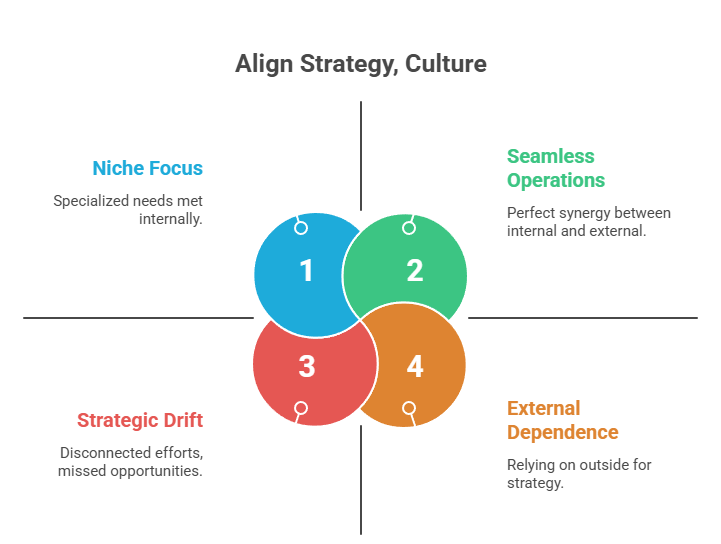
The marketing approach must align with broader organizational strategy, culture, and operational preferences. Misalignment in these areas creates friction that undermines even technically sound decisions.
Organizations with strong internal creative cultures often struggle with agency creative output, regardless of objective quality measures. Companies that prioritize rapid decision-making may find agency approval processes frustrating. Businesses with complex product lines might need in-house expertise that understands nuanced positioning requirements.
Geographic considerations increasingly matter in global organizations. Time zone differences can create collaboration challenges with agencies, while in-house teams provide natural alignment with internal schedules and cultural norms.
Specific scenarios consistently favor one approach over the other, based on patterns I’ve observed across hundreds of marketing organization decisions. Understanding these patterns helps identify which evaluation criteria matter most for your situation.
Agencies provide superior value in scenarios requiring specialized expertise, rapid scaling, or broad capability sets with limited internal resources. The outsourcing benefits become overwhelming when speed-to-market determines competitive advantage.
Startups and early-stage companies almost always benefit from agency partnerships. The alternative of hiring junior marketers who learn on your budget while making expensive mistakes is rarely cost-effective. Agencies provide immediate access to senior expertise and proven processes that accelerate time-to-revenue.
Complex technical marketing requirements strongly favor agencies. Programmatic advertising optimization, advanced marketing automation, and sophisticated attribution modeling require specialized knowledge that’s difficult to hire and expensive to maintain in-house. I’ve seen companies waste hundreds of thousands attempting to build these capabilities internally when agency expertise was readily available.
Seasonal businesses benefit from agency flexibility that allows scaling capabilities up and down based on business cycles. Retail organizations can access enhanced capabilities during peak seasons without carrying fixed costs during slow periods.
International expansion scenarios heavily favor agencies with existing local market expertise. Building international marketing capabilities internally requires months or years, while agencies can provide immediate market access with established local knowledge.
In-house teams excel when deep product knowledge drives marketing success, when iterative testing requires constant communication, or when proprietary processes create competitive advantages.
Complex B2B organizations with lengthy sales cycles often benefit from in-house teams that develop intimate product knowledge over time. This expertise becomes particularly valuable when technical accuracy and industry credibility drive purchasing decisions.
Companies with unique business models or innovative products may find that agencies struggle to understand nuanced positioning requirements. The time required to educate external teams can exceed the benefits of their specialized marketing knowledge.
Organizations requiring extensive integration between marketing and other functions benefit from in-house teams. When marketing success depends on close collaboration with product development, customer success, or sales teams, internal alignment often proves more valuable than external expertise.
Large enterprises with sufficient scale to support specialized roles can achieve superior performance through in-house teams. When revenue supports hiring senior specialists across all required disciplines, the coordination benefits and cultural alignment often justify higher costs.
Sophisticated organizations increasingly adopt hybrid models that combine in-house strategic leadership with agency tactical execution. This approach captures benefits from both models while mitigating primary weaknesses.
The most effective hybrid models place strategic oversight, brand management, and performance analysis in-house while outsourcing specialized execution to agencies. This structure maintains control over critical decisions while accessing specialized expertise efficiently.
Successful hybrid implementations require clear role definitions and communication protocols. Confusion about responsibilities destroys the efficiency benefits that justify the additional complexity of managing both internal teams and external partners.
The transition process often determines ultimate success regardless of which approach offers theoretical advantages. Poor implementation can destroy the benefits of sound strategic decisions.
Agency transitions require comprehensive briefing processes, clear success metrics, and defined communication rhythms. The most successful partnerships begin with detailed documentation of brand guidelines, target audiences, historical performance data, and strategic objectives. Plan for 60-90 days of intensive collaboration to establish working rhythms and performance baselines.
In-house hiring requires systematic capability planning and cultural integration support. The biggest mistakes involve hiring individual specialists without considering team dynamics and knowledge transfer requirements. Plan for 6-12 months to build effective in-house teams, including time for cultural integration and process development.
Success requires defining measurement criteria before implementation begins. The metrics should address both quantitative marketing performance and qualitative factors like collaboration effectiveness and strategic alignment.
Marketing results measurement should include leading indicators like campaign launch speed, testing velocity, and capability development alongside lagging indicators like cost per acquisition, lifetime value, and revenue attribution. This comprehensive approach reveals whether the chosen model delivers expected benefits across all important dimensions.
Qualitative measures matter enormously but often receive insufficient attention. Stakeholder satisfaction, communication effectiveness, and strategic alignment quality significantly impact long-term success. Regular assessment of these factors helps identify optimization opportunities before they become major problems.
Real-world case studies illustrate how different approaches succeed in various contexts. These examples provide practical insights that abstract frameworks cannot capture.
A $15M SaaS company achieved 300% growth over 18 months through a strategic agency partnership that provided immediate access to product marketing expertise, demand generation capabilities, and customer success optimization. The alternative of building these capabilities internally would have required 12-18 months and significantly higher investment with uncertain outcomes.
A $100M manufacturing company improved marketing performance 40% by transitioning from agencies to an in-house team led by a senior marketing director with deep industry experience. The internal team’s superior product knowledge and direct access to engineering teams enabled positioning innovations that external agencies couldn’t develop.
A global technology company optimized performance through a hybrid model combining in-house strategic leadership with specialized agency partnerships for paid media, content creation, and marketing automation. This approach reduced costs 25% while improving campaign performance across all key metrics.
Systematic decision-making requires structured evaluation tools that ensure comprehensive analysis of all relevant factors. These tools help avoid common biases that lead to suboptimal choices.
Create a weighted scoring matrix that addresses your specific priorities across cost, capability, risk, and strategic alignment dimensions. Assign weights based on your organization’s priorities, then score each option objectively across all criteria. This approach reveals whether gut-level preferences align with analytical evaluation.
Develop total cost of ownership models that include all direct and indirect costs over 24-36 month timeframes. Shorter timeframes bias toward agencies due to hiring and onboarding costs, while longer timeframes may favor in-house teams through accumulated expertise and cultural integration benefits.
Design pilot programs that allow testing preferred approaches before making full commitments. Three-month agency trials or contract-hire arrangements for in-house specialists provide valuable data about actual performance versus projected benefits.
Experience reveals predictable mistakes that destroy otherwise sound strategies. Understanding these pitfalls helps organizations avoid costly errors during evaluation and implementation processes.
The most dangerous mistake involves making decisions based on short-term cost optimization without considering capability requirements and strategic implications. Choosing the cheapest option rarely delivers optimal marketing performance over meaningful timeframes.
Another common error involves underestimating management requirements for chosen approaches. Agency relationships require active oversight and clear communication to succeed. In-house teams need leadership, direction, and cultural integration support. Treating either as “set and forget” solutions guarantees underperformance.
Organizations frequently fail to establish clear success metrics before implementation begins. Without defined expectations, it becomes impossible to evaluate performance objectively or optimize approaches based on actual results versus theoretical benefits.
The marketing landscape continues evolving rapidly, with artificial intelligence, privacy regulations, and new channel development creating fresh capability requirements. Future-oriented decisions must consider how these trends affect the relative advantages of different organizational approaches.
AI integration increasingly favors organizations with access to cutting-edge tools and expertise. Agencies that serve multiple clients can justify investments in advanced AI capabilities that individual companies cannot support economically. This trend may strengthen the case for agency partnerships among smaller organizations.
Privacy regulation complexity creates advantages for specialized expertise that stays current with evolving requirements across multiple jurisdictions. In-house teams may struggle to maintain necessary expertise as regulations become more complex and geographically diverse.
The rapid evolution of new marketing channels favors flexible approaches that can adapt quickly to emerging opportunities. Organizations locked into fixed approaches may miss important developments that could provide competitive advantages.
The agency versus in-house decision represents a strategic choice that significantly impacts marketing performance, organizational capability, and competitive positioning. Success requires systematic evaluation that addresses financial, operational, strategic, and risk considerations rather than simplified heuristics based on company size or industry sector.
The most sophisticated organizations increasingly recognize that this choice isn’t permanent. Regular reassessment ensures that organizational approaches remain aligned with evolving business needs, market conditions, and capability requirements. The goal isn’t to make the perfect decision once, but to maintain marketing organizational structures that consistently deliver superior performance as conditions change.
My experience strongly suggests that organizations investing proper effort in systematic evaluation and thoughtful implementation achieve superior marketing results regardless of which approach they choose. The decision process matters more than the specific choice, because rigorous analysis ensures alignment between organizational needs and chosen solutions.
Key Takeaways: Optimizing Average Order Value (AOV) consistently delivers faster, more measurable ROI than scaling paid traffic spend. Bundling, upsells, cross-sells, and...
Mike VillarKey Takeaways: Statistical significance is widely misunderstood and misreported in marketing tests, leading to decisions based on faulty data. Peeking at test results before...
Alvar SantosKey Takeaways: Looker Studio is the best budget-friendly option for marketing teams already embedded in the Google ecosystem, offering free access and solid connector support. Domo...
Amanda Bianca CoStart your brand's success journey today with a conversation. Share your goals and objectives with us and let's set up a discovery call.