
Why Average Order Value Optimization Beats Chasing New Traffic
Key Takeaways: Optimizing Average Order Value (AOV) consistently delivers faster, more measurable ROI than scaling paid traffic spend. Bundling, upsells, cross-sells, and...
Mike VillarKey Takeaways Strategic automation can reduce project delivery times by 40-60% without sacrificing quality or requiring additional headcount Template systems and standardized...
 Josh EvoraDecember 25, 2025

Key Takeaways
The digital marketing landscape has fundamentally shifted. Clients no longer tolerate the traditional agency timeline of 6-8 weeks for campaign development. They demand rapid deployment, iterative optimization, and real-time responsiveness. Yet most agencies continue operating with outdated workflows designed for a slower era.
After nearly two decades of working with enterprise clients and high-growth startups, I’ve witnessed agencies attempt to solve speed challenges by throwing more bodies at projects. This approach is not only financially unsustainable but operationally counterproductive. More people create more complexity, more communication overhead, and more potential failure points.
The solution lies in intelligent automation and systematic process optimization. Forward-thinking agencies are achieving 40-60% faster delivery times while maintaining or improving quality standards. The secret isn’t working harder; it’s engineering systems that work smarter.
Modern agency infrastructure requires a fundamental reimagining of how work flows through your organization. Traditional linear workflows create bottlenecks and dependencies that compound delays. Automation-first infrastructure eliminates these friction points through parallel processing and intelligent routing.
Your agency technology foundation should center on three core pillars: workflow orchestration, asset management, and performance monitoring. Each pillar requires specific automation tools that integrate seamlessly within your broader martech stack.
Workflow orchestration tools like Monday.com or Asana, when properly configured with automation rules, can eliminate 70% of manual project management tasks. These platforms should automatically trigger next-phase activities, assign resources based on capacity algorithms, and escalate bottlenecks before they impact delivery timelines.
Asset management systems must go beyond simple file storage. Intelligent digital asset management platforms can automatically tag creative assets, maintain version control, and suggest relevant assets for new projects based on client industry, campaign objectives, and historical performance data.
Performance monitoring requires real-time dashboards that aggregate data from multiple sources within your agency stack. These systems should provide early warning signals when projects deviate from planned timelines and automatically suggest resource reallocation strategies.
Template systems represent the most underutilized acceleration opportunity in modern agencies. Not the basic creative templates that most agencies already use, but comprehensive framework templates that encompass strategy development, creative briefing, production workflows, and optimization protocols.
Strategic framework templates compress discovery and planning phases from weeks to days. A well-designed competitive analysis template, integrated with automation tools, can pull real-time data from multiple sources and generate insights that would typically require 20-30 hours of manual research. The result is delivered in 2-3 hours with greater accuracy and consistency.
Creative briefing templates, when integrated with AI-powered content generation tools, can automatically populate client-specific briefs using historical performance data, industry benchmarks, and audience intelligence. This approach reduces briefing development time by 75% while improving creative relevance and strategic alignment.
Production workflow templates standardize complex multi-stage processes into repeatable systems. A comprehensive social media campaign template should include automated asset creation workflows, approval routing systems, scheduling protocols, and performance tracking mechanisms. Teams can deploy campaigns in days rather than weeks while maintaining quality standards.
Implementation requires discipline and systematic thinking. Start by documenting your three most frequent campaign types. Map every step, decision point, and deliverable. Identify automation opportunities at each stage. Build templates incrementally, testing and refining based on real project data.
Production automation represents the highest-impact opportunity for timeline compression. Modern marketing tools enable end-to-end automated production workflows that require minimal human intervention while delivering professional-quality outputs.
Video production exemplifies this transformation. Platforms like Lumen5 and Pictory can automatically generate video content from blog posts, social media content, or strategic briefs. These tools can compress video production timelines from 2-3 weeks to 2-3 hours while maintaining brand consistency and message clarity.
Display advertising production can be completely automated using dynamic creative optimization platforms. Tools like Bannerflow or Celtra can generate hundreds of ad variations from a single creative brief, automatically adapting messaging, imagery, and calls-to-action based on audience segments and placement specifications.
Email campaign production benefits significantly from automation tools that can generate subject lines, body copy, and visual layouts based on campaign objectives and audience data. Platforms like Phrasee use AI to generate and optimize email elements that often outperform human-created alternatives while reducing production time by 80%.
Social media content production can be streamlined through AI-powered platforms that generate post copy, select imagery, and schedule distribution across multiple platforms. Tools like Later or Hootsuite, when integrated with AI content generators, can produce and schedule weeks of social content in hours.
The key to successful production automation is maintaining human oversight at critical decision points while eliminating routine execution tasks. Humans should focus on strategy, creative direction, and quality validation. Machines should handle asset generation, formatting, and distribution.
AI-assisted creative tools don’t replace creative talent; they amplify it. These tools enable creative teams to explore more concepts, iterate faster, and deliver higher-quality outputs in compressed timeframes.
Concept development traditionally requires extensive brainstorming sessions, mood board creation, and iterative refinement. AI tools like Midjourney and DALL-E can generate dozens of visual concepts from written briefs in minutes. Creative teams can use these outputs as inspiration, starting points, or even final assets, dramatically accelerating the ideation process.
Copywriting acceleration tools like Copy.ai and Jasper enable writers to generate multiple messaging variations, headlines, and body copy options rapidly. Rather than replacing copywriters, these tools provide inspiration and overcome creative blocks while handling routine content generation tasks.
Design iteration becomes exponentially faster with AI-powered design tools. Platforms like Canva’s AI features or Adobe’s Sensei can automatically generate design variations, suggest color palettes, and optimize layouts based on performance data from similar campaigns.
The most effective implementation strategy involves training creative teams to use AI tools as collaborative partners rather than replacement technologies. Establish clear guidelines for when AI assistance adds value versus when human creativity should lead. Create workflows that integrate AI outputs with traditional creative processes.
Process standardization eliminates decision fatigue and reduces project complexity while enabling consistent quality delivery regardless of team composition. Standardized processes become the foundation for effective automation implementation.
Client onboarding standardization can reduce new client setup time by 60-70%. Create detailed checklists, automated data collection forms, and standardized discovery processes. Use tools like Typeform or Calendly to automate scheduling and information gathering. Implement CRM automation that triggers appropriate workflows based on client type and service requirements.
Quality control standardization ensures consistent output quality while accelerating approval cycles. Develop detailed quality checklists for each deliverable type. Implement automated quality checks where possible, such as broken link detection, image optimization validation, and brand guideline compliance verification.
Communication standardization reduces client confusion and internal inefficiency. Create template communication sequences for project phases, milestone achievements, and issue escalation. Use automation tools to trigger appropriate communications based on project status and timeline markers.
Reporting standardization enables automated performance tracking and client communication. Develop template reporting frameworks that automatically pull data from relevant sources and generate insights. Tools like Google Data Studio or Tableau can create automated reporting systems that update in real-time without manual intervention.
| Process Area | Traditional Timeline | Automated Timeline | Time Savings |
|---|---|---|---|
| Client Onboarding | 2-3 weeks | 3-5 days | 70% |
| Campaign Strategy Development | 1-2 weeks | 2-3 days | 75% |
| Creative Production | 2-3 weeks | 3-5 days | 80% |
| Quality Review Cycles | 1-2 weeks | 1-2 days | 85% |
| Performance Reporting | 2-3 days | Real-time | 90% |
Workflow optimization requires systematic analysis of how work moves through your organization and intelligent redesign of those flows to eliminate waste and accelerate delivery. Most agencies operate with workflows designed by accident rather than intention.
Parallel processing represents the most significant optimization opportunity. Traditional linear workflows create unnecessary dependencies where tasks wait for previous stages to complete entirely. Intelligent workflow design enables multiple workstreams to progress simultaneously.
For example, creative development doesn’t need to wait for complete strategy finalization. Initial creative exploration can begin based on preliminary strategic direction, with refinements happening in parallel as strategy details are finalized. This approach can compress overall project timelines by 30-40%.
Automated routing eliminates manual handoffs and reduces coordination overhead. Workflow automation tools can automatically assign tasks based on resource availability, skill requirements, and deadline priorities. This eliminates the bottlenecks created by manual resource allocation decisions.
Exception handling automation addresses the reality that not all projects follow standard paths. Build automated workflows that can detect when projects deviate from normal parameters and automatically trigger appropriate escalation or alternative routing protocols.
Real-time visibility enables proactive optimization rather than reactive problem-solving. Implement dashboard systems that provide instant visibility into project status, resource utilization, and potential bottlenecks. These systems should automatically alert relevant stakeholders when intervention is required.
Strategic automation implementation requires understanding where time is actually consumed in your operations versus where teams perceive time consumption occurs. Time-tracking analysis often reveals surprising insights about actual versus perceived time allocation.
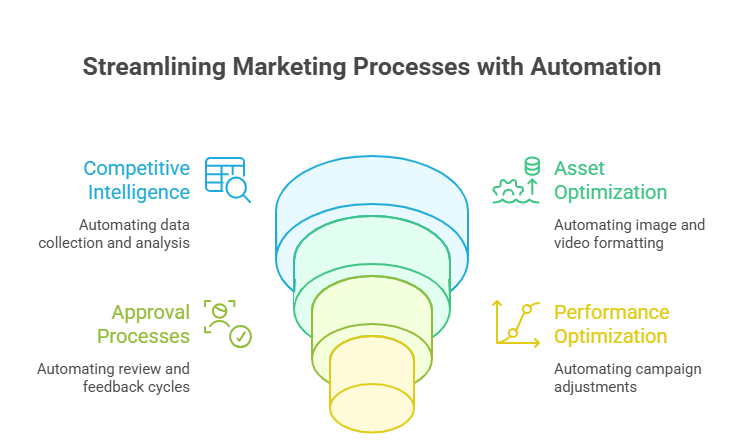
Research and intelligence gathering represents a massive automation opportunity. Traditional competitive research, audience analysis, and market intelligence gathering can consume 20-40 hours per project. Automated research tools can compile this intelligence in 1-2 hours while providing more comprehensive and current data.
Tools like SEMrush, Ahrefs, and SimilarWeb can automatically generate competitive intelligence reports that would require days of manual research. Social listening platforms like Sprout Social or Hootsuite Insights can provide real-time audience sentiment and behavior data automatically.
Asset optimization and formatting automation eliminates routine production tasks. Automated image optimization tools can compress file sizes, adjust dimensions, and optimize images for different platforms without manual intervention. Video optimization tools can automatically generate multiple formats and resolutions for cross-platform distribution.
Approval process automation can eliminate the 3-7 day delays typically associated with client review cycles. Automated approval routing systems can simultaneously distribute assets to multiple stakeholders, track review status, consolidate feedback, and trigger next-phase activities based on approval status.
Performance optimization automation enables real-time campaign adjustments without manual monitoring. Automated bid management, ad creative rotation, and budget allocation tools can continuously optimize campaign performance based on predefined parameters and learning algorithms.
Client satisfaction increasingly correlates with delivery velocity rather than purely with creative quality or strategic sophistication. Modern clients value agencies that can respond quickly to market opportunities, competitive threats, and emerging trends.
Rapid prototyping capabilities enable clients to see and test concepts within days of project initiation. Tools like Figma for design prototyping, Loom for rapid video concepts, or even simple PowerPoint animations can provide clients with tangible previews that accelerate feedback and approval cycles.
Real-time collaboration tools eliminate the delays associated with traditional review and revision cycles. Platforms like Slack, Microsoft Teams, or dedicated project collaboration tools enable continuous client interaction without formal meeting scheduling delays.
Iterative delivery approaches provide clients with continuous value rather than requiring them to wait for complete project completion. Break large projects into smaller deliverable chunks that can be deployed and optimized incrementally.
Transparent progress tracking gives clients confidence in project momentum and timing. Automated project status updates, milestone notifications, and progress dashboards eliminate client anxiety about project status while reducing account management overhead.
Proactive optimization capabilities demonstrate ongoing value beyond initial delivery. Automated performance monitoring and optimization recommendations show clients that their investments continue generating value without additional resource requirements.
Operational efficiency directly translates to profit margin improvement through reduced labor costs, faster project turnaround, and increased client capacity without proportional overhead increases.
Labor cost reduction occurs naturally as automation eliminates routine tasks and accelerates complex processes. Teams can handle larger project volumes with the same headcount while focusing human effort on high-value strategic and creative activities.
Project velocity improvements enable higher client throughput without increasing operational overhead. Agencies can serve more clients with existing infrastructure, directly improving profit margins while maintaining service quality standards.
Reduced revision cycles decrease project costs while improving client satisfaction. Automation tools that improve initial output quality and streamline approval processes can reduce revision cycles by 60-80%, significantly impacting project profitability.
Predictable delivery timelines enable better resource planning and utilization optimization. When project timelines become consistent and reliable, agencies can optimize resource allocation and reduce bench time between projects.
The compounding effect of multiple efficiency improvements can drive profit margin improvements of 25-35% while simultaneously improving client satisfaction scores and reducing employee stress levels.
Successful automation implementation requires systematic planning and gradual rollout rather than attempting comprehensive transformation simultaneously. Start with pilot programs that demonstrate clear value before expanding automation initiatives.
Begin with process mapping and time tracking analysis. Document current workflows in detail, identifying time consumption patterns and bottleneck locations. Use time-tracking tools to gather objective data about where effort is actually allocated versus perceived allocation.
Prioritize automation opportunities based on time savings potential and implementation complexity. Quick wins with high impact should be implemented first to build momentum and demonstrate value to skeptical team members.
Select agency technology stack components that integrate effectively rather than implementing point solutions that create new silos. Choose platforms that offer robust API connectivity and can share data seamlessly across your martech stack.
Train teams systematically on new tools and processes. Automation adoption fails when teams lack proper training or don’t understand how new tools improve their daily work experience. Invest in comprehensive training programs that demonstrate personal benefits alongside organizational improvements.
Measure results systematically using both quantitative metrics (delivery timelines, revision cycles, client satisfaction scores) and qualitative feedback from teams and clients. Use this data to refine automation implementations and identify additional optimization opportunities.
The agencies that thrive in the next decade will be those that embrace automation as a competitive advantage rather than viewing it as a threat to traditional agency models. Client expectations will continue increasing for faster delivery, greater transparency, and more responsive service.
Emerging technologies like advanced AI, machine learning algorithms, and workflow orchestration platforms will create new automation possibilities that aren’t currently available. Agencies should build automation infrastructure that can evolve and expand as new tools become available.
The human element becomes more valuable, not less valuable, in highly automated environments. As routine tasks become automated, human creativity, strategic thinking, and client relationship management become the primary differentiators between agencies.
Continuous improvement mindsets become essential for maintaining competitive advantages. Automation implementation isn’t a one-time project but an ongoing optimization process that requires constant attention and refinement.
The agencies that master automation-driven speed will capture disproportionate market share while achieving superior profit margins. The time to begin this transformation is now, before automation becomes a basic expectation rather than a competitive differentiator.
Key Takeaways: Optimizing Average Order Value (AOV) consistently delivers faster, more measurable ROI than scaling paid traffic spend. Bundling, upsells, cross-sells, and...
Mike VillarKey Takeaways: Statistical significance is widely misunderstood and misreported in marketing tests, leading to decisions based on faulty data. Peeking at test results before...
Alvar SantosKey Takeaways: Looker Studio is the best budget-friendly option for marketing teams already embedded in the Google ecosystem, offering free access and solid connector support. Domo...
Amanda Bianca CoStart your brand's success journey today with a conversation. Share your goals and objectives with us and let's set up a discovery call.