
Why Average Order Value Optimization Beats Chasing New Traffic
Key Takeaways: Optimizing Average Order Value (AOV) consistently delivers faster, more measurable ROI than scaling paid traffic spend. Bundling, upsells, cross-sells, and...
Mike VillarKey Takeaways: Most digital marketing agencies struggle with experimentation not because of a lack of tools, but because of a lack of structured culture and process. When marketing...
 Mike VillarMarch 25, 2026

Key Takeaways:
After nearly two decades working at the intersection of performance marketing, customer acquisition, and digital strategy, one pattern stands out above almost everything else: the agencies and marketing teams that consistently win are not necessarily the ones with the most sophisticated tools or the biggest budgets. They are the ones that have built a genuine, operational marketing experimentation culture. Not a culture of running a few A/B tests here and there, but a deeply embedded organizational habit of forming hypotheses, testing them rigorously, learning from outcomes, and feeding those learnings back into every client account they manage.
And yet, for most digital marketing agencies, this is exactly where the wheels fall off. Experimentation gets treated as a project deliverable rather than an operational discipline. A test gets launched when a client pushes back on performance, or when a new platform feature catches someone’s attention, not because there is a systematic process demanding it happen. This reactive posture is costing agencies in ways they often cannot directly trace: underperforming campaigns, eroding client trust, and a competitive disadvantage that compounds over time.
This article is written specifically for digital marketing agencies managing multiple client accounts across paid media, SEO, content, and conversion optimization. The goal is practical and direct: explain why experimentation culture breaks down, what it costs when it does, and how to build the systems and workflows that make it sustainable and profitable.
Let us be clear about what is actually at stake. When a digital marketing agency operates without a structured experimentation culture, several things happen simultaneously, and most of them are invisible until the damage is done.
First, budget gets misallocated with confidence. Without a testing framework, teams rely on intuition, past experience, or vendor recommendations to make spending decisions. Some of those decisions will work. Many will not. The problem is that without controlled experimentation, you rarely know which is which, and you cannot replicate success when it happens.
Second, client relationships deteriorate quietly. Clients do not always know how to articulate why performance feels stagnant, but they feel it. When an agency cannot explain why something is working or not working with evidence, the narrative defaults to excuses. That erodes trust faster than almost anything else.
Third, you lose institutional knowledge. Every test that runs without proper documentation is a test that might as well have never happened. The learnings die with the campaign, the quarter, or the account manager who ran it. Multiply that across dozens of client accounts and years of work, and an agency has essentially been paying tuition to the same school of hard knocks over and over again without ever graduating.
The financial impact is real. According to research from McKinsey, companies with strong experimentation cultures are 1.5 to 2 times more likely to report above-average growth. For agencies, that translates directly into client retention, expanded retainers, and the kind of case study-worthy results that drive new business.
There is no single reason experimentation culture fails inside agencies. It is usually a combination of structural, behavioral, and operational factors working against each other. Understanding the specific failure points is the first step toward fixing them.
The solution is not to hire a data scientist or purchase an enterprise experimentation platform, though those things can help at scale. The solution is to build simple, repeatable systems that force experimentation to happen regardless of who is working on which account. Here is what that looks like in practice.
Step 1: Create a Centralized Experimentation Backlog
Every client account should feed into a shared hypothesis repository. This can live in Notion, Airtable, or a simple Google Sheet, but it must be centralized and actively maintained. Each entry should include the hypothesis statement, the metric it is intended to move, the required sample size or budget, and the expected duration. Marketing ops owns this backlog and ensures it is reviewed in regular planning cycles.
Step 2: Standardize the Test Brief Template
Before any test launches, a one-page brief should be completed. It should answer five questions: What is the hypothesis? What is the control and the variant? What metric defines success? What is the minimum detectable effect? How long will the test run? This removes ambiguity and makes results interpretable. Agencies that skip this step consistently misread their own data.
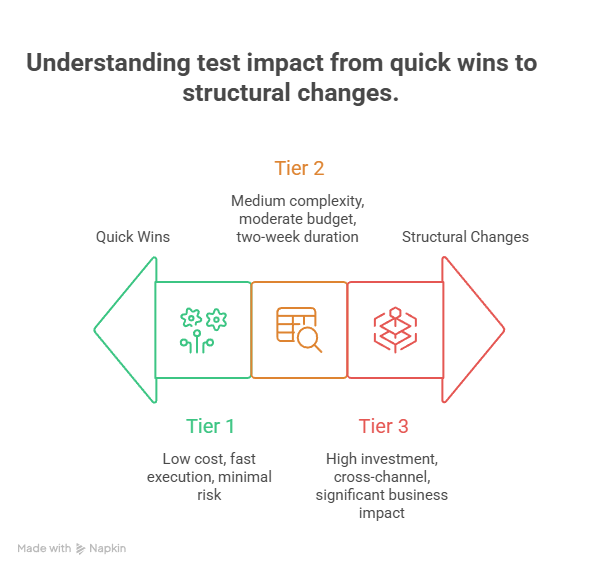
Step 3: Implement a Tiered Testing Framework
Not all tests deserve the same investment. A useful framework is to categorize tests into three tiers.
Step 4: Build a Cross-Client Learning Loop
This is where most agencies leave serious value on the table. Every test that completes, regardless of outcome, should produce a findings summary that is added to a shared knowledge base. Once per month or per quarter, marketing ops should synthesize patterns across clients and distribute insights to all account teams. A winning creative strategy in e-commerce may have direct application for a B2B SaaS client. Connections like this only happen if the infrastructure for sharing them exists.
Step 5: Set Expectations With Clients Upfront
Experimentation needs to be sold as part of the service, not squeezed in around it. Agencies that do this well include a testing roadmap in their onboarding process, define quarterly learning objectives alongside performance targets, and frame experimentation as the mechanism that delivers compounding performance gains over time. Clients who understand the process are far more likely to be patient when a test disrupts short-term numbers.
Marketing ops is the infrastructure layer that determines whether experimentation is a consistent agency-wide practice or a sporadically implemented good intention. In agencies that have gotten this right, marketing ops owns the following functions.
Without a dedicated marketing ops function that carries authority inside the agency, experimentation will always be subject to the pressures of day-to-day execution. It will get deprioritized. The teams that understand this invest in marketing ops not as a support function but as a strategic one.
Consider an agency managing paid media for eight clients across DTC, B2B SaaS, and professional services. Without an experimentation culture, each account manager is effectively running their own informal strategy, informed by experience and platform recommendations. Results vary widely. When a client asks why performance has plateaued, there is no structured answer.
Now introduce a basic experimentation infrastructure. The agency builds a shared backlog, standardizes its test brief template, and assigns marketing ops to maintain the knowledge base. Within two quarters, patterns emerge. Ad fatigue cycles are shorter than assumed. Long-form video outperforms short-form at mid-funnel across three different verticals. A specific landing page structure is consistently outperforming client-provided designs. These insights become agency IP. They feed into new client pitches, training materials, and service differentiation.
The business impact compounds. Client retention improves because clients can see a systematic approach to performance improvement. New business closes faster because the agency can demonstrate a repeatable methodology backed by cross-client evidence. Margins improve because less time is spent on reactive troubleshooting and more is spent on systematic optimization.
Agencies will encounter internal resistance when trying to implement a more structured experimentation culture. Here are the most common objections and honest responses to each.
A digital marketing agency that commits to building a genuine marketing experimentation culture is doing something most of its competitors are not: it is turning client work into a learning asset. Every campaign becomes a data point. Every test adds to a library of evidence. Over three to five years, an agency with this infrastructure has accumulated a depth of market and channel knowledge that simply cannot be replicated by a competitor who is still running on instinct and intuition.
This is not about being the most tech-forward agency or having the most impressive dashboard. It is about building the organizational discipline to learn faster than the market changes, and to use that learning systematically across everything you do.
The agencies that will lead in the next decade of digital marketing will be the ones that treated experimentation not as a tactic but as a core operational capability. That shift starts with culture, and culture starts with making the decision that learning is not optional.
Key Takeaways: Optimizing Average Order Value (AOV) consistently delivers faster, more measurable ROI than scaling paid traffic spend. Bundling, upsells, cross-sells, and...
Mike VillarKey Takeaways: Statistical significance is widely misunderstood and misreported in marketing tests, leading to decisions based on faulty data. Peeking at test results before...
Alvar SantosKey Takeaways: Looker Studio is the best budget-friendly option for marketing teams already embedded in the Google ecosystem, offering free access and solid connector support. Domo...
Amanda Bianca CoStart your brand's success journey today with a conversation. Share your goals and objectives with us and let's set up a discovery call.