
Why Average Order Value Optimization Beats Chasing New Traffic
Key Takeaways: Optimizing Average Order Value (AOV) consistently delivers faster, more measurable ROI than scaling paid traffic spend. Bundling, upsells, cross-sells, and...
Mike VillarKey Takeaways: Modern CRM workflows powered by GPT and automation can reduce manual tasks by up to 80% while improving lead quality and campaign performance No-code platforms like...
 Amanda Bianca CoNovember 19, 2025

Key Takeaways:
The digital marketing landscape has reached a tipping point. While most agencies are still drowning in manual processes, spreadsheet management, and reactive campaign adjustments, the smart players are building automated systems that work around the clock. The convergence of advanced AI models, sophisticated automation platforms, and intelligent CRM systems has created an unprecedented opportunity to reimagine how marketing workflows operate.
After nearly two decades in this industry, I’ve witnessed every supposed “game-changer” come and go. But what we’re seeing now with GPT-powered automation isn’t just another shiny tool—it’s a fundamental shift in how agencies can scale their operations, improve client outcomes, and maintain competitive advantages. The agencies that master these modern CRM workflows will dominate the next decade. Those that don’t will become obsolete.
Traditional CRM systems were designed for a different era—one where human touch was the primary differentiator and data analysis happened in monthly review meetings. Today’s marketing environment demands real-time decision making, personalized interactions at scale, and seamless integration across dozens of platforms and touchpoints.
Modern CRM workflows powered by automation represent a complete reimagining of this architecture. Instead of static databases that store contact information, we’re building dynamic systems that think, learn, and execute. These systems combine three critical components:
The magic happens when these components work together seamlessly. A lead enters your system, AI analyzes their behavior and firmographic data, automation platforms trigger personalized sequences, and GPT generates contextually relevant content—all without human intervention.
I’ve tested virtually every automation platform available, from Zapier to Microsoft Power Automate. For agency environments, Make.com consistently outperforms alternatives in both functionality and reliability. The visual workflow builder makes complex multi-step automations manageable, while the robust error handling ensures campaigns don’t break when APIs change or data formats shift.
What sets Make.com apart for CRM workflows is its native understanding of marketing data structures. Unlike generic automation tools, Make.com handles the nuanced data transformations that marketing workflows require. When you’re pulling lead scores from HubSpot, enriching them with intent data from Bombora, and pushing personalized sequences to Outreach, you need an automation platform that understands marketing attribution models and customer journey mapping.
The platform’s scenario templates specifically designed for marketing use cases dramatically reduce implementation time. Instead of building workflows from scratch, agencies can adapt proven templates for lead qualification, customer onboarding, and campaign optimization. This accelerated deployment is crucial when serving multiple clients with varying requirements.
Client onboarding traditionally consumes 15-20% of agency resources on new accounts. Multiple discovery calls, lengthy questionnaires, and back-and-forth revisions stretch what should be a streamlined process into weeks of inefficiency. GPT-powered brief generation eliminates this bottleneck while improving brief quality and completeness.
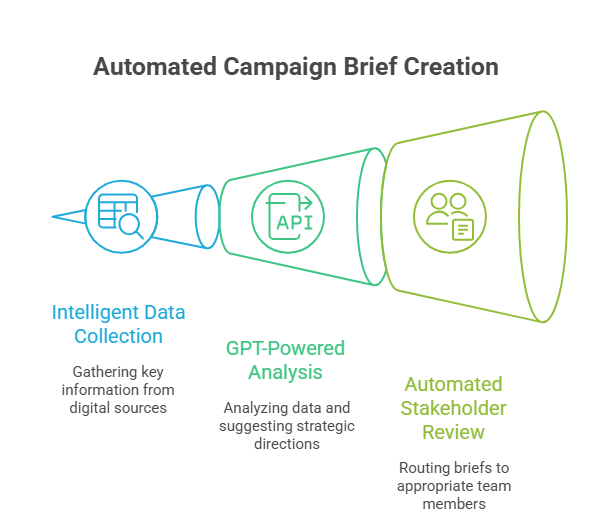
Here’s how sophisticated agencies are automating this process:
Phase 1: Intelligent Data Collection
Instead of sending clients generic questionnaires, automated systems analyze their existing digital presence first. Web scraping tools extract key information from websites, social media profiles, and public business records. This preliminary research informs dynamic questionnaires that ask targeted questions based on industry, company size, and current marketing sophistication.
Phase 2: GPT-Powered Analysis and Brief Creation
Raw client responses flow into GPT models trained on thousands of successful campaign briefs. The AI doesn’t just compile answers—it identifies gaps, suggests strategic directions, and highlights potential challenges based on pattern recognition from similar accounts.
Phase 3: Automated Stakeholder Review
Generated briefs trigger review workflows that route drafts to appropriate team members based on campaign type, budget, and complexity. Senior strategists receive high-value accounts automatically, while routine campaigns flow to junior team members with AI-generated guidance notes.
Implementation requires careful prompt engineering to ensure consistent output quality. Here’s a proven brief generation prompt structure:
“Analyze the following client information: [CLIENT_DATA]. Generate a comprehensive marketing brief that includes: 1) Executive summary with key challenges and opportunities, 2) Target audience analysis with persona development, 3) Competitive landscape assessment, 4) Recommended channel strategy with budget allocation, 5) Success metrics and KPI framework, 6) Potential risks and mitigation strategies. Format output for immediate stakeholder review and client presentation.”
This automation typically reduces brief creation time from 8-12 hours to 45 minutes while improving consistency and completeness.
Traditional lead scoring relies on basic demographic and behavioral data—job title, company size, email opens, website visits. This approach worked when marketing was simpler and competition was lighter. Today’s B2B environment requires sophisticated scoring algorithms that analyze intent signals, engagement patterns, and predictive indicators across multiple touchpoints.
Modern lead scoring workflows powered by GPT analyze unstructured data that traditional systems miss entirely. Email response sentiment, social media engagement quality, and website browsing patterns provide deeper insights into purchase intent than simple page views or download metrics.
Here’s how to build an intelligent lead scoring system:
Data Integration Layer
Connect all customer touchpoints to your CRM through automation platforms. This includes obvious sources like website analytics and email platforms, plus indirect signals like social media monitoring tools, review platforms, and industry publications. The goal is comprehensive data collection across the entire customer journey.
AI Analysis Engine
GPT models process this multi-source data to identify patterns that correlate with closed deals. Instead of simple point accumulation, the AI evaluates contextual factors like timing, sequence, and behavioral combinations. A prospect who downloads a pricing guide, visits competitor comparison pages, and engages with case studies represents higher intent than someone who simply attended a webinar.
Dynamic Score Adjustment
Scores update in real-time as new information becomes available. Automation workflows monitor for trigger events—executive job changes, company funding announcements, technology implementations—that indicate shifting purchase priorities. This dynamic approach ensures sales teams focus on prospects with genuine near-term potential.
| Traditional Lead Scoring | AI-Powered Lead Scoring |
|---|---|
| Static point assignment | Dynamic pattern recognition |
| Basic demographic data | Multi-source behavioral analysis |
| Manual score updates | Real-time automated adjustments |
| Generic scoring rules | Industry-specific algorithms |
| Limited data sources | Comprehensive touchpoint integration |
The most powerful CRM workflows operate through intelligent trigger systems that initiate appropriate actions based on specific conditions or behavioral patterns. Unlike simple drip campaigns that follow predetermined sequences, modern trigger systems adapt to individual prospect behavior and respond with contextually relevant next steps.
Effective trigger systems require careful mapping of customer journey stages and corresponding response protocols. Each trigger should connect to specific business outcomes and include escalation paths for high-value prospects or complex scenarios.
Behavioral Trigger Examples:
Contextual Trigger Implementation:
The key to sophisticated trigger systems lies in contextual analysis rather than simple event monitoring. A pricing page visit from a Fortune 500 prospect carries different implications than the same action from a startup. Automation workflows should evaluate context—company size, industry, previous engagement history, current technology stack—before determining appropriate responses.
GPT models excel at this contextual analysis, processing multiple data points to determine optimal next actions. The AI can evaluate factors like seasonal buying patterns, budget cycles, and competitive landscapes to time outreach perfectly and personalize messaging for maximum impact.
Traditional marketing campaigns operate in silos—awareness campaigns run independently from consideration content, conversion optimization happens separately from retention programs. This fragmented approach creates inconsistent messaging, missed opportunities, and suboptimal resource allocation.
Modern full-funnel automation treats the entire customer journey as an integrated system. Each touchpoint connects to previous interactions and influences future engagement. Automation workflows ensure consistent progression through awareness, consideration, decision, and advocacy stages while adapting to individual prospect behavior.
Awareness Stage Automation:
AI-powered content distribution ensures prospects encounter relevant messaging across multiple channels. Instead of broadcasting generic content, automated systems analyze prospect characteristics and deliver personalized thought leadership, industry insights, and educational resources through preferred channels. Social media automation, programmatic advertising, and content syndication work together to maximize reach while maintaining message consistency.
Consideration Stage Orchestration:
As prospects demonstrate increased interest, automation workflows shift to deeper engagement tactics. GPT generates personalized case studies, ROI calculators, and comparison guides based on prospect industry and use case. Email sequences adapt based on content engagement patterns, while retargeting campaigns deliver increasingly specific messaging.
Decision Stage Acceleration:
High-intent prospects trigger intensive nurture sequences designed to address specific objections and provide purchasing confidence. Automated workflows coordinate sales team outreach, deliver social proof content, and schedule personalized demonstrations. AI analyzes engagement patterns to predict optimal contact timing and preferred communication methods.
Advocacy Stage Development:
Post-purchase automation extends beyond basic onboarding to create genuine advocates. Intelligent surveys gather feedback at optimal moments, success milestones trigger case study development workflows, and referral opportunities appear when customer satisfaction peaks. This systematic approach to advocacy development creates sustainable growth engines that compound over time.
Most agencies barely scratch the surface of GPT’s capabilities, using it primarily for content creation and basic customer service responses. The real power lies in custom GPT implementations that understand your specific business context, client industries, and performance metrics.
Custom GPTs trained on your agency’s successful campaigns, client outcomes, and industry expertise provide strategic recommendations that generic AI tools cannot match. These specialized models analyze campaign performance data, identify optimization opportunities, and suggest tactical adjustments based on proven success patterns from similar accounts.
Campaign Optimization GPTs:
Train models on your historical campaign data to identify performance patterns that human analysts might miss. These GPTs can analyze ad creative performance, audience engagement rates, and conversion metrics to recommend optimization strategies. The AI considers factors like seasonal trends, competitive dynamics, and industry-specific behaviors to provide actionable recommendations.
Client Communication GPTs:
Develop specialized models for client reporting and communication that understand industry terminology, success metrics, and presentation preferences. These GPTs generate client reports, meeting summaries, and strategic recommendations that maintain your agency’s voice and expertise while scaling communication efficiency.
Strategic Planning GPTs:
Advanced implementations use GPT for strategic planning and competitive analysis. Feed the AI industry reports, competitive intelligence, and market research to generate strategic recommendations for client campaigns. These models can identify emerging opportunities, predict market shifts, and recommend positioning strategies based on comprehensive data analysis.
Successfully implementing modern CRM workflows requires systematic planning and phased deployment. Agencies that attempt comprehensive automation overnight typically experience system conflicts, data inconsistencies, and team resistance. The most successful implementations follow proven deployment strategies that minimize disruption while maximizing adoption.
Phase 1: Foundation Building (Weeks 1-4)
Phase 2: Core Workflow Development (Weeks 5-8)
Phase 3: Advanced Integration (Weeks 9-12)
Phase 4: Optimization and Scaling (Weeks 13-16)
Traditional marketing metrics fail to capture the true impact of automated CRM workflows. Click-through rates and conversion percentages provide limited insight when systems operate across multiple touchpoints and extended timeframes. Sophisticated measurement frameworks evaluate automation effectiveness through operational efficiency gains, revenue impact, and client satisfaction improvements.
Operational Efficiency Metrics:
Revenue Impact Indicators:
Client Satisfaction Measures:
Even well-planned automation implementations encounter predictable challenges that can derail progress and team adoption. Understanding these pitfalls and preparing solutions prevents costly delays and system failures.
Data Quality Issues:
Automated systems amplify existing data problems. Inconsistent contact information, duplicate records, and incomplete prospect profiles create automation failures and poor customer experiences. Implement data cleaning protocols before launching automation workflows, and establish ongoing data hygiene practices that prevent quality degradation.
Over-Automation Syndrome:
Enthusiasm for automation often leads to removing human touchpoints that customers value. High-value prospects and complex sales situations still benefit from personal attention and customized approaches. Design automation workflows with clear escalation paths that route appropriate prospects to human team members at optimal moments.
Integration Complexity:
Modern agencies use dozens of specialized tools that must work together seamlessly. API limitations, data format incompatibilities, and version updates can break automated workflows unexpectedly. Build redundancy into critical workflows and establish monitoring systems that alert teams to integration failures immediately.
Team Resistance and Training:
Automation changes fundamental job responsibilities and requires new skills from existing team members. Invest in comprehensive training programs that help team members understand how automation enhances rather than replaces their expertise. Create new role definitions that emphasize strategic thinking and automation management over routine task execution.
The automation landscape evolves rapidly, with new AI capabilities and integration possibilities emerging monthly. Agencies that build flexible, adaptable systems maintain competitive advantages as technology advances. Future-proofing requires architectural decisions that accommodate change and continuous learning approaches that leverage new capabilities quickly.
Design automation workflows with modularity in mind. Instead of monolithic systems that handle everything, create interconnected components that can be updated, replaced, or enhanced independently. This approach allows rapid adoption of new AI models, automation platforms, and integration capabilities without rebuilding entire systems.
Establish continuous learning processes that monitor industry developments and test emerging technologies systematically. Allocate time and resources for experimentation with new tools and techniques. The agencies that dominate future markets will be those that identify and implement breakthrough technologies before competitors recognize their potential.
The convergence of AI, automation, and CRM systems represents the most significant operational shift in digital marketing since the emergence of social media platforms. Agencies that master these integrated workflows will operate with unprecedented efficiency while delivering superior client outcomes. Those that cling to manual processes and reactive strategies will find themselves increasingly irrelevant in a market that rewards speed, personalization, and strategic sophistication.
The tools and techniques outlined here aren’t theoretical possibilities—they’re proven strategies that forward-thinking agencies are implementing successfully today. The question isn’t whether automation will transform agency operations, but whether your agency will lead or follow this transformation. The window for early adoption advantages is closing rapidly. The time for implementation is now.
Key Takeaways: Optimizing Average Order Value (AOV) consistently delivers faster, more measurable ROI than scaling paid traffic spend. Bundling, upsells, cross-sells, and...
Mike VillarKey Takeaways: Statistical significance is widely misunderstood and misreported in marketing tests, leading to decisions based on faulty data. Peeking at test results before...
Alvar SantosKey Takeaways: Looker Studio is the best budget-friendly option for marketing teams already embedded in the Google ecosystem, offering free access and solid connector support. Domo...
Amanda Bianca CoStart your brand's success journey today with a conversation. Share your goals and objectives with us and let's set up a discovery call.