Key Takeaways
- Magento automation can eliminate up to 75% of manual eCommerce operations through strategic implementation of workflow tools, API integrations, and AI-driven systems
- Automated product management systems reduce catalog maintenance time by 60-80% while improving data accuracy and consistency across channels
- AI-powered search and merchandising automation increases conversion rates by 15-25% through real-time personalization and intelligent product positioning
- Automated customer journey orchestration delivers 3-5x higher lifetime value compared to manual campaign management
- Strategic API implementation and webhook automation create scalable systems that reduce operational overhead while improving customer experience
The eCommerce landscape has reached a tipping point where operational efficiency determines market survival. After nearly two decades of watching businesses struggle with manual processes that throttle growth, I’ve seen firsthand how Magento automation transforms operational drag into competitive advantage. The question isn’t whether you should automate your Magento operations—it’s whether you can afford not to.
Modern eCommerce operations face an unprecedented complexity challenge. Managing thousands of SKUs, orchestrating multi-channel campaigns, personalizing customer experiences at scale, and maintaining competitive pricing requires superhuman efficiency that manual processes simply cannot deliver. This is where strategic Magento automation becomes your operational multiplier.
The Hidden Cost of Manual Operations
Before diving into solutions, let’s acknowledge the elephant in the room: operational drag kills more eCommerce businesses than poor marketing ever will. I’ve audited hundreds of Magento stores where talented teams spend 70% of their time on repetitive tasks that automation could handle in minutes.
Consider the typical day of an eCommerce operations manager: updating product information across multiple channels, manually adjusting pricing based on competitor analysis, creating personalized email campaigns, managing inventory levels, and responding to customer service inquiries. Each task seems manageable individually, but collectively they create a resource drain that prevents strategic growth initiatives.
The compounding effect of operational inefficiency becomes exponentially worse as businesses scale. A store managing 500 products might handle manual updates, but at 5,000 products, manual processes become impossible. This scaling wall is where most eCommerce businesses plateau, not because of market limitations, but because of operational constraints.
Magento’s Automation Architecture Advantage
Magento’s open-source foundation provides unparalleled flexibility for automation implementation. Unlike closed-platform solutions that limit customization, Magento’s modular architecture allows deep integration with modern automation tools, creating systems that adapt to unique business requirements rather than forcing businesses to adapt to platform limitations.
The key differentiator lies in Magento’s robust API ecosystem and webhook capabilities. These technical foundations enable real-time data synchronization, automated workflow triggers, and seamless third-party integrations that transform static eCommerce operations into dynamic, responsive systems.
Magento Commerce (Enterprise) users gain additional automation advantages through built-in features like automated staging and preview, advanced reporting APIs, and enterprise-grade security protocols that support complex automation workflows without compromising data integrity.
Strategic Product Management Automation
Product catalog management represents the highest-impact automation opportunity for most Magento stores. Manual product updates, pricing adjustments, and inventory management consume enormous resources while introducing human error risks that damage customer trust.
Implementing automated product management starts with establishing data governance protocols. Create standardized product information management (PIM) systems that serve as single sources of truth for all product data. Tools like Akeneo PIM or Pimcore integrate seamlessly with Magento, enabling automated product information distribution across multiple channels.
For pricing automation, implement dynamic pricing engines that monitor competitor pricing, inventory levels, and demand patterns to optimize profit margins automatically. Extensions like Magento Dynamic Pricing or custom API integrations with pricing intelligence platforms can adjust thousands of product prices in real-time based on predefined business rules.
Inventory automation prevents stockouts and overstock situations through predictive reordering systems. Integrate Magento with inventory management platforms like TradeGecko or NetSuite to create automated purchase orders when inventory levels reach predetermined thresholds, accounting for lead times and seasonal demand patterns.
AI-Driven Search and Merchandising Revolution
Traditional eCommerce search functionality feels prehistoric compared to modern AI-powered alternatives. Customers expect Amazon-level search intelligence, and manual merchandising cannot deliver the personalization sophistication that drives conversion optimization.
Implementing AI-driven search begins with replacing Magento’s default search with intelligent alternatives like Elasticsearch or Algolia. These platforms provide natural language processing capabilities, typo tolerance, and machine learning algorithms that improve search relevance based on user behavior patterns.
Automated merchandising takes personalization further by dynamically adjusting product positioning based on individual customer profiles, browsing history, and purchase patterns. Extensions like Yotpo Visual UGC or custom implementations using Adobe Sensei (for Magento Commerce users) create personalized product recommendations that adapt in real-time.
Visual search automation represents the next frontier of eCommerce search evolution. Implementing computer vision APIs that allow customers to search using images dramatically improves product discovery, particularly for fashion and home décor categories where visual attributes drive purchase decisions.
| Search Enhancement |
Manual Implementation |
Automated Solution |
Performance Impact |
| Product Recommendations |
Static, rule-based lists |
AI-driven, behavioral analysis |
25-40% conversion lift |
| Search Results |
Keyword matching only |
Natural language processing |
15-30% search success rate |
| Merchandising |
Manual category management |
Dynamic, personalized sorting |
20-35% revenue per visitor |
| Visual Search |
Text-based only |
Image recognition integration |
10-20% engagement increase |
Customer Journey Automation Excellence
Modern customers expect personalized experiences that anticipate their needs and preferences. Manual campaign management cannot deliver the sophistication required for effective customer journey orchestration across multiple touchpoints and channels.
Automated email marketing represents the foundation of customer journey automation. Implement platforms like Klaviyo or Omnisend that integrate directly with Magento to trigger behavioral email sequences based on customer actions. Abandoned cart recovery, browse abandonment, post-purchase follow-ups, and win-back campaigns should operate automatically with minimal manual intervention.
Advanced journey automation extends beyond email to include SMS, push notifications, and social media retargeting. Create omnichannel workflows that deliver consistent messaging across all customer touchpoints, ensuring cohesive brand experiences that build trust and encourage repeat purchases.
Segmentation automation improves campaign effectiveness by automatically categorizing customers based on behavior patterns, purchase history, and engagement levels. Instead of static customer segments, implement dynamic segmentation that adjusts in real-time as customer behavior evolves.
Scalable Campaign Execution Framework
Campaign management complexity increases exponentially with business growth. Manual campaign creation, audience targeting, and performance optimization become bottlenecks that limit marketing agility and responsiveness to market opportunities.
Automated campaign execution begins with establishing standardized templates and workflows for common campaign types. Create campaign blueprints for product launches, seasonal promotions, and customer lifecycle stages that can be deployed automatically when specific triggers occur.
Implement dynamic creative optimization that automatically tests different ad variations, email subject lines, and landing page elements to identify highest-performing combinations. Tools like Google Ads automated bidding strategies or Facebook’s automated placements reduce manual campaign management while improving performance metrics.
Cross-channel campaign synchronization ensures consistent messaging and prevents customer experience fragmentation. Automate campaign deployment across email, social media, display advertising, and SMS channels to create cohesive promotional experiences that reinforce brand messaging.
Essential Magento Automation Plugins and Extensions
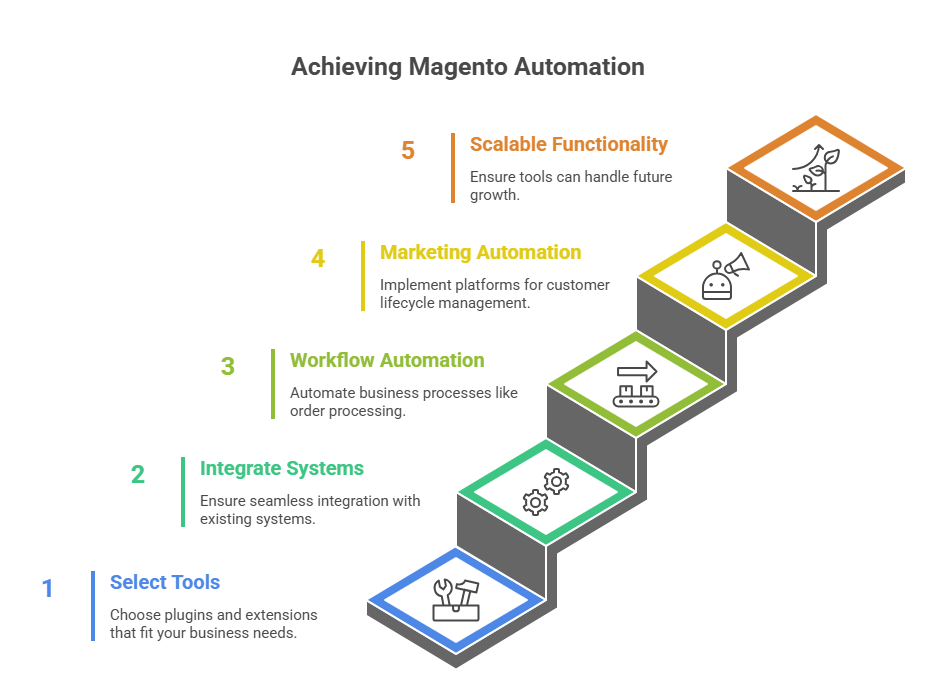
Successful Magento automation requires strategic selection of tools and extensions that integrate seamlessly with existing systems while providing scalable functionality for future growth.
For workflow automation, implement extensions like Magento Workflow or custom solutions built on Apache Airflow. These tools enable complex business process automation including order processing, inventory management, and customer service workflows.
Marketing automation integration requires platforms that understand eCommerce data structures and customer lifecycle stages. Mailchimp for Magento, Constant Contact, or HubSpot provide robust automation capabilities with native Magento integration for seamless data synchronization.
Reporting automation eliminates manual data compilation and analysis through automated dashboard generation and performance monitoring. Extensions like Advanced Reports or Google Analytics Enhanced Ecommerce integration provide automated insights that inform strategic decision-making.
API Strategy and Integration Best Practices
Effective Magento automation depends on robust API implementations that enable reliable data exchange between systems while maintaining security and performance standards.
REST API implementation provides the foundation for most automation workflows. Magento’s REST API enables external systems to interact with product catalogs, customer data, order information, and inventory levels programmatically. Establish API rate limiting and authentication protocols to prevent system overload while maintaining security.
Webhook automation creates real-time response systems that trigger actions immediately when specific events occur. Configure webhooks for order placement, inventory updates, customer registration, and payment processing to enable instant automation responses that improve customer experience and operational efficiency.
GraphQL implementation offers more efficient data retrieval for complex automation workflows, particularly when dealing with large product catalogs or customer databases. GraphQL’s query flexibility reduces API calls while providing precise data access for automation systems.
Performance Optimization Through Automation
Automation systems must maintain optimal performance standards to avoid creating new operational bottlenecks. Poorly implemented automation can actually increase operational drag through system slowdowns and reliability issues.
Implement caching strategies that optimize automated processes without interfering with real-time data requirements. Redis or Memcached integration ensures automation workflows access frequently used data efficiently while maintaining system responsiveness for customer-facing operations.
Database optimization becomes critical as automation increases data processing volume. Implement automated database maintenance routines, query optimization, and indexing strategies that maintain performance as automation complexity grows.
Monitoring and alerting systems ensure automation reliability through proactive issue detection and resolution. Tools like New Relic or DataDog provide automated monitoring that identifies performance bottlenecks and system failures before they impact customer experience.
Security Considerations for Automated Systems
Automation increases system complexity and potential security vulnerabilities. Implementing robust security protocols protects customer data and business operations while enabling powerful automation capabilities.
API security requires comprehensive authentication and authorization protocols that prevent unauthorized access while enabling legitimate automation workflows. Implement OAuth 2.0 or JWT tokens for secure API access with appropriate scope limitations for different automation systems.
Data encryption ensures sensitive customer information remains protected throughout automated workflows. Encrypt data in transit and at rest, particularly for payment processing and personal information handling within automation systems.
Regular security auditing identifies potential vulnerabilities in automated systems before they become exploitation opportunities. Implement automated security scanning and penetration testing for all automation integrations and custom implementations.
Measuring Automation ROI and Impact
Successful automation implementation requires clear metrics and measurement frameworks that demonstrate operational improvements and business impact.
Time savings measurement provides immediate ROI calculation by comparing manual process completion times with automated alternatives. Track specific tasks like product updates, campaign creation, and customer service responses to quantify efficiency gains.
Error rate reduction demonstrates quality improvements through automation implementation. Manual processes inevitably introduce human errors that automation eliminates, improving customer experience and reducing operational costs associated with error correction.
Revenue impact measurement connects automation improvements to business outcomes through conversion rate improvements, customer lifetime value increases, and operational cost reductions that directly impact profitability.
Future-Proofing Your Automation Strategy
Technology evolution requires automation strategies that adapt to changing market conditions, customer expectations, and technological capabilities.
Modular architecture design ensures automation systems can integrate new technologies and capabilities without requiring complete rebuilds. Design automation workflows with clear interfaces and standardized data formats that accommodate future enhancements.
Artificial intelligence integration represents the next evolution of eCommerce automation. Prepare systems for AI-powered decision-making, predictive analytics, and autonomous optimization capabilities that will define competitive advantage in coming years.
Scalability planning ensures automation systems can handle business growth without performance degradation. Design automation infrastructure with horizontal scaling capabilities that accommodate increased transaction volume and operational complexity.
The operational transformation that Magento automation enables goes beyond simple efficiency gains. It fundamentally changes how eCommerce businesses operate, compete, and serve customers. Organizations that embrace comprehensive automation strategies don’t just reduce operational drag—they create sustainable competitive advantages that compound over time.
The choice facing eCommerce leaders isn’t whether to implement automation, but how quickly they can transform manual operations into automated systems that enable strategic growth initiatives. In a market where operational efficiency determines survival, Magento automation provides the foundation for sustainable success.
The businesses that thrive in the next decade will be those that recognized automation as a strategic imperative rather than a tactical improvement. The question remaining is whether your organization will lead this transformation or struggle to catch up with competitors who embraced automation as a core competitive strategy.
Glossary of Terms
- API (Application Programming Interface): A set of protocols and tools that allows different software applications to communicate and exchange data automatically
- Operational Drag: The cumulative effect of manual processes, inefficiencies, and resource constraints that slow business growth and limit competitive advantage
- Webhook: Automated messages sent from apps when specific events occur, enabling real-time data transfer and instant automation triggers
- Dynamic Pricing: Automated pricing strategies that adjust product prices in real-time based on market conditions, competitor analysis, and demand patterns
- PIM (Product Information Management): Centralized systems that manage all product data and distribute information consistently across multiple sales channels
- GraphQL: A query language and runtime for APIs that enables more efficient data retrieval by allowing clients to request specific data fields
- Customer Journey Orchestration: Automated management of customer interactions and touchpoints across multiple channels to create cohesive brand experiences
- Behavioral Segmentation: Automatic categorization of customers based on actions, purchase patterns, and engagement levels rather than static demographic data
- Omnichannel Automation: Coordinated automation across multiple customer touchpoints including email, SMS, social media, and advertising platforms
- Predictive Analytics: Use of data, statistical algorithms, and machine learning to identify future outcomes based on historical patterns
Further Reading