
Why Average Order Value Optimization Beats Chasing New Traffic
Key Takeaways: Optimizing Average Order Value (AOV) consistently delivers faster, more measurable ROI than scaling paid traffic spend. Bundling, upsells, cross-sells, and...
Mike VillarKey Takeaways AI automation is fundamentally reshaping funnel optimization by enabling real-time personalization and intelligent decision-making across every customer touchpoint...
 Josh EvoraNovember 11, 2025

Key Takeaways
The digital marketing landscape has reached a pivotal moment. Traditional funnel optimization strategies that relied on manual processes, static segmentation, and reactive decision-making are being systematically dismantled by intelligent automation systems. After nearly two decades in this industry, I’ve witnessed countless technological shifts, but none as transformative as the current AI automation revolution reshaping how we approach funnel optimization.
The stakes have never been higher. Agencies that cling to manual processes are watching their margins evaporate while competitors leverage AI automation to deliver superior results at scale. The transformation isn’t coming; it’s here, and it’s fundamentally changing the rules of customer acquisition and retention.
Traditional funnels operated on assumptions and averages. We’d create buyer personas based on demographic data, design linear customer journeys, and hope our messaging resonated with enough prospects to drive conversions. This approach worked when competition was limited and customer expectations were lower, but today’s reality demands something entirely different.
Modern AI automation is reshaping funnel optimization by introducing dynamic, responsive systems that adapt in real-time to individual user behavior. Instead of pushing prospects through predetermined stages, we’re creating intelligent pathways that respond to micro-signals, behavioral patterns, and predictive indicators that would be impossible for human marketers to process manually.
The transformation goes beyond simple task automation. We’re talking about intelligent decision-making systems that can analyze thousands of data points simultaneously, predict customer intent, and automatically adjust messaging, timing, and channel selection to maximize conversion probability. This isn’t just optimization; it’s funnel evolution.
Platforms like Make.com have fundamentally changed the automation game by putting enterprise-level workflow capabilities into the hands of marketers without requiring extensive development resources. The implications for agencies are staggering.
Consider the traditional challenge of connecting disparate marketing tools. Previously, agencies needed dedicated developers to create custom integrations between CRM systems, email platforms, advertising accounts, and analytics tools. Now, sophisticated automation workflows can be built visually using drag-and-drop interfaces that connect virtually any marketing technology stack.
Here’s a practical example of what’s possible: An agency can create a Make.com scenario that automatically monitors Google Ads performance, identifies underperforming keywords, pauses low-performing ads, reallocates budget to high-converting campaigns, updates the CRM with performance data, and triggers personalized email sequences to prospects who engaged with specific ad creative, all without human intervention.
The automation possibilities extend far beyond simple data transfers. Advanced scenarios can incorporate AI-powered decision trees, dynamic content generation, behavioral triggers, and predictive analytics to create truly intelligent marketing systems.
One of the most immediate applications of AI automation in agency workflows is automated brief generation. Traditional brief creation is time-intensive, often inconsistent, and heavily dependent on individual expertise. AI automation is reshaping this process by creating dynamic, data-driven briefs that incorporate real-time market intelligence, competitive analysis, and performance insights.
Using GPT-powered systems integrated with automation platforms, agencies can create workflows that automatically generate comprehensive campaign briefs based on client objectives, historical performance data, industry benchmarks, and current market conditions. The system can analyze competitor campaigns, identify trending creative elements, and suggest messaging frameworks tailored to specific audience segments.
A practical implementation might look like this:
This approach doesn’t just save time; it ensures consistency, incorporates data insights that might be overlooked manually, and creates a scalable framework for handling multiple client campaigns simultaneously.
Traditional lead scoring models relied on basic demographic information and simple behavioral triggers. AI automation is reshaping lead scoring by incorporating sophisticated predictive analytics that consider hundreds of variables simultaneously, creating dynamic scores that update in real-time based on ongoing interactions.
Modern automated lead scoring systems analyze website behavior, email engagement, social media interactions, content consumption patterns, and external data sources to create comprehensive prospect profiles. The system can identify subtle behavioral patterns that indicate purchase intent, such as specific page sequences, time-on-site variations, or content engagement combinations that correlate with eventual conversions.
Here’s how agencies can implement intelligent lead scoring automation:
The results speak for themselves. Agencies implementing sophisticated lead scoring automation typically see 30-50% improvements in conversion rates simply through better qualification and more targeted nurturing efforts.
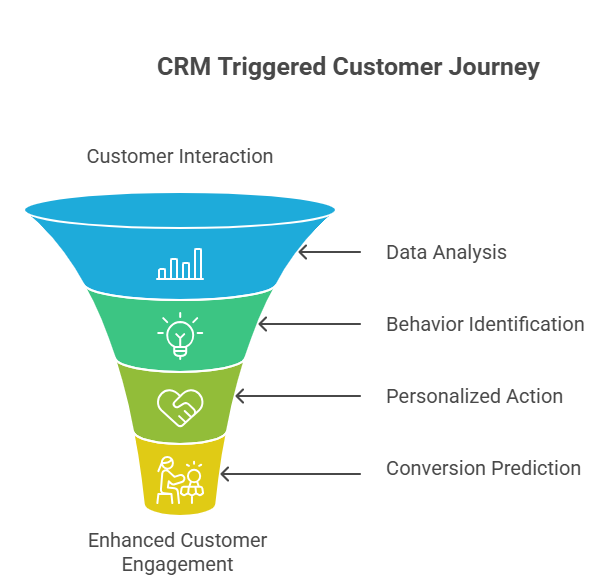
CRM automation has evolved far beyond simple email sequences. Modern AI-powered CRM triggers create dynamic, multi-channel customer journeys that adapt based on individual behavior, preferences, and engagement patterns. This level of personalization was previously impossible to achieve at scale.
Intelligent CRM triggers can monitor dozens of customer touchpoints simultaneously and respond with personalized actions that feel natural and timely. When a prospect downloads a specific resource, the system doesn’t just add them to a generic email sequence. Instead, it analyzes their company size, industry, previous interactions, and behavioral patterns to determine the optimal follow-up strategy.
For example, an automated CRM trigger system might identify that enterprise prospects who download case studies on Tuesday afternoons and spend more than three minutes reading them are 4x more likely to convert when contacted by phone within 24 hours. The system automatically flags these prospects for immediate sales follow-up while continuing to nurture other segments through appropriate channels.
Advanced CRM automation can also predict customer lifecycle events, such as contract renewals, upselling opportunities, or churn risks, and automatically initiate appropriate retention or expansion campaigns before issues arise.
The most transformative aspect of AI automation in funnel optimization is the ability to orchestrate complete customer journeys across multiple channels, platforms, and touchpoints. Traditional campaign management required constant manual monitoring, adjustment, and optimization. AI automation creates self-managing campaigns that continuously optimize performance while maintaining strategic alignment.
Full-funnel automation systems can simultaneously manage awareness campaigns on social media, retargeting efforts across display networks, email nurturing sequences, sales outreach coordination, and post-conversion retention campaigns. The system continuously analyzes performance data to reallocate budgets, adjust messaging, and optimize timing across all channels.
| Traditional Approach | AI Automated Approach |
|---|---|
| Manual campaign monitoring | Real-time performance optimization |
| Static audience segmentation | Dynamic behavioral clustering |
| Predetermined messaging schedules | Optimal timing algorithms |
| Channel-specific optimization | Cross-channel performance balancing |
| Periodic reporting and adjustments | Continuous learning and adaptation |
Consider a comprehensive automation system that manages the entire customer acquisition process: It identifies high-intent prospects through behavioral analysis, serves them personalized content across multiple channels, automatically adjusts messaging based on engagement patterns, coordinates sales outreach at optimal moments, and continues post-conversion nurturing to drive retention and expansion.
AI agents represent the cutting edge of marketing automation, creating autonomous systems that can make complex decisions, learn from outcomes, and continuously improve performance without human intervention. Unlike traditional automation that follows predetermined rules, AI agents can adapt their behavior based on changing conditions and emerging patterns.
Marketing AI agents can be designed to handle specific functions within the funnel optimization process. A content personalization agent might analyze individual visitor behavior, company characteristics, and engagement history to dynamically generate personalized website experiences, email content, and ad creative for each prospect.
Another practical application is competitive intelligence agents that continuously monitor competitor activities, pricing changes, campaign launches, and market positioning shifts, automatically adjusting campaign strategies to maintain competitive advantage.
The development of no-code AI agent platforms means agencies can create these sophisticated systems without extensive technical resources. Agents can be trained on specific industry data, client objectives, and performance criteria to create highly specialized automation systems tailored to individual business needs.
Effective AI automation in funnel optimization depends entirely on comprehensive data integration. The most sophisticated automation systems are useless if they’re operating on incomplete or siloed information. Modern agencies must prioritize creating unified data ecosystems that provide AI systems with complete visibility into customer behavior across all touchpoints.
This integration challenge goes beyond technical connectivity. It requires strategic thinking about data architecture, privacy compliance, and analytical frameworks that support intelligent decision-making. Agencies that succeed in creating comprehensive data integration typically see automation performance improvements of 200-300% compared to those operating with fragmented data sources.
The integration process involves connecting first-party data from websites and CRM systems with third-party data sources, advertising platforms, social media channels, and external market intelligence tools. Advanced integration strategies also incorporate predictive data sources and behavioral analytics platforms that provide forward-looking insights rather than just historical reporting.
AI automation enables real-time personalization that responds to individual behavior patterns rather than broad demographic segments. This capability is reshaping funnel optimization by creating unique customer experiences that adapt dynamically based on interaction history, engagement patterns, and predictive indicators.
Real-time personalization systems can analyze hundreds of variables simultaneously to determine the optimal content, messaging, timing, and channel for each individual interaction. This goes far beyond simple dynamic content insertion; it’s about creating fundamentally different customer experiences based on intelligent interpretation of behavioral signals.
For agencies, this means the ability to create highly personalized campaigns at scale without proportional increases in manual effort. A single campaign framework can automatically generate thousands of variations tailored to individual prospect characteristics and behaviors.
The integration of predictive analytics into automated funnel optimization allows agencies to anticipate customer needs and proactively adjust strategies before performance issues arise. Rather than reacting to declining metrics, predictive systems identify early warning signs and automatically implement corrective measures.
Predictive automation can forecast seasonal demand fluctuations, identify emerging market opportunities, predict customer lifetime value, and anticipate churn risks with remarkable accuracy. These insights enable automated systems to make strategic adjustments that human marketers might not recognize until much later.
Advanced predictive systems also enable scenario planning automation, where AI agents test different strategic approaches in controlled environments to identify optimal tactics before full implementation.
Successfully implementing AI automation in funnel optimization requires a strategic approach that balances ambition with practical execution capabilities. Agencies should begin with high-impact, low-complexity automation projects that deliver immediate value while building the foundation for more sophisticated systems.
The implementation process should prioritize:
Successful agencies typically start with simple automation workflows, such as lead scoring and email sequencing, before progressing to more complex systems like predictive campaign optimization and AI agent deployment.
Agencies that embrace AI automation early in the adoption curve gain significant competitive advantages that compound over time. Automated systems continuously learn and improve, meaning early adopters build increasingly sophisticated capabilities while competitors remain dependent on manual processes.
The data advantage is particularly significant. Agencies with mature automation systems collect more comprehensive behavioral data, develop more accurate predictive models, and create more effective personalization algorithms. This creates a virtuous cycle where automation performance continuously improves while manual competitors fall further behind.
Market dynamics are already shifting to reward agencies that can deliver superior results with greater efficiency. Clients increasingly expect real-time optimization, predictive insights, and personalized experiences that are simply impossible to deliver manually at scale.
The trajectory of AI automation in funnel optimization points toward increasingly autonomous marketing systems that require minimal human intervention for routine optimization tasks. This doesn’t eliminate the need for human expertise; it elevates the role of marketers to focus on strategy, creativity, and complex problem-solving while AI handles execution and optimization.
The agencies that thrive in this environment will be those that successfully integrate human creativity with AI efficiency, creating hybrid systems that leverage the strengths of both. The future belongs to marketers who can design intelligent automation systems, interpret AI-generated insights, and continuously refine algorithmic performance.
This transformation represents the most significant shift in marketing operations since the advent of digital advertising. Agencies that recognize the magnitude of this change and invest accordingly will define the future of customer acquisition and retention.
AI automation isn’t just reshaping funnel optimization; it’s redefining what’s possible in customer relationship management, campaign performance, and business growth. The question isn’t whether automation will transform your agency operations, but whether you’ll lead the transformation or be left behind by it.
Glossary of Terms
Further Reading
Key Takeaways: Optimizing Average Order Value (AOV) consistently delivers faster, more measurable ROI than scaling paid traffic spend. Bundling, upsells, cross-sells, and...
Mike VillarKey Takeaways: Statistical significance is widely misunderstood and misreported in marketing tests, leading to decisions based on faulty data. Peeking at test results before...
Alvar SantosKey Takeaways: Looker Studio is the best budget-friendly option for marketing teams already embedded in the Google ecosystem, offering free access and solid connector support. Domo...
Amanda Bianca CoStart your brand's success journey today with a conversation. Share your goals and objectives with us and let's set up a discovery call.