Does AI content hurt your SEO? What Google really says
The short answer No. Google does not penalize AI content just because a model wrote it. It demotes low-quality, unoriginal pages made to manipulate rankings, however they were...
No. Google does not penalize AI content just because a model wrote it. It demotes low-quality, unoriginal pages made to manipulate rankings, however they were produced.
The risk is in how you use the tool. Publishing unedited drafts by the hundred can hurt you. Using AI writing as a drafting aid, with a person checking facts, adding experience and owning the result, carries no ranking penalty that Google has described.
A second risk has little to do with penalties. AI Overviews are cutting clicks even to pages that rank first, so your SEO work now has to extend to GEO and AEO, meaning getting cited inside AI-generated answers. This article covers what Google has said, what the data shows, where the real dangers sit and how to build a workflow that holds up.
What counts as AI content?
“AI content” covers a wide range, and the range matters because Google’s rules do not treat all of it the same way. It helps to place your own process on this spectrum:
Fully generated: a prompt goes in, a page comes out, and it is published with little or no review.
AI-assisted: a person writes or directs the piece, and AI helps with outlines, research summaries, first drafts or edits.
Human-written with light AI help: grammar fixes, headline options or reformatting.
Most arguments about whether AI content “works” fall apart because people compare the first category with the third. The data below shows that the mix matters.
Google’s official stance on AI-generated content
Google Search Central’s guidance: quality over production method
Google laid out its position in a February 2023 Search Central post titled “Google Search’s guidance about AI-generated content.”
The core idea is that Google rewards high-quality content however it is produced. Automation is not against the guidelines in itself. Using it mainly to manipulate search rankings is, because that violates Google’s spam policies.
Coverage at the time read it the same way. Get a Copywriter noted that Google took no stance on AI-generated content and focused on the quality of what any tool produced. Typeface’s summary of the position is blunt: Google does not penalize your content solely based on how it was created.
So the test Google applies is about the page, not the process. A useful, accurate, original page passes whether a person typed it or a model drafted it. A thin, repetitive page fails either way.
Helpful content, E-E-A-T, and the shift away from “written by people”
Google’s helpful content guidance asks you to think about quality through the questions Who, How and Why. Who created this and why should a reader trust them? How was it made? Why does it exist: to help readers or to attract search traffic?
In 2023 Google also dropped the phrase “written by people” from its helpful content wording and replaced it with a focus on content created for people. Commentators, including Todhost in December 2023, read that and the updated guidelines as a greater acceptance of AI-generated content. The wording shows the intent: Google cares about whether the content helps, not who or what typed it.
E-E-A-T still matters here. It stands for Experience, Expertise, Authoritativeness and Trustworthiness, and it is the framework Google’s quality raters use to judge whether a page deserves trust. A model has no first-hand experience, so the “E” for experience is the part you have to supply yourself.
Scaled content abuse and the March 2024 core update
The clearest enforcement signal came with Google’s March 2024 core update, which also added a spam policy against “scaled content abuse.” That policy targets the mass production of low-quality content, with the aim of ranking rather than helping people. IT Helps Digital’s breakdown of the update stresses the key point: the policy applies regardless of how the content is made.
That means a site could trigger it with a team of underpaid freelancers or with a script calling an AI model. AI makes scale cheap, which makes it easier to cross that line. The policy itself is not specific to AI.
What the data says about AI content and rankings
How much top-ranking content is AI-written?
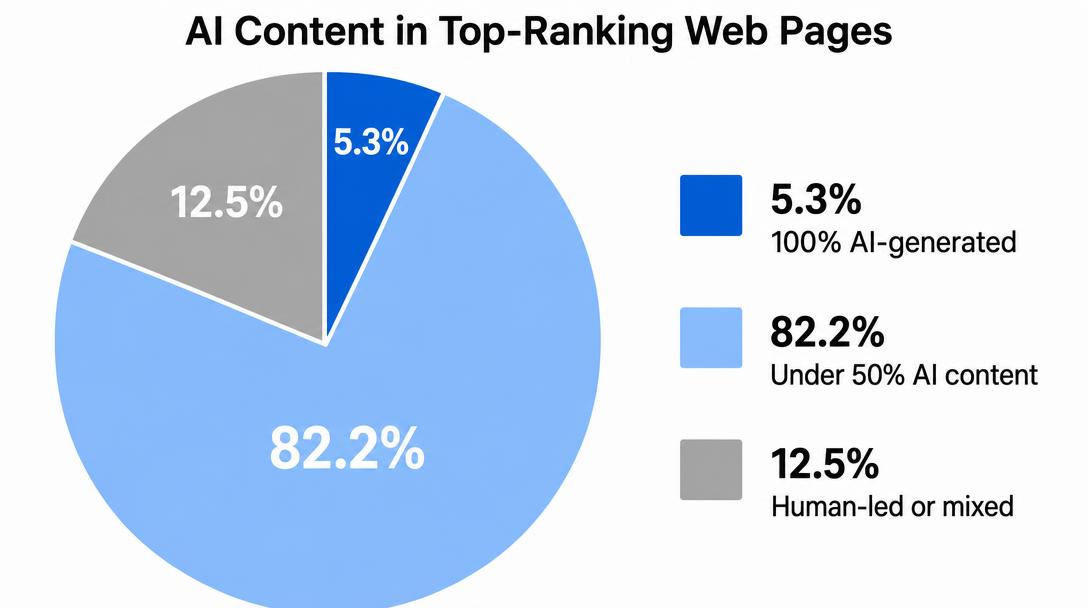
The best-known dataset comes from Ahrefs, in a study titled “Google Doesn’t Punish AI Content.” Looking at top-ranking pages, it found that 5.3% of pages in positions 1 to 3 were 100% AI-generated. It also found that pages with under 50% AI content accounted for 82.2% of top-3 rankings.
Read those two numbers together. Fully AI-written pages can reach the top, which rules out any blanket penalty. But the pages that dominate the top spots are overwhelmingly human-led or mixed, and the fully automated ones are rare.
The data does not prove that AI use helps rankings, and it does not prove that human involvement is the cause of the better results. What it shows is that the winning pattern in search results is a person steering the work, with AI assisting.
Why some sites using AI writing lose rankings anyway
Sites that adopt AI writing sometimes lose rankings, and it is tempting to blame detection. The more likely explanation is quality and scale. A site that publishes hundreds of near-identical, generic pages gives Google little reason to rank any of them, and it may land squarely inside the scaled content abuse policy.
The pattern is easy to spot after the fact. Pages restate what already ranks, add nothing original, and cover topics the site has no real authority on. Ranking drops follow, and “Google hates AI” becomes the convenient story. The fix is better pages.
The real SEO risks of publishing AI content
Thin, unoriginal content published at scale
Language models are trained to produce the most probable answer, which tends to be the average of what already exists. If you ask for an article on a topic, you often get a competent summary of the top ten results. That adds nothing for a reader who has already seen those results.
Search engines have little reason to rank a page that is a rewrite of pages they already index. The value you can add is the part a model can’t pull from its training data: your numbers, your customers, your process and your opinion.
Factual errors and missing first-hand expertise
Models state wrong things with the same confidence as right ones. Intuico Digital’s commentary on recent guidance says Google now expects AI content to be fact-checked by a person before publishing. Whether or not you treat that as an official rule, the practical advice is sound. A wrong statistic or invented quote damages trust with readers, and trust is what E-E-A-T measures.
Experience is the other gap. A page about choosing a CRM written by someone who has run a CRM migration reads differently from one assembled from other pages. Readers notice, and so do quality raters.
Site-wide quality signals and publishing velocity
Google has described its helpful content signals as something that can apply across a whole site, not only to single pages. A pile of weak AI pages can therefore drag down good ones living alongside them. That is why cleaning up or removing low-value pages can help stronger pages recover.
Google has not published a safe number of posts per week, and you should be suspicious of anyone who claims to know one. A better rule is to let your review capacity set your pace. If you can’t give each page real editing, you are publishing too fast.
Beyond SEO: why GEO and AEO now matter as much as rankings
AI Overviews are cutting clicks to top-ranking pages
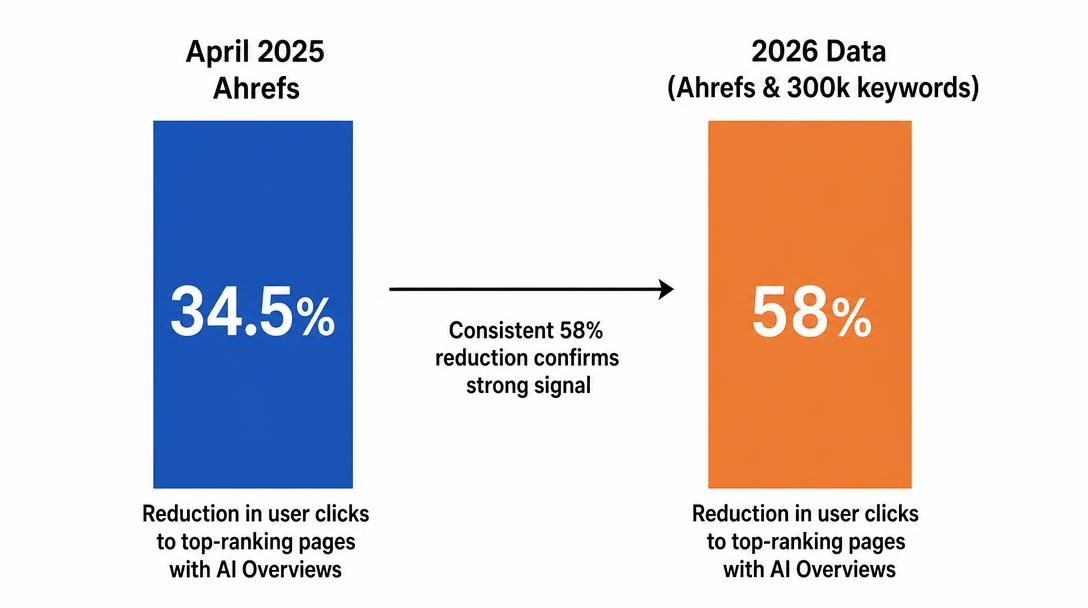
Even if your AI-assisted content ranks, fewer people may click through. In April 2025, Ahrefs measured AI Overviews reducing clicks to top-ranking content by 34.5%. In a February 2026 update, it revised that figure to 58%.
A separate analysis of 300,000 keywords, reported in May 2026, reached the same number: a 58% lower average click-through rate for top-ranking pages when an AI Overview appears. Two different datasets landing on the same figure is a strong signal that the shift is real.
This changes the question you should be asking. “Will Google penalize my content?” matters less than “Will anyone visit, or will the answer appear above my link?” Ranking is still necessary, but it no longer guarantees traffic.
What generative engine optimization (GEO) and answer engine optimization (AEO) mean
Generative engine optimization (GEO) is the practice of structuring content so AI systems such as ChatGPT, Gemini, Perplexity and Google’s AI Overviews surface, cite or reference it in their responses. Answer engine optimization (AEO) is a close relative. It focuses on being the direct answer to a question, whether that answer appears in a featured snippet, a voice response or an AI summary.
The two overlap heavily in practice, and both sit on top of ordinary SEO rather than replacing it. Many of these systems retrieve live web content before writing an answer, so pages that rank and are easy to extract from have the advantage.
One caution. Research on exactly which techniques increase citations is still young, and anyone promising a guaranteed method is overselling. Treat the tactics below as sensible structure, not proven levers.
Structuring content so AI answer engines can cite it
The habits that help AI systems cite a page are mostly habits that help human readers too:
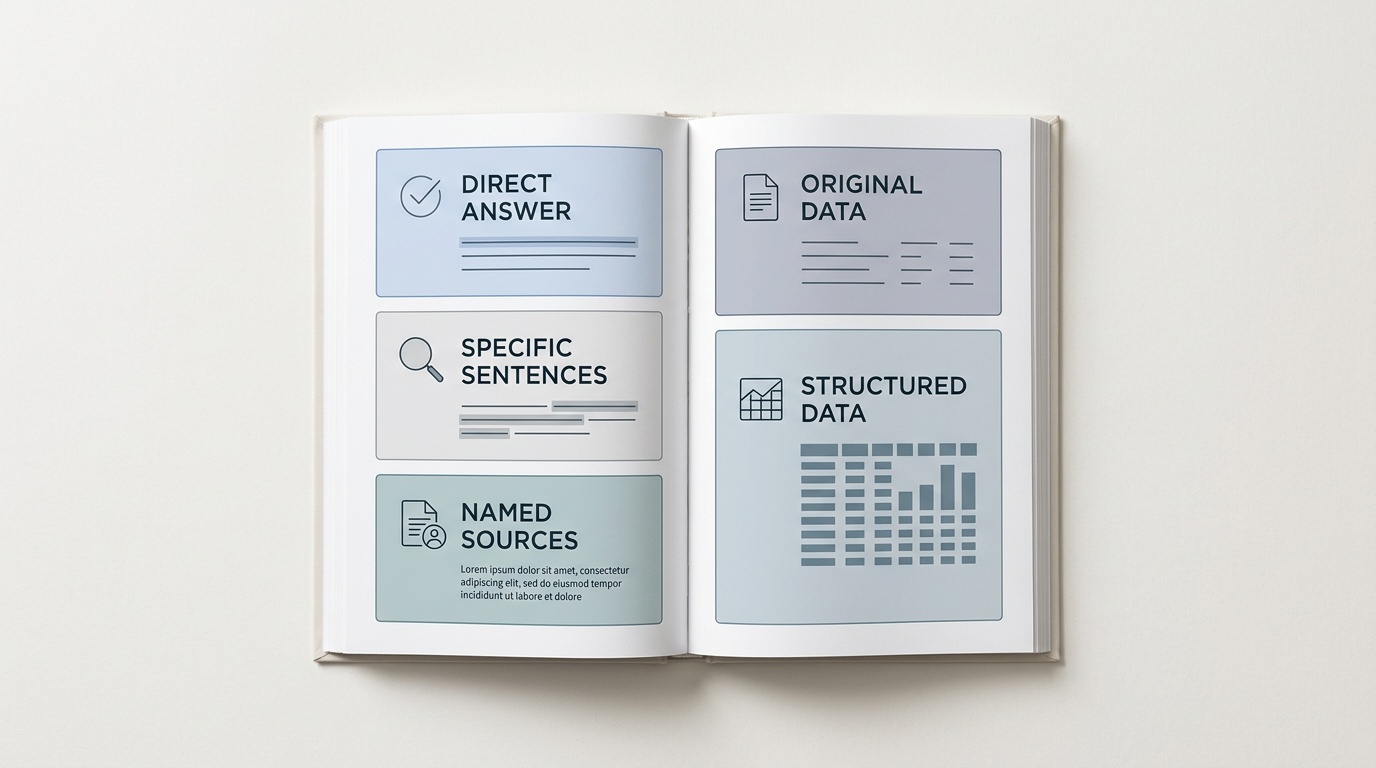
Put the direct answer at the start of each section, then expand on it.
Write specific, checkable sentences with named sources instead of vague claims.
Name the thing you are describing early, so a model can tell what the passage is about.
Include original data or first-hand examples that exist nowhere else.
Add structured data (code that labels your content for search engines), such as FAQ schema, where it fits the content.
Build clusters of related, interlinked articles so your coverage of a topic looks deep rather than one-off.
Notice that unedited AI writing is weakest on exactly these points. It tends toward vague phrasing, unsourced claims and generic examples, which makes it less citable. Human editing is what turns a draft into something an answer engine can quote with confidence.
How to use AI writing tools without hurting your SEO
Keep human review and fact-checking in the workflow
Treat every AI draft as a draft. A named person should read it start to finish, verify every statistic, name and date against the original source, and cut anything that can’t be confirmed. Delete invented quotes and fake-sounding case studies on sight.
Assign an owner to each page. The “Who” in Google’s Who, How and Why test is easier to answer when a real author with relevant experience stands behind the piece and the byline is not decorative.
Add original data, examples, and experience AI can’t replicate
This is the step that separates pages that rank from pages that get filtered out. Before publishing, ask what this page contains that a reader couldn’t get from the top five results. If the answer is nothing, add something:
Your own numbers, such as results from campaigns, surveys or internal tests.
A worked example from a real client or project, with details only you would know.
A clear opinion, including where you disagree with common advice.
Screenshots, quotes from your team or customers, and process notes.
Original material also helps with GEO and AEO. When your page holds the only copy of a fact, an AI system that wants to cite it has to cite you.
Match search intent and answer questions directly
Start with the query, not the tool. Check what the top results actually do for the search: do they define, compare, list steps or sell? Then build the page to satisfy that intent and give the answer in the opening lines.
Use AI where it saves time without lowering quality: outlining, summarizing your own research, suggesting headings, tightening drafts and spotting gaps. Keep it away from the parts that carry trust, which are claims, experience and judgment.
Our experience with AI content and human review
At Growth Rocket, we use AI writing for the early and mechanical parts of production, and people own everything that carries trust. A model helps with outlines, research summaries and tightening drafts. A named editor then checks every claim against its source, adds our own data and examples, and decides what gets published.
Each page goes through the same steps:
Check the search intent and write a brief before any drafting starts.
Produce a first draft with AI, working from the brief and our own research.
Have an editor verify every statistic, name and date, and cut anything that can’t be confirmed.
Add original material, such as client results, screenshots and a clear point of view.
Assign an author who stands behind the page.
Here is what that workflow has produced so far:
Publishing speed: 6x higher throughput from a smaller content team
Search visibility: 60% more keywords getting indexed and ranked by Google
Traffic and citations: AI Overview citations and mentions breach 1,000+ in the first 4 months
Pages that didn’t work: poorly-researched AI slop with little human editorial movement
The pattern is consistent. Drafts get faster with AI, but the pages that perform are the ones where a person added something the model couldn’t supply.
Hidden watermarks in AI content: what we know and don’t know
Some AI providers are building invisible signatures into the text their models write. A reader can’t see them, but software that knows what to look for can. Google DeepMind describes one example, SynthID, which adjusts word choices in generated text to leave a statistical pattern a detector can later pick up.
The bigger open question is what search engines will do with these signals. Google’s public guidance on AI content doesn’t say it uses watermarks to rank, demote or penalize pages. Nobody in the industry knows if, or when, it will enforce its content guidelines this way.
Plan for both outcomes. A watermark can’t tell Google whether your page is useful, and Google’s stated test is still the quality and originality of the content. Pages with real editing, original data and a named author hold up whether or not detection ever becomes part of enforcement.
GEO priorities for small teams: what to do first (and what to skip) If you run marketing with one to three people, your GEO priorities for small teams come down to this: make sure...
Key Takeaways: Optimizing Average Order Value (AOV) consistently delivers faster, more measurable ROI than scaling paid traffic spend. Bundling, upsells, cross-sells, and...
Key Takeaways: Statistical significance is widely misunderstood and misreported in marketing tests, leading to decisions based on faulty data. Peeking at test results before...