
Why Average Order Value Optimization Beats Chasing New Traffic
Key Takeaways: Optimizing Average Order Value (AOV) consistently delivers faster, more measurable ROI than scaling paid traffic spend. Bundling, upsells, cross-sells, and...
Mike VillarGEO priorities for small teams: what to do first (and what to skip) If you run marketing with one to three people, your GEO priorities for small teams come down to this: make sure...
 Mike VillarOctober 26, 2026

If you run marketing with one to three people, your GEO priorities for small teams come down to this: make sure AI crawlers can read your pages, add sourced facts and direct answers to the pages closest to revenue, and test your visibility in a few AI engines. Then, in days 31 to 90, add structured data, buyer-stage pages and third-party mentions. Skip big content hubs and expensive tools until you have a baseline.
This article ranks ten GEO tasks by effort, cost and likely lead impact. It ends with a 90-day plan, a skip list, and a look at where outside help saves the most time.
Generative engine optimization (GEO) is the work of making your content easy for AI engines like ChatGPT, Perplexity and Google AI Overviews to find, cite and describe correctly. The question for a small team is not whether it matters. It is how many of your limited hours it deserves.
The evidence points to a small, targeted slice. Ahrefs found that AI search visitors converted at 23 times the rate of its organic search visitors, with just 0.5% of its traffic producing 12.1% of signups. That is one company’s data, but it shows the leads can be good.
The volume is still small. Ahrefs also reports that AI traffic averages about 0.25% of a site’s total traffic, even after growing 9.7 times in a year. Small volume, strong intent, fast growth: that profile earns GEO a ranked list of tasks on your roadmap. It does not earn a second full-time job.
Most guides on where to start with GEO hand you a 25-point audit or a definition. Neither helps when you have about ten hours a week to spare. You need an order of operations, and you need permission to ignore most of the list.
Each task gets three scores, using low, medium or high.
Effort is the hours your team spends, including review and approvals.
Cost is cash spent beyond salaries, such as tools, freelancers or listing fees.
Lead impact is how likely the task is to bring in qualified leads, based on how close it sits to buying decisions and what the research shows.
These scores are our editorial judgment from working with lean teams, not measured benchmarks. Your site, sales cycle and competitors will shift them. The ranking logic is what matters: do low-effort, low-cost work with medium or high impact first, schedule high-effort work that has high impact, and skip anything that is expensive with unproven returns.
Here is how the ten tasks score:
Crawler access check: low effort, low cost, high impact. Nothing else works if engines can’t read your pages.
Baseline prompt test: low effort, low cost, medium impact. It points every later decision.
Citations, statistics and expert quotes on key pages: low to medium effort, low cost, high impact.
Answer-first restructuring of key pages: medium effort, low cost, high impact.
Structured data on top pages: medium effort, low to medium cost, medium to high impact.
Comparison, pricing and FAQ pages: high effort, low cost, high impact.
Third-party mentions, reviews and directory listings: high effort, medium cost, high impact.
Brand fact sheet and entity consistency: low to medium effort, low cost, medium impact.
A large new content hub: high effort, medium to high cost, uncertain impact.
An AI visibility platform subscription: medium effort, high cost, low direct impact.
Tasks one through four are your first 30 days. Tasks five through eight take most of days 31 to 90. Tasks nine and ten go on the skip list.
These four tasks cost little and sit upstream of everything else. Plan on roughly one to two weeks of part-time work for all four, depending on how many pages you start with.
Start here, because a blocked page can’t be cited. Open your robots.txt file and check whether it disallows AI crawlers such as GPTBot or PerplexityBot. Then ask your developer or host whether firewall or CDN bot rules are blocking them too.
Next, check how your top pages load. If the main content only appears after JavaScript runs, or sits behind a login, a pop-up or a form, some crawlers will see an empty page. View the page source and confirm your headline, key claims and pricing text are in the HTML.
Blocking AI crawlers can be a deliberate business decision, so make it on purpose. For most B2B teams that want leads from AI answers, the default should be open. This check takes an hour or two and has the best ratio of effort to impact on the list.
The best-known study here is the Princeton paper by Aggarwal and colleagues, which found GEO methods can boost visibility in generative engine responses by up to 40% across diverse queries. Coverage of the study points to adding citations, statistics and quotations as among the best-performing tactics. They are also among the cheapest.
Pick your five to ten most important pages. For each major claim, add a specific fact from a named source and link to the original study or dataset, not to a blog that summarized it. Add a quote from someone on your team who has real expertise, with their name and role.
Never invent a number to fill the gap. If you can’t source a claim, rewrite it as a plain statement or cut it. AI engines and readers both punish vague claims.
AI engines pull passages, not whole pages. A passage that opens with a clear answer is easier to lift and quote than one that builds slowly toward a point.
For each key page, rewrite headings as the questions buyers ask, and put the answer in the first one or two sentences under each. Keep paragraphs short, define jargon on first use, and add a two-sentence summary near the top. You don’t have to rewrite everything. Edit the opening of each section and leave the rest alone.
Choose pages by revenue proximity. ToTheWeb advises starting with the pages that matter most to buyers: product, service, comparison and FAQ pages. A blog post that gets traffic but never leads to a sale can wait.
Write down 15 to 20 questions your buyers ask before they purchase. Pull them from sales calls, support tickets and the questions prospects ask in your inbox. Include a few comparison questions, like “best [your category] for [your customer type].”
Run each question through ChatGPT, Perplexity and Google AI Overviews. In a spreadsheet, record whether your brand appears, which sources get cited, whether the facts about you are right, and which competitors show up. This takes an afternoon and costs nothing.
The baseline tells you which of the later tasks matter for you. If you’re never mentioned but a review site is cited every time, third-party listings jump up your list. If you appear but with wrong details, entity consistency comes first. Repeat the test each quarter.
These tasks take real hours, so schedule them one at a time. Start each only after the quick wins are live on your top pages.
Structured data, also called schema markup, is code that labels what a page contains so machines don’t have to guess. The usual format is JSON-LD, a block of code added to the page. Start with Organization schema on your homepage, FAQPage schema on pages with real question-and-answer content, and Product or Service schema on your core offer pages.
Include the sameAs property in your Organization markup. It links your company to your official profiles elsewhere, which helps engines confirm they’re talking about the right business. Many content management systems have plugins that handle the basics, but check the output with a validator.
Schema labels content. It doesn’t replace it. If the page is thin or vague, markup won’t change the result, which is why it comes after restructuring.
Buyers ask AI engines questions like “X vs Y” and “how much does X cost.” If you don’t have a page that answers them honestly, someone else’s page will, and it may be a competitor’s or a reseller’s.
Build one page at a time, about every two weeks. Use these as a starting order:
An FAQ page built from real sales-call questions, with plain, specific answers.
A comparison page for your most common alternative, with fair criteria and a clear note on who each option suits.
A pricing explanation page, even if all you can share is what drives price and typical starting points you’re able to state truthfully.
This is the most labor-intensive item on the quick-win and scheduled lists. It’s also the one closest to purchase intent, so it earns the hours.
AI engines don’t rely on your site alone. They also draw on review sites, directories, industry publications and community discussions, so what others say about you shapes what engines say about you. If you want more on closing that gap, our guide on optimizing brand mentions for AI search citations covers the method in depth.
For a small team, begin with what you control. Publish a short brand fact sheet with your canonical company description, location, offerings and leadership, then make your directory profiles and social bios match it word for word. Conflicting details across the web are a common reason AI engines get facts about a brand wrong.
After that, claim the profiles on review platforms your buyers use, and ask three to five happy customers for honest reviews. Add one or two pitches a month to publications or podcasts your buyers follow. A big earned-media push can wait, but steady small steps compound.
The research is full of tactics that make sense for companies with a dedicated GEO owner and a budget line. For a team of one to three, these cost more than they return in the first 90 days.
A large new content hub. Dozens of new articles eat your hours and spread your best facts thin. Improve the ten pages you already have first.
An AI visibility platform. These tools are good at reporting where you appear. Your spreadsheet baseline does that job for free until you know what you’d do with daily data.
Optimizing for each engine separately. The same fundamentals work across engines: readable pages, direct answers, sourced facts and consistent mentions elsewhere. Engine-specific tweaks come later.
A big PR or analyst-relations campaign. Earned media matters, but it takes sustained time and money. Do the small version in the section above.
Rewriting the whole site. Most pages don’t drive leads. Leave them until your top pages are done.
Daily or weekly prompt tracking. AI answers change often, so single data points are noisy. A quarterly check shows you the trend without eating your week.
Skipping isn’t forever. Revisit this list after your second baseline test, when you know which gaps are real.
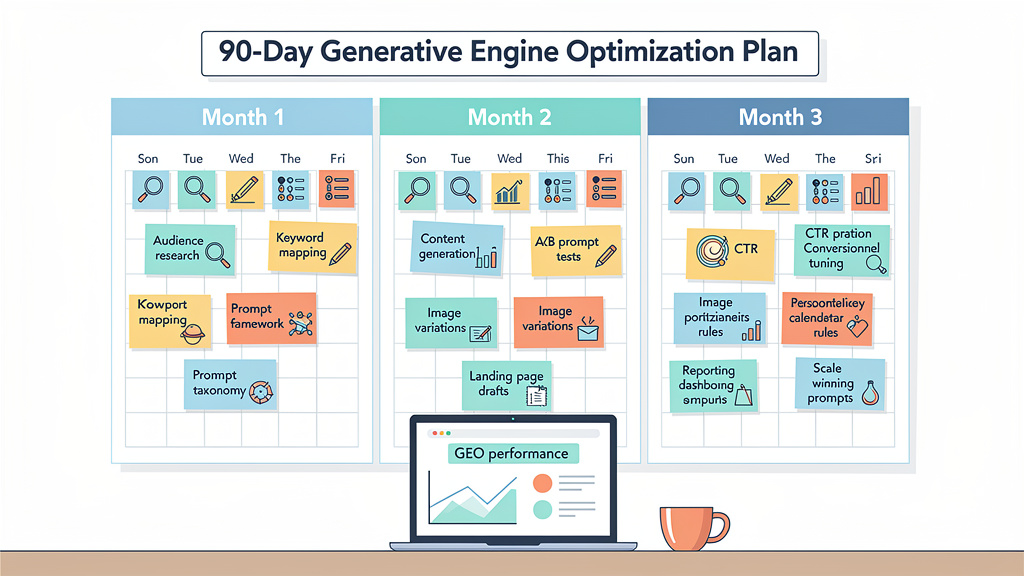
Use this generative engine optimization checklist as your working plan. Each step maps to the sections above.
Week 1: Check robots.txt, firewall rules and page rendering for AI crawler access. Fix blocks you didn’t intend.
Week 1 to 2: Write your 15 to 20 buyer questions and run them through ChatGPT, Perplexity and Google AI Overviews. Record the baseline.
Week 2 to 4: Add sourced statistics, links to primary sources and named expert quotes to your top five to ten pages.
Week 2 to 4: Rewrite section openings on those pages as direct answers under question-style headings.
Week 5 to 6: Publish a brand fact sheet and align your directory profiles and bios with it.
Week 5 to 8: Add Organization, FAQPage and Product or Service schema to your highest-value pages, and validate it.
Week 7 to 12: Publish an FAQ page, a comparison page and a pricing explanation, one at a time.
Week 9 to 12: Claim review profiles, request customer reviews, and send your first one or two publication pitches.
Week 12: Re-run your baseline questions and compare. Decide what moves up the list next.
The hard part of GEO isn’t finding out what’s wrong. Gradial makes this point about tools: they have become good at surfacing data, but someone still has to do the implementation work. For a team of one to three, implementation is exactly where the hours run out.
Looking across the matrix, outside help saves the most time in four places:
Schema across page templates, where one correct setup covers many pages and mistakes are easy to make.
Sourcing and restructuring at volume, which means finding primary sources, checking claims and rewriting openings across many pages.
Third-party outreach, because pitching, relationship-building and follow-up are slow and hard to fit around other work.
Quarterly citation audits, which are repetitive and need consistent method to show real change.
Keep these in-house: the list of questions your buyers ask, the expert quotes, and final approval on claims. Nobody outside knows your customers as well as you do, and that knowledge is what makes the content worth citing.
If you want this matrix applied to your own site, book a strategy call with Growth Rocket. We’ll look at your baseline, score the tasks against your team’s real capacity, and tell you which two or three to start on and which to hand off.
Key Takeaways: Optimizing Average Order Value (AOV) consistently delivers faster, more measurable ROI than scaling paid traffic spend. Bundling, upsells, cross-sells, and...
Mike VillarKey Takeaways: Statistical significance is widely misunderstood and misreported in marketing tests, leading to decisions based on faulty data. Peeking at test results before...
Alvar SantosKey Takeaways: Looker Studio is the best budget-friendly option for marketing teams already embedded in the Google ecosystem, offering free access and solid connector support. Domo...
Amanda Bianca CoStart your brand's success journey today with a conversation. Share your goals and objectives with us and let's set up a discovery call.