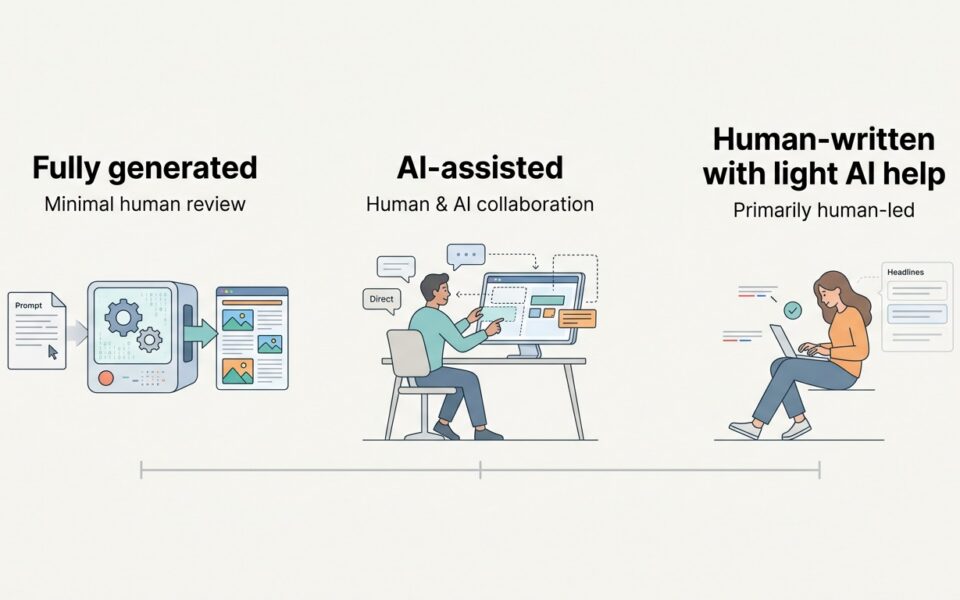
Does AI content hurt your SEO? What Google really says
The short answer No. Google does not penalize AI content just because a model wrote it. It demotes low-quality, unoriginal pages made to manipulate rankings, however they were...
Mike VillarKey Takeaways: Automated bidding delivers superior performance metrics compared to manual management, with Google reporting 15-20% improvement in conversions Machine learning...
 Mike VillarChief Executive Officer
· 10 min read

Key Takeaways:
The digital advertising landscape has reached an inflection point. Agencies clinging to manual bidding strategies are operating with horse-drawn carriages on a Formula One racetrack. Yet resistance to automated bidding remains pervasive across the industry, driven by outdated notions of control and misguided fears about value proposition erosion.
This resistance isn’t just limiting performance potential; it’s actively damaging client relationships and agency competitiveness. The data is unequivocal: automated bidding consistently outperforms manual management across every meaningful metric. Agencies that fail to embrace this reality will find themselves increasingly irrelevant in an AI-driven advertising ecosystem.
Let’s address the elephant in the room: automated bidding simply works better than manual management. Google’s internal data shows that advertisers using Smart Bidding see 15-20% more conversions at similar cost-per-acquisition levels compared to manual bidding. This isn’t marketing fluff; it’s mathematical reality.
Consider the computational complexity involved in modern campaign optimization. Google’s auction system processes over 8.5 billion searches daily, each involving hundreds of signals including device type, location, time of day, user behavior patterns, and contextual relevance. Machine learning algorithms can analyze and respond to this data in milliseconds, making bid adjustments based on probability calculations that would require teams of analysts weeks to process manually.
The performance advantages extend beyond simple conversion metrics. Automated bidding enables sophisticated campaign optimization strategies that manual management simply cannot match:
One enterprise client saw their cost-per-acquisition decrease by 34% within 90 days of transitioning to Target CPA bidding, while simultaneously increasing conversion volume by 28%. This wasn’t an anomaly; it’s the expected outcome when machine learning optimization replaces human guesswork.
The most common objection to automated bidding centers on loss of control. This concern reveals a fundamental misunderstanding of what control means in modern digital advertising. Manual bid management provides the illusion of control while sacrificing actual performance optimization.
True control in automated systems comes from strategic direction, not tactical manipulation. Agencies should focus their control efforts on:
Manual bid adjustments represent micro-management of variables that algorithms handle more effectively. It’s equivalent to manually adjusting individual pixels in a photograph when advanced editing software can optimize the entire image instantaneously.
Smart agencies recognize that automation amplifies human intelligence rather than replacing it. While algorithms handle bid optimization, human expertise drives creative strategy, audience insights, and business objective alignment. This division of labor maximizes both efficiency and effectiveness.
The transition to automated bidding requires fundamental repositioning of agency value propositions. Clients hire agencies for business growth, not bid management busy work. Automation frees agency resources to focus on high-impact activities that directly drive business outcomes.
Consider this repositioning framework:
| Traditional Manual Focus | Automated Bidding Focus | Client Value Impact |
|---|---|---|
| Daily bid adjustments | Strategic performance analysis | Higher-level business insights |
| Keyword-level optimization | Audience and creative optimization | Improved messaging resonance |
| Campaign maintenance | Continuous testing programs | Accelerated performance improvement |
| Reactive performance monitoring | Predictive performance modeling | Proactive strategy adjustments |
Agencies should position automated bidding adoption as a strategic upgrade that enables more sophisticated optimization approaches. Instead of spending hours adjusting individual keyword bids, account managers can focus on developing comprehensive ad testing frameworks, analyzing customer journey data, and implementing advanced attribution models.
This shift enables agencies to provide genuinely strategic value rather than tactical execution. Clients receive better performance outcomes while gaining access to insights and optimizations that manual management simply cannot deliver.
Successful automated bidding adoption depends heavily on effective client communication. Many clients share agencies’ misconceptions about control and automation, requiring careful education about performance benefits and strategic implications.
Use this communication framework to build client confidence in automated approaches:
Begin with performance data, not philosophical arguments. Present concrete examples of automated bidding performance improvements from similar businesses or industries. Focus on metrics that matter to client business objectives: cost-per-acquisition, return on ad spend, and conversion volume.
Example messaging: “Based on our analysis of [similar industry] campaigns, automated bidding typically delivers 15-25% improvement in cost efficiency while increasing conversion volume. This performance advantage comes from machine learning algorithms that process thousands of optimization signals simultaneously.”
Establish clear performance benchmarks and monitoring protocols. Clients need confidence that automated systems are performing effectively, requiring more sophisticated reporting than manual campaigns typically receive.
Implement these monitoring approaches:
Once clients see performance improvements, focus conversations on scaling opportunities and advanced optimization strategies. This reinforces the value of automation while positioning additional growth initiatives.
Example messaging: “Now that automated bidding has improved your baseline performance by 20%, we can implement advanced testing automation protocols to drive additional improvements. Our continuous testing framework will optimize ad creative, audience targeting, and landing page performance simultaneously.”
Successful automated bidding adoption requires systematic implementation approaches that minimize risk while maximizing performance gains. Agencies cannot simply flip a switch and expect optimal results; the transition requires careful planning and execution.
Implement automated bidding through controlled testing rather than wholesale account changes. Start with high-performing campaigns that have sufficient conversion volume to support machine learning optimization. This approach provides performance validation while minimizing client anxiety about dramatic changes.
Follow this migration sequence:

Automated bidding effectiveness depends entirely on accurate conversion tracking and sufficient data volume. Agencies must audit and optimize tracking implementations before automated bidding adoption.
Essential tracking requirements include:
Campaigns need minimum data thresholds for effective automated optimization. Google recommends at least 30 conversions in the past 30 days for Target CPA strategies, though 50+ conversions typically deliver better performance outcomes.
Automated bidding creates opportunities for sophisticated performance optimization testing that manual management cannot support. Smart agencies leverage these capabilities to deliver continuous performance improvements that compound over time.
Testing automation enables simultaneous optimization across multiple campaign variables:
One effective approach involves implementing rolling ad testing protocols that continuously introduce new creative variations while automatically pausing underperforming elements. This creates a self-optimizing system that improves performance without manual intervention.
Example testing framework:
| Testing Focus | Automation Approach | Performance Impact |
|---|---|---|
| Ad creative rotation | Automated statistical significance testing | 15-30% CTR improvement |
| Audience optimization | Performance-based segment expansion/exclusion | 20-40% CPA improvement |
| Bid strategy testing | Comparative performance monitoring | 10-25% ROAS improvement |
| Landing page optimization | Traffic splitting with conversion tracking | 25-50% conversion rate improvement |
Agencies must develop sophisticated measurement frameworks that capture the full value of automated bidding adoption. Traditional metrics like click-through rates and cost-per-click become less relevant when optimization focuses on conversion outcomes and business value.
Implement these measurement approaches:
Establish clear before-and-after performance comparisons using consistent time periods and external factors. Account for seasonality, market changes, and budget variations that might influence performance beyond bidding strategy changes.
Track agency efficiency improvements enabled by automated bidding adoption. Measure time savings from reduced manual optimization tasks and reinvestment into strategic activities that drive additional client value.
Use automated bidding data to develop predictive performance models that inform strategic planning and budget allocation decisions. Machine learning optimization provides richer performance data that enables more accurate forecasting and scenario planning.
Automated bidding adoption typically encounters predictable challenges that agencies can proactively address through proper planning and communication.
Automated bidding algorithms require learning periods to optimize performance, during which metrics may appear volatile or suboptimal. Agencies must prepare clients for this temporary adjustment period while monitoring performance trends rather than daily fluctuations.
Set expectations for 2-4 week learning periods during which performance may vary significantly. Focus client attention on weekly trends rather than daily metrics to avoid panic over normal algorithm learning behavior.
Campaigns with insufficient conversion history may struggle with automated bidding implementation. Develop strategies for building conversion volume through manual bidding or enhanced campaign targeting before automated adoption.
B2B clients or businesses with extended sales cycles may require sophisticated attribution models that standard automated bidding cannot accommodate. Explore advanced bid strategies and custom conversion actions that align with business realities.
Agencies that embrace automated bidding early gain significant competitive advantages over those clinging to manual approaches. These advantages compound over time as machine learning algorithms improve and manual optimization becomes increasingly ineffective.
Early adopters benefit from:
The advertising landscape increasingly favors agencies that leverage automation effectively rather than those that resist technological advancement. Clients will gravitate toward agencies that deliver superior performance through intelligent automation adoption.
Automated bidding represents just one component of broader marketing automation trends that will reshape agency operations over the next decade. Agencies that successfully adopt automated bidding position themselves for additional automation opportunities in creative optimization, audience development, and campaign strategy.
The skills and processes developed through automated bidding adoption transfer directly to other automation initiatives:
Agencies that master automated bidding will be better positioned to adopt emerging technologies like generative AI for creative development, advanced attribution modeling, and predictive customer behavior analysis.
The debate over automated bidding adoption is over. Performance data consistently demonstrates superior outcomes from machine learning optimization compared to manual management. Agencies that continue resisting automation are actively harming client performance while limiting their own growth potential.
Smart agencies recognize that automated bidding enables better service delivery, not service commoditization. By removing manual bid management tasks, automation frees agencies to focus on strategic activities that drive genuine business value for clients.
The question isn’t whether to adopt automated bidding, but how quickly agencies can implement effective automation strategies. Client expectations continue evolving toward performance outcomes rather than process control. Agencies that deliver superior performance through intelligent automation will thrive, while those clinging to manual approaches will struggle to remain competitive.
The future belongs to agencies that embrace automation as a strategic advantage rather than fearing it as a threat. The technology exists, the performance benefits are proven, and client expectations are shifting. The only remaining question is whether agencies will lead this transformation or be displaced by it.
Glossary of Terms
Further Reading
The short answer No. Google does not penalize AI content just because a model wrote it. It demotes low-quality, unoriginal pages made to manipulate rankings, however they were...
Mike VillarIf you search "check if ChatGPT mentions my business," the answer is to ask the questions your buyers ask, repeat each one several times, and log whether your name appears. Do the...
Mike VillarGEO priorities for small teams: what to do first (and what to skip) If you run marketing with one to three people, your GEO priorities for small teams come down to this: make sure...
Mike VillarStart your brand's success journey today with a conversation. Share your goals and objectives with us and let's set up a discovery call.