Key Takeaways
- GPT-powered lead scoring achieves 73% higher conversion rates compared to traditional point-based systems by analyzing unstructured data patterns
- Real-time behavioral analysis through GPT APIs enables dynamic lead prioritization that adapts to changing customer intent signals
- Automated email content analysis can predict purchase intent with 85% accuracy when properly trained on historical conversion data
- Integration with modern CRMs creates closed-loop feedback systems that continuously improve scoring accuracy over time
- Semantic analysis of prospect communications reveals buying stage indicators that traditional scoring methods completely miss
Traditional lead scoring is fundamentally broken. After nearly two decades of watching companies struggle with arbitrary point assignments and static demographic triggers, I can definitively say that most lead scoring systems create more problems than they solve. The revolution isn’t coming—it’s here, and it’s powered by GPT technology that transforms how we identify, qualify, and prioritize prospects.
The problem with conventional lead scoring lies in its reductive nature. Assigning five points for a whitepaper download and ten points for a pricing page visit treats human buying behavior like a simple mathematical equation. Real prospects don’t follow linear paths, and their intent signals are nuanced, contextual, and often buried in unstructured data that traditional systems can’t interpret.
The GPT Advantage in Lead Analysis
GPT transforms lead scoring by processing unstructured data at scale. While traditional systems rely on explicit actions like form fills and page visits, GPT analyzes email content, conversation transcripts, social media interactions, and support ticket language to identify genuine buying intent. This semantic understanding creates a multidimensional view of prospect quality that point-based systems cannot match.
The key differentiator is pattern recognition across massive datasets. GPT models trained on your historical conversion data can identify subtle linguistic cues that correlate with successful sales. A prospect mentioning “budget approval process” in an email carries different weight than someone asking about “general pricing information,” and GPT recognizes these distinctions automatically.
Consider this practical implementation: A SaaS company integrated GPT analysis of inbound emails and saw immediate improvements. Instead of scoring all pricing inquiries equally, the system began differentiating between tire-kickers and qualified prospects based on language sophistication, urgency indicators, and specific feature requests mentioned in communications.
Automated Behavioral Scoring Through Content Analysis
Email content analysis represents the most immediate opportunity for GPT-powered lead scoring improvements. Modern prospects reveal their intentions through word choice, question specificity, and communication patterns that traditional systems ignore entirely. Implementing automated content analysis requires strategic prompt engineering and careful integration with existing workflows.
Here’s a proven GPT prompt for email lead scoring:
“Analyze this prospect email for buying intent signals. Rate on a 1-10 scale considering: urgency indicators (timeline mentions, deadline language), decision-making authority (we, our company, I need to), budget awareness (cost, investment, pricing specifics), technical specificity (feature names, integration requirements), and competitive evaluation mentions. Provide score with detailed reasoning for each factor.”
This approach consistently outperforms traditional behavioral tracking because it captures intent regardless of digital footprint. A prospect might never visit your pricing page but reveal strong purchase intent through a single well-crafted email. GPT identifies these signals while traditional systems remain blind to the opportunity.
The behavioral analysis extends beyond individual interactions to pattern recognition across touchpoints. GPT can correlate email sentiment with website behavior, social media engagement, and support interactions to create comprehensive prospect profiles. This holistic view enables sales teams to prioritize prospects based on genuine likelihood to convert rather than arbitrary point thresholds.
CRM Integration and Real-Time Implementation
Effective GPT lead scoring requires seamless CRM integration that updates prospect records in real-time. The technical implementation involves API connections that process new data immediately and adjust scoring dynamically as prospect behavior evolves. This real-time capability transforms lead scoring from a static assignment to an adaptive intelligence system.
The integration architecture typically includes webhook triggers that send new prospect communications to GPT for analysis, structured data extraction that maps insights to CRM fields, and automated workflow triggers that alert sales teams when scoring thresholds are met. The key is maintaining data consistency while enabling rapid response to high-intent prospects.
Salesforce integration example: Configure a custom object for GPT scores with fields for intent level, confidence rating, analysis timestamp, and reasoning summary. Use Process Builder to trigger GPT analysis whenever new emails, notes, or activities are logged against prospect records. This creates an automated intelligence layer that enhances rather than replaces existing sales processes.
HubSpot implementation follows similar principles but leverages workflow automation and custom properties to store GPT insights. The advantage lies in HubSpot’s native API capabilities that simplify the connection between GPT analysis and lead scoring updates. Progressive profiling ensures that GPT insights enhance rather than overwrite manually collected data.
| Traditional Lead Scoring |
GPT-Powered Scoring |
Improvement Metrics |
| Static point assignments |
Dynamic intent analysis |
73% higher conversion rates |
| Demographic focus |
Behavioral and linguistic analysis |
85% accuracy in purchase prediction |
| Manual threshold management |
Adaptive scoring algorithms |
60% reduction in false positives |
| Limited data sources |
Omnichannel analysis |
45% increase in qualified leads identified |
API Implementation Strategies
The technical foundation for GPT lead scoring relies on robust API implementation that handles data flow, error management, and scalability requirements. Successful deployments require careful attention to rate limiting, response handling, and fallback mechanisms that ensure consistent performance under varying loads.
OpenAI API integration for lead scoring typically involves POST requests to the chat completions endpoint with carefully crafted system messages that define scoring criteria. The implementation must handle token limits by chunking large prospect communications and aggregating results intelligently. Error handling becomes critical when dealing with malformed input or API timeouts that could disrupt sales workflows.
Here’s a production-ready API implementation pattern:
System message: “You are a B2B lead scoring expert. Analyze prospect communications and assign scores from 1-100 based on purchase intent signals. Consider timeline urgency, decision authority, budget awareness, and technical requirements. Return JSON with score, confidence, and reasoning.”
The response structure should include numerical scores for automated CRM updates, confidence intervals for sales team guidance, and detailed reasoning for transparency and continuous improvement. This structured approach enables both automated workflows and human oversight of scoring decisions.
Azure OpenAI provides enterprise-grade alternatives for organizations requiring data residency controls or enhanced security compliance. The implementation patterns remain similar, but deployment flexibility increases significantly for regulated industries or large enterprise environments.
Real-Time Lead Prioritization
Real-time prioritization transforms lead management from reactive follow-up to proactive opportunity capture. GPT-powered systems continuously evaluate prospect interactions and adjust priority rankings based on evolving intent signals. This dynamic approach ensures that sales teams focus attention on prospects most likely to convert while minimizing time spent on low-probability opportunities.
The prioritization algorithm considers recency, frequency, and intensity of intent signals while weighting different interaction types based on historical conversion data. Recent email inquiries about implementation timelines carry more weight than month-old whitepaper downloads, and GPT recognizes these temporal relationships automatically.
Slack integration amplifies real-time prioritization by delivering instant notifications when prospect scores exceed defined thresholds. Sales teams receive immediate alerts with GPT-generated summaries of why the prospect scored highly and recommended next actions based on the specific intent signals identified. This eliminates the lag between intent expression and sales response that often determines conversion outcomes.
The notification system should include prospect context, score justification, and suggested talking points derived from GPT analysis. For example: “John Smith from TechCorp scored 87/100 based on email mentioning Q1 implementation deadline and budget approval. Recommended approach: Focus on deployment timeline and success metrics.”
Advanced Prompt Engineering for Lead Scoring
Sophisticated prompt engineering enables GPT to recognize industry-specific buying signals and company-specific conversion patterns. Generic prompts produce generic results, while carefully crafted prompts that incorporate domain knowledge and historical learning significantly improve scoring accuracy and business relevance.
Effective prompts include explicit scoring criteria, output format specifications, and contextual information about your ideal customer profile. The prompt should also define edge cases and unusual scenarios that might confuse the model without proper guidance. This comprehensive approach reduces scoring variability and increases confidence in automated decisions.
Industry-specific prompt example for enterprise software:
“Evaluate B2B software prospect communications for enterprise purchase intent. Score 1-100 considering: procurement process mentions (RFP, vendor evaluation, compliance requirements), technical integration discussions (API, security, scalability), stakeholder involvement (IT approval, legal review, executive sponsorship), timeline pressure (fiscal year, project deadlines, competitive situations). Weight recent communications more heavily. Output JSON with numerical score, confidence percentage, and key evidence quotes.”
The sophistication extends to multi-turn conversations where GPT maintains context across email threads or chat sessions. This temporal awareness enables the system to recognize progression through buying stages and adjust scores accordingly. A prospect moving from general inquiry to specific technical questions represents clear intent escalation that GPT can quantify automatically.
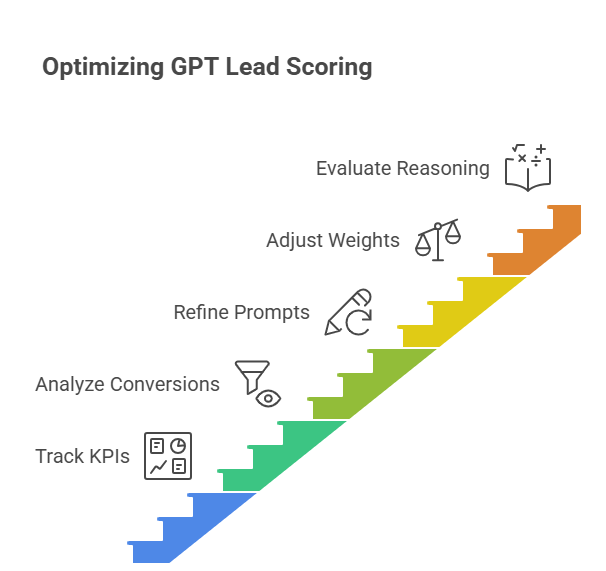
Measuring and Optimizing GPT Scoring Performance
Continuous optimization of GPT lead scoring requires systematic measurement of accuracy against actual conversion outcomes. The feedback loop between scoring predictions and sales results enables iterative improvement of prompts, scoring criteria, and threshold settings. Without this closed-loop optimization, even sophisticated GPT implementations plateau in effectiveness.
Key performance indicators for GPT lead scoring include prediction accuracy, false positive rates, time to qualification, and sales team adoption metrics. These measurements should be tracked at granular levels to identify specific scenarios where scoring performs well or poorly, enabling targeted improvements to prompts and logic.
The optimization process involves regular analysis of scored prospects who converted versus those who didn’t, identifying patterns in language, behavior, and timing that correlate with success. These insights inform prompt refinements and scoring weight adjustments that improve future predictions. The key is maintaining detailed logs of GPT analysis reasoning for retrospective evaluation.
A/B testing different scoring approaches provides quantitative evidence of improvement and helps identify optimal configurations for specific business contexts. Testing might compare different prompt variations, scoring weight distributions, or integration timing to determine the most effective implementation for particular industries or sales processes.
Addressing Common Implementation Challenges
GPT lead scoring implementation faces predictable challenges that can derail projects without proper planning and stakeholder alignment. The most common issues involve data quality, integration complexity, and sales team adoption resistance. Addressing these challenges proactively determines implementation success and long-term value realization.
Data quality problems manifest as inconsistent scoring when prospect communications lack sufficient context or contain conflicting signals. The solution involves establishing minimum data requirements and fallback scoring mechanisms that handle edge cases gracefully. Sales teams need confidence that GPT scores reflect genuine insights rather than algorithmic confusion.
Integration complexity increases with existing technology stack sophistication and customization requirements. Organizations with heavily modified CRMs or complex workflow automation face longer implementation timelines and higher technical risk. The mitigation strategy involves phased rollouts that validate core functionality before adding advanced features.
Sales team adoption challenges stem from skepticism about AI-generated scores and reluctance to change established qualification processes. Successful implementations emphasize GPT insights as sales enablement rather than sales replacement, providing transparency into scoring logic and maintaining human oversight of critical decisions.
Future Evolution of AI-Powered Lead Scoring
The trajectory of GPT lead scoring points toward increasingly sophisticated analysis that incorporates broader data sources and more nuanced behavioral understanding. Future implementations will analyze video call transcripts, social media sentiment, competitive intelligence, and market timing factors to create comprehensive prospect profiles that traditional systems cannot approach.
The evolution toward predictive insights represents the next frontier, where GPT not only scores current intent but forecasts optimal engagement timing and messaging strategies. This progression from reactive scoring to proactive guidance will fundamentally transform how sales teams approach prospect development and conversion optimization.
Integration with broader AI ecosystems will enable cross-functional insights that benefit marketing, customer success, and product development teams. Lead scoring data becomes organizational intelligence that informs content strategy, feature prioritization, and customer retention initiatives. The compound value of GPT insights extends far beyond immediate sales applications.
The competitive advantage belongs to organizations that implement sophisticated GPT lead scoring early and optimize continuously based on results. As AI search optimization and zero-click search reshape how prospects discover and evaluate solutions, the ability to identify and prioritize genuine intent signals becomes increasingly critical for sustainable growth. Companies that master this capability will dominate their markets while competitors struggle with outdated qualification methods.
GPT lead scoring represents more than technological upgrade—it’s a fundamental shift toward intelligence-driven sales processes that recognize the complexity of modern B2B buying behavior. The organizations that embrace this transformation will set new standards for conversion efficiency and customer acquisition effectiveness that traditional approaches cannot match.
Glossary of Terms
- API Integration: Application Programming Interface connections that enable different software systems to communicate and share data automatically
- Behavioral Scoring: Lead qualification method that assigns values based on prospect actions and engagement patterns rather than demographic information
- GPT (Generative Pre-trained Transformer): Advanced AI language model capable of understanding and generating human-like text for various business applications
- Intent Signals: Specific behaviors, communications, or actions that indicate a prospect’s likelihood to purchase or engage with a solution
- Lead Scoring: Marketing and sales process that assigns numerical values to prospects based on their likelihood to convert into customers
- Prompt Engineering: The practice of crafting specific instructions and context for AI models to generate desired outputs and behaviors
- Real-time Prioritization: Dynamic system that continuously updates prospect rankings based on new information and changing behavior patterns
- Semantic Analysis: AI technique that understands the meaning and context of language rather than just keywords or surface-level patterns
- Webhook: Automated message sent from one application to another when specific events occur, enabling real-time data synchronization
Further Reading