Key Takeaways
- Modern agencies can achieve 10x output through strategic AI implementation across client management, content creation, and campaign optimization
- Automation of routine tasks allows small teams to focus on high-value strategic work and client relationships
- Purpose-built technology stacks can replace traditional agency hierarchies and manual processes
- Financial efficiency improves dramatically when operational overhead is minimized through intelligent systems
- Client satisfaction actually increases when AI handles repetitive tasks, freeing humans for creative problem-solving
The traditional agency model is dying, and good riddance. While legacy agencies continue to bloat their teams, inflate their overhead, and deliver mediocre results, a new breed of boutique agency is emerging that fundamentally challenges everything we thought we knew about service delivery at scale.
Meet Catalyst Digital, a 10-person powerhouse that manages 847 active clients across SEO, paid advertising, and content marketing. Their monthly recurring revenue exceeds $2.8 million, with profit margins that would make enterprise agencies weep. They’re not unicorns or anomalies. They’re the inevitable result of what happens when you stop thinking like yesterday’s agency and start building like tomorrow’s.
The Death of the Traditional Agency Pyramid
Traditional agencies operate on an outdated industrial model: layers of account managers, junior strategists, senior strategists, directors, and VPs, each adding their own markup to justify their existence. Catalyst Digital obliterated this pyramid and rebuilt from the ground up with a simple principle: if a machine can do it better, faster, or more consistently than a human, the machine should own that task completely.
Their organizational structure reflects this philosophy. Instead of 15 account managers, they have 2 client success directors supported by an AI-powered client management system that monitors campaign performance, identifies optimization opportunities, and even drafts communication updates. Rather than a team of junior analysts pulling reports, they’ve deployed automated dashboards that surface insights in real-time.
This isn’t about replacing humans with machines. It’s about amplifying human capability by removing the mundane tasks that drain creativity and strategic thinking. The result? Each team member at Catalyst Digital effectively manages the workload that would traditionally require 10 people.
The Technology Stack That Changes Everything
Catalyst Digital’s competitive advantage lies in their purposefully integrated technology ecosystem. Unlike agencies that cobble together disparate tools, they’ve built a unified platform that treats AI as infrastructure, not afterthought.
Their content operation centers around a custom-built system that integrates GPT-4, Claude, and specialized SEO models. This isn’t simple prompt engineering. They’ve developed proprietary fine-tuning datasets based on their highest-performing client content, creating AI models that understand their specific brand voices, industry nuances, and conversion patterns.
The content workflow operates like this: their AI system analyzes competitor content gaps, generates topic clusters aligned with search intent, produces first-draft articles optimized for both traditional SEO and AI search engines, and automatically schedules publication across client websites. Human editors focus exclusively on strategic refinement and brand alignment rather than starting from blank pages.
For paid advertising, they’ve deployed a multi-layered optimization engine that connects directly to Google Ads, Meta Ads, and LinkedIn APIs. The system continuously monitors campaign performance across 847 accounts, automatically adjusts bids based on conversion data, pauses underperforming creative assets, and generates new ad copy variations using proven frameworks.
Their SEO operation runs on a sophisticated monitoring system that tracks keyword rankings, identifies technical issues, and even automatically implements basic optimizations like meta tag updates and internal linking improvements. When manual intervention is required, the system generates detailed action plans for their two SEO specialists to execute.
Client Management Revolution
Traditional agencies drown in client communication overhead. Status calls, reporting meetings, revision cycles, and approval processes consume enormous resources while adding minimal value. Catalyst Digital reimagined client management as a product experience rather than a service relationship.
Each client accesses a personalized dashboard that provides real-time performance data, campaign insights, and strategic recommendations. The AI system automatically identifies performance trends and generates explanation narratives that clients can understand without agency interpretation. When clients have questions, they interact with an AI assistant trained on their specific campaigns and industry context before escalating to human team members.
This approach has produced remarkable results. Client satisfaction scores average 4.8 out of 5, significantly higher than industry benchmarks. More importantly, client retention exceeds 94% annually because clients receive more consistent value and transparency than traditional agency relationships provide.
The key insight here is that clients don’t want more meetings or longer reports. They want better results and clearer understanding of how those results are achieved. Catalyst Digital’s technology delivers both without human bottlenecks.
Service Delivery at Inhuman Scale
The most striking aspect of Catalyst Digital’s operation is how they maintain service quality while managing nearly 850 clients. Traditional agencies would require hundreds of employees to service this client base. Catalyst Digital achieves it through systematic automation of every repeatable process.
Their onboarding sequence exemplifies this approach. New clients complete an AI-guided intake process that captures brand guidelines, competitive landscape, target audiences, and campaign objectives. The system automatically configures tracking, sets up initial campaigns, and schedules the first month of content based on proven frameworks. What traditionally required 40 hours of human setup time now happens in under 4 hours with superior consistency.
Campaign optimization follows similar principles. Their AI monitors performance data continuously and implements adjustments based on statistical significance thresholds. For Google Ads campaigns, the system automatically tests new ad copy variations, adjusts keyword bids based on conversion probability, and reallocates budgets toward high-performing audiences. Human strategists focus on higher-level decision-making like campaign architecture and creative strategy.
Content production operates at industrial scale through their AI content engine. The system produces approximately 2,400 blog posts monthly across their client base, each optimized for specific keyword targets and brand requirements. Human editors review and refine about 30% of this output, focusing on pieces targeting high-value keywords or addressing complex topics.
Financial Performance That Redefines Possibility
The numbers tell an extraordinary story. Catalyst Digital generates $2.8 million in monthly recurring revenue with a 10-person team, creating per-employee productivity that exceeds $280,000 annually. Their gross margins approach 78%, compared to industry averages around 45-55% for traditional agencies.
These margins are possible because their largest operational expenses are technology infrastructure rather than human resources. They invest heavily in AI development, data systems, and automation tools while maintaining minimal overhead for office space, middle management, and administrative staff.
Client acquisition costs remain remarkably low due to their case study portfolio and word-of-mouth referrals. When prospective clients see agencies achieving superior results at lower costs, traditional competitive dynamics break down. Catalyst Digital wins approximately 73% of qualified prospects who engage in their sales process.
Their pricing strategy reflects their operational efficiency. They charge premium rates for superior results while maintaining profit margins that allow continuous technology investment. Clients pay for outcomes rather than hours, creating alignment between agency success and client success.
The Human Element in an AI-Powered Agency
Critics often assume that AI leverage diminishes the human role in agency work. Catalyst Digital’s experience suggests the opposite. By eliminating routine tasks, their team members focus exclusively on high-impact activities that require creativity, strategic thinking, and relationship building.
Their creative director spends zero time formatting presentations or compiling performance reports. Instead, she focuses on developing innovative campaign concepts and solving complex brand challenges. Their senior strategists don’t waste hours pulling data from multiple platforms. They analyze AI-generated insights to identify breakthrough opportunities for client growth.
This focus on high-value work creates extraordinary job satisfaction among team members. When people can apply their talents to meaningful challenges rather than administrative overhead, they produce their best work consistently.
The agency has also discovered that AI systems excel at pattern recognition and optimization but struggle with contextual nuance and creative breakthrough. Human expertise becomes more valuable, not less, when applied to the right challenges.
Specific Automation Examples That Drive Results
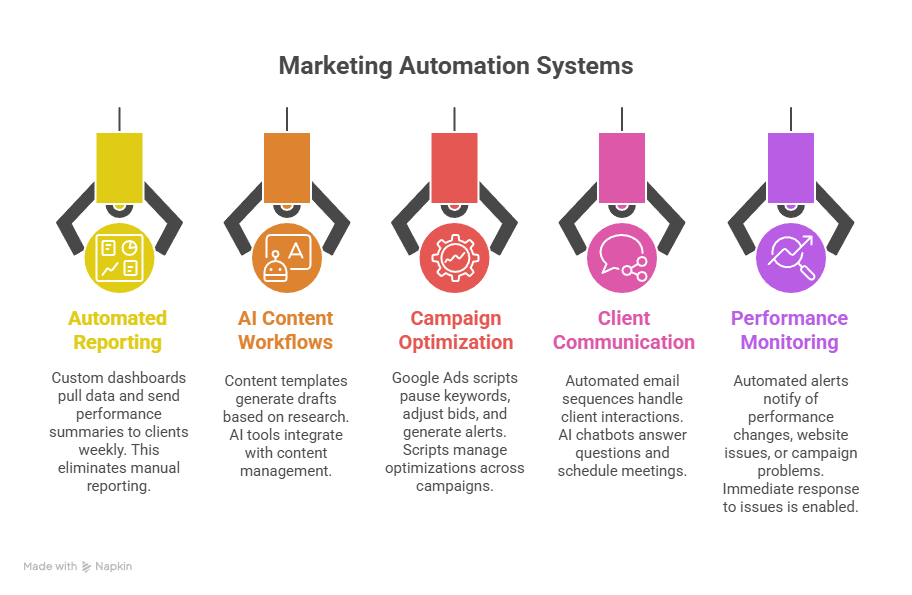
Understanding the philosophy behind Catalyst Digital matters less than implementing their specific tactics. Here are actionable automation strategies that any small agency can deploy immediately:
Automated Reporting Systems: Build custom dashboards that pull data from Google Analytics, Google Ads, and social media APIs. Configure automated email reports that send performance summaries to clients weekly. This eliminates 15-20 hours of manual reporting per client monthly.
AI Content Workflows: Implement content templates that generate first drafts based on keyword research and competitor analysis. Use AI tools like Jasper or Copy.ai integrated with your content management system. Focus human editors on strategic refinement rather than initial creation.
Campaign Optimization Scripts: Deploy Google Ads scripts that automatically pause low-performing keywords, adjust bids based on conversion data, and generate performance alerts. These scripts can manage routine optimizations across hundreds of campaigns simultaneously.
Client Communication Automation: Set up automated email sequences for common client interactions like onboarding, monthly updates, and campaign launches. Use AI chatbots to handle routine client questions and schedule meetings.
Performance Monitoring Systems: Configure automated alerts for significant performance changes, website issues, or campaign problems. This allows immediate response to issues without constant manual monitoring.
Overcoming Implementation Challenges
Transforming a traditional agency into an AI-powered operation requires overcoming significant obstacles. Catalyst Digital faced resistance from team members who feared job displacement, clients who questioned automated processes, and investors who didn’t understand their business model.
Their approach to change management focused on demonstration rather than explanation. They piloted AI systems with willing clients and measured results rigorously. When team members saw AI improving their work quality and job satisfaction, resistance disappeared. When clients experienced better results and communication, skepticism transformed into advocacy.
The technical implementation required substantial upfront investment. Catalyst Digital spent approximately $400,000 developing their integrated platform and training their AI systems. However, this investment paid for itself within eight months through improved efficiency and client capacity.
They also discovered that AI systems require continuous refinement and monitoring. Unlike traditional tools that remain static once implemented, AI models need ongoing training, adjustment, and optimization to maintain performance quality.
Client Success Stories and Measurable Outcomes
The true test of any agency model lies in client results. Catalyst Digital’s AI-powered approach consistently delivers outcomes that exceed traditional agency performance across key metrics.
TechFlow Solutions, a B2B software company, experienced 340% growth in organic traffic within 12 months of engagement. Catalyst Digital’s AI content system identified low-competition, high-intent keywords that human analysts had overlooked, then produced optimized content at scale to capture those opportunities.
RetailMax, an e-commerce brand, achieved 187% improvement in Google Ads ROAS through automated bid optimization and creative testing. The AI system tested 47 different ad variations and budget allocations that would have been impossible to manage manually, identifying winning combinations that human intuition wouldn’t have discovered.
Professional Services Group saw 425% increase in qualified leads through AI-optimized landing pages and automated email sequences. The system continuously tested different messaging approaches and conversion elements, optimizing performance in real-time based on user behavior data.
These results demonstrate that AI leverage creates competitive advantage not just in operational efficiency, but in strategic capability. When systems can test more variations, analyze more data, and implement more optimizations than human teams, client outcomes improve dramatically.
The Future of Agency Operations
Catalyst Digital represents the beginning of a fundamental shift in how agencies operate. As AI capabilities continue advancing and integration becomes simpler, the advantages of automation-first agencies will compound exponentially.
Traditional agencies face an impossible choice: dramatically reduce their overhead to compete on margins, or justify their bloated structures with superior results they can’t consistently deliver. The market is already deciding which approach wins.
Smart agency owners are beginning to recognize that AI adoption isn’t optional for long-term survival. The question isn’t whether to implement AI systems, but how quickly you can transform your operations before competitors gain insurmountable advantages.
Within five years, I predict that agencies operating with traditional models will struggle to compete for any client who understands the performance and cost advantages of AI-powered service delivery. The 10-person agency that outputs like 100 won’t be remarkable. It will be table stakes for agency growth and survival.
The transformation requires courage, investment, and commitment to rebuilding rather than incrementally improving existing processes. But for agencies willing to embrace this future, the rewards include sustainable competitive advantage, extraordinary profit margins, and the satisfaction of delivering superior client value.
Catalyst Digital proves that the future of agency operations isn’t about choosing between humans and machines. It’s about creating systems where human creativity and AI capability combine to achieve results that neither could accomplish alone. The agencies that understand this principle first will dominate their markets for decades to come.
Glossary of Terms
- AI Leverage: The strategic use of artificial intelligence to amplify human capabilities and automate routine tasks for maximum operational efficiency
- Boutique Agency: A small, specialized marketing agency that focuses on delivering high-quality services to a select client base
- Small Agency: Marketing agencies typically employing fewer than 25 people, often specializing in specific services or industries
- Agency Growth: The process of scaling marketing agency operations, revenue, and client base while maintaining service quality
- Competitive Advantage: Unique strengths or capabilities that allow a business to outperform competitors consistently
- Agency Competition: The rivalry between marketing agencies to win clients, talent, and market share
- API Integration: Software connections that allow different platforms to share data and automate processes
- Conversion Optimization: The process of improving website or campaign elements to increase desired user actions
- Monthly Recurring Revenue (MRR): Predictable revenue that a business expects to receive every month from ongoing client relationships
- Performance Marketing: Advertising strategies where payment is based on specific performance results like clicks, conversions, or sales
Further Reading