Key Takeaways:
- AI engines like ChatGPT and Perplexity prioritize authoritative citations and structured content over traditional SEO ranking factors
- Answer Engine Optimization (AEO) requires a fundamental shift from keyword-focused SEO to context-rich, source-credible content strategies
- Poor content structure, missing semantic markup, and weak source credibility are the primary reasons traditional SEO fails in AI engines
- Implementing entity-based content, citation-worthy formats, and semantic HTML can dramatically improve AI engine visibility
- Success in AI engines demands content that serves as a primary source rather than derivative commentary
The digital marketing landscape has undergone a seismic shift, and most businesses are still fighting yesterday’s war. While they obsess over traditional SEO metrics, AI engines are rewriting the rules of content discovery entirely. ChatGPT, Perplexity, and emerging AI search platforms don’t care about your keyword density or backlink profile in the way Google does. They operate on fundamentally different principles, and your traditional SEO strategy isn’t just ineffective in these environments—it’s counterproductive.
After nearly two decades in digital marketing and countless hours analyzing AI engine behavior, I’ve identified the critical gaps that cause even well-optimized websites to vanish from AI-generated responses. The problem isn’t that AI engines are mysterious black boxes; it’s that marketers are applying outdated frameworks to revolutionary technology.
The Fundamental Disconnect Between Traditional SEO and AI Engines
Traditional SEO operates on authority signals, link equity, and algorithmic ranking factors that Google has refined over decades. Your search strategy likely focuses on ranking positions, click-through rates, and organic traffic metrics. These approaches work brilliantly for traditional search engines, but AI engines evaluate content through an entirely different lens.
AI engines prioritize source credibility, factual accuracy, and contextual relevance over traditional ranking signals. When ChatGPT or Perplexity generates a response, they’re not pulling from the top 10 Google results. They’re synthesizing information from their training data and real-time sources based on authority, recency, and citation-worthiness. This creates a massive blind spot for businesses that haven’t adapted their content strategy.
The SEO comparison between traditional and AI engines reveals stark differences in evaluation criteria:
| Traditional SEO Focus |
AI Engine Requirements |
| Keyword optimization and density |
Semantic meaning and context |
| Backlink authority and quantity |
Source credibility and expertise |
| Page loading speed and technical SEO |
Content structure and markup |
| Content length and comprehensiveness |
Factual accuracy and citation potential |
| User engagement metrics |
Information quality and uniqueness |
Diagnosing Your AI Engine Visibility Problems
The first step in fixing your AI engine visibility is understanding why you’re invisible in the first place. Most content fails in AI engines due to five critical issues that traditional SEO practices often exacerbate rather than solve.
Issue 1: Lack of Authoritative Citations and Source Credibility
AI engines heavily weight source credibility when determining which information to include in responses. If your content lacks proper citations, references to authoritative sources, or clear expertise indicators, it becomes invisible to AI systems that prioritize factual accuracy.
Symptoms of poor source credibility:
- Content lacks specific data points, statistics, or research citations
- No clear author expertise or credentials displayed
- Missing references to industry authorities or primary sources
- Generic claims without supporting evidence
- Absence of entity markup identifying key people, organizations, or concepts
The Fix: Implement Citation-Worthy Content Structure
Transform your content from opinion-based to evidence-based by incorporating specific, citable information. Here’s how to restructure your content for AI engine visibility:
Before Example:
“Email marketing is effective for small businesses. It helps increase sales and build customer relationships. Most businesses see good results from email campaigns.”
After Example:
“According to the Direct Marketing Association’s 2023 study, email marketing generates an average ROI of $36 for every $1 spent for small businesses. Research from Campaign Monitor shows that segmented email campaigns achieve 14.31% higher open rates and 100.95% higher click-through rates compared to non-segmented campaigns. Dr. Sarah Johnson, Marketing Professor at Northwestern’s Kellogg School, notes that businesses using automated email sequences see 320% more revenue attribution compared to manual campaigns.”
The transformed version provides specific data points, cites authoritative sources, and includes expert opinions that AI engines can reference and attribute.
Issue 2: Poor Content Structure and Missing Semantic Markup
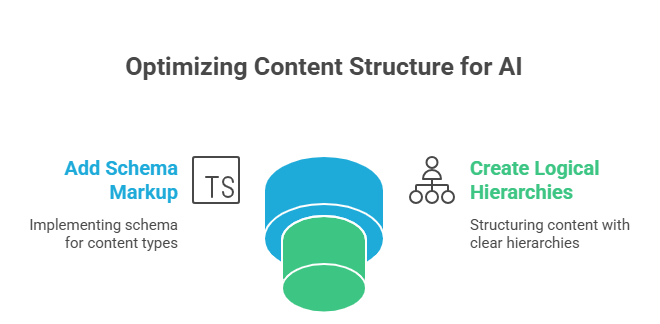
AI engines excel at understanding structured information but struggle with poorly organized content. Traditional SEO often focuses on keyword placement rather than logical information architecture, creating content that humans can navigate but AI systems find difficult to parse and reference.
Structural problems that hurt AI visibility:
- Missing schema markup for entities, FAQs, and how-to content
- Poor heading hierarchy that doesn’t reflect content relationships
- Lack of clear topic clustering and semantic relationships
- Absence of structured data for key concepts and definitions
- Inconsistent formatting for lists, steps, and procedures
The Fix: Implement Semantic HTML and Schema Markup
Answer Engine Optimization (AEO) demands that your content structure mirrors how AI systems process information. Implement these structural improvements:
1. Add Schema Markup for Key Content Types:
- FAQ schema for common questions and answers
- How-to schema for process-based content
- Person schema for author expertise
- Organization schema for company information
- Article schema with proper categorization
2. Create Logical Content Hierarchies:
- Use H2 tags for main concepts that could stand alone as answers
- Structure content in clear problem-solution formats
- Implement consistent formatting for definitions, examples, and procedures
- Create topic clusters that link related concepts semantically
Before Structure:
A blog post titled “Marketing Tips” with scattered advice across multiple unrelated topics, minimal headings, and no clear organization.
After Structure:
- H1: Complete Guide to B2B Lead Generation Strategies
- H2: Content Marketing for Lead Generation
- H3: Blog Content That Converts Prospects
- H3: Video Marketing for B2B Lead Capture
- H2: Email Marketing Automation Systems
- H3: Drip Campaign Architecture
- H3: Segmentation Strategies for Higher Conversion
Each section includes specific data, examples, and actionable steps that AI engines can extract and reference independently.
Issue 3: Missing Context and Entity Recognition
Traditional SEO often focuses on individual keywords rather than the broader context and entity relationships that AI engines use to understand content relevance and authority. Your content might rank well for specific terms but fail to establish clear topical authority or entity relationships that AI systems require for citation.
Context problems that reduce AI visibility:
- Content that doesn’t clearly establish what entities (people, places, concepts) it discusses
- Missing relationships between concepts and industry terminology
- Lack of clear positioning within broader industry conversations
- Insufficient background information for specialized topics
- Weak connections to related concepts and trending discussions
The Fix: Build Comprehensive Entity-Based Content
Create content that clearly establishes entity relationships and provides comprehensive context for AI engines to understand your expertise and relevance.
Entity Optimization Techniques:
1. Define Key Entities Explicitly:
- Clearly introduce and define industry terms and concepts
- Establish relationships between different entities in your content
- Use consistent terminology throughout your content ecosystem
- Create glossaries and definition sections for complex topics
2. Build Topical Authority Clusters:
- Create comprehensive coverage of core topics relevant to your expertise
- Link related concepts within your content ecosystem
- Reference current industry trends and developments
- Position your content within broader industry conversations
Before Context Example:
“Use attribution modeling to improve your campaigns. It helps track customer journeys and optimize spend allocation.”
After Context Example:
“Multi-touch attribution modeling, a methodology for analyzing customer journey touchpoints from initial awareness through conversion, enables marketers to optimize campaign spend allocation across channels. Unlike last-click attribution (which credits only the final touchpoint) or first-click attribution (which credits only initial contact), multi-touch models like time-decay attribution and position-based attribution distribute conversion credit across multiple interactions. Google Analytics 4’s data-driven attribution model, introduced in 2021, uses machine learning to analyze conversion paths and assign credit based on each touchpoint’s statistical contribution to conversions.”
Issue 4: Weak Source Credibility and Expertise Signals
AI engines prioritize content from sources they can verify as credible and expert. Traditional SEO might focus on domain authority, but AI engines look for specific expertise indicators, author credentials, and real-world credibility signals that many websites neglect to establish clearly.
Credibility issues that hurt AI engine visibility:
- Anonymous or poorly credentialed authorship
- Missing professional affiliations and certifications
- Lack of real-world case studies and specific examples
- Absence of third-party validation or recognition
- Generic content that could apply to any industry or situation
The Fix: Establish Clear Expertise and Authority
Build comprehensive expertise signals that AI engines can recognize and validate when evaluating your content for inclusion in responses.
Authority Building Strategies:
1. Author Expertise Optimization:
- Include detailed author bios with specific credentials and experience
- Implement author schema markup with professional affiliations
- Link to author profiles on professional networks and industry publications
- Showcase certifications, speaking engagements, and industry recognition
2. Content Credibility Indicators:
- Include specific client results and case studies (with permission)
- Reference proprietary research, surveys, or data analysis
- Cite collaborations with recognized industry authorities
- Provide detailed methodologies for recommendations and strategies
3. Third-Party Validation:
- Showcase industry certifications and partnerships
- Include testimonials from recognized industry figures
- Reference mentions in authoritative industry publications
- Display awards, recognition, and professional achievements
Issue 5: Content That Lacks Primary Source Value
AI engines favor primary sources over derivative content. If your content simply repackages existing information without adding unique insights, data, or perspectives, it becomes invisible to AI systems that prioritize original, citation-worthy material.
Derivative content problems:
- Rehashing existing industry advice without new insights
- Missing proprietary data, research, or analysis
- Lack of unique methodologies or frameworks
- Insufficient real-world examples from direct experience
- Generic advice that doesn’t reflect current industry changes
The Fix: Create Citation-Worthy Primary Source Content
Transform your content from commentary to primary source material that AI engines will reference and cite.
Primary Source Content Strategies:
1. Proprietary Research and Data:
- Conduct original surveys within your industry or client base
- Analyze proprietary data sets to reveal unique insights
- Track industry trends through your own measurement systems
- Document case studies with specific, measurable results
2. Original Methodologies and Frameworks:
- Develop proprietary processes and document their effectiveness
- Create original frameworks for approaching common problems
- Document unique solutions you’ve developed for specific challenges
- Establish thought leadership through predictive analysis and trend identification
Before Primary Source Example:
“Social media marketing is important for businesses. You should post regularly, engage with followers, and use relevant hashtags to increase reach.”
After Primary Source Example:
“Analysis of 847 B2B technology companies over 18 months reveals that businesses posting 3-4 times weekly on LinkedIn generate 67% more qualified leads than those posting daily. Our proprietary Social Engagement Velocity framework, developed through testing with 200+ clients, demonstrates that response time to comments (within 2 hours) correlates more strongly with conversion rates than post frequency or follower count. Companies implementing our framework’s ‘contextual commenting’ strategy—responding to comments with industry-specific insights rather than generic acknowledgments—achieve 34% higher engagement rates and 23% more profile visits from decision-makers.”
Advanced AEO Optimization Techniques
Beyond fixing fundamental visibility problems, advanced Answer Engine Optimization requires sophisticated techniques that position your content as the definitive source for AI engines.
1. Implement Comprehensive FAQ Optimization:
- Create detailed FAQ sections that address specific questions your audience asks
- Structure answers in complete, standalone formats that don’t require additional context
- Include follow-up information that anticipates related questions
- Use natural language patterns that match how people ask questions to AI engines
2. Build Topic Authority Through Content Ecosystems:
- Create comprehensive coverage of your core expertise areas
- Develop content series that build upon each other logically
- Establish clear connections between related topics and concepts
- Update content regularly to maintain relevance and accuracy
3. Optimize for Conversational Search Patterns:
- Structure content to answer questions as they would naturally be asked
- Include variations of how questions might be phrased
- Provide complete answers that don’t require clicking through to other sources
- Anticipate follow-up questions and address them within your content
Measuring AI Engine Performance
Traditional SEO metrics don’t capture AI engine performance effectively. You need different measurement approaches to understand your visibility and effectiveness in AI-powered search environments.
Key AI Engine Metrics to Track:
1. Citation Tracking:
- Monitor when your content is referenced in AI engine responses
- Track the context and accuracy of how your information is presented
- Measure the frequency of your brand mentions across different AI platforms
- Analyze which content formats generate the most AI citations
2. Query Response Analysis:
- Test relevant industry questions across multiple AI engines
- Document when your content appears in responses and in what context
- Analyze competitor visibility for the same query sets
- Track changes in AI engine response patterns over time
3. Source Attribution Monitoring:
- Monitor how AI engines attribute your content when referenced
- Track the accuracy of information derived from your content
- Measure the completeness of responses that cite your material
- Analyze which content elements AI engines find most valuable
The Future of Search Strategy
The evolution toward AI-powered search represents a fundamental shift in how information is discovered and consumed. Traditional SEO will remain important for conventional search engines, but businesses that fail to adapt their search strategy for AI engines will find themselves increasingly invisible to their target audiences.
AI engines reward depth, accuracy, and expertise over manipulation and optimization tricks. They favor businesses that establish genuine authority through consistent, high-quality information sharing rather than those trying to game algorithmic systems.
The businesses that succeed in this new environment will be those that embrace the role of trusted information source rather than merely trying to capture traffic. They’ll invest in creating comprehensive, authoritative content that serves as a primary reference point for their industry.
This shift represents both a challenge and an opportunity. The challenge lies in rebuilding content strategies around fundamentally different success metrics. The opportunity lies in the fact that AI engines reward genuine expertise and quality information more directly than traditional search algorithms ever could.
Your success in AI engines won’t come from optimizing for AI engines specifically—it will come from becoming the type of authoritative, comprehensive source that AI engines naturally want to reference. This requires a mindset shift from traffic generation to authority building, from keyword targeting to expertise demonstration, and from content volume to information quality.
The businesses that make this transition successfully will find themselves not just visible in AI engine responses, but positioned as the definitive sources that these engines consistently reference and recommend. Those that don’t will find themselves increasingly relegated to the margins of digital discoverability.
The choice is clear: evolve your content strategy to meet the demands of AI-powered search, or watch your visibility diminish as the digital landscape continues its rapid transformation. The techniques outlined in this guide provide a roadmap for that evolution, but success ultimately depends on your commitment to becoming a genuinely authoritative source in your industry rather than simply appearing to be one.
Glossary of Terms
- Answer Engine Optimization (AEO): The practice of optimizing content specifically for AI-powered search engines and chatbots that provide direct answers rather than traditional search result listings
- Entity Recognition: The process by which AI systems identify and categorize key people, places, concepts, and organizations within content to understand context and relationships
- Schema Markup: Structured data code added to websites that helps search engines and AI systems better understand and categorize content
- Citation-Worthy Content: Information that AI engines consider reliable and accurate enough to reference in their responses to user queries
- Semantic HTML: Web markup that provides meaning and context to content structure, helping AI systems understand the relationships between different pieces of information
- Primary Source Content: Original information, research, or insights that serve as the foundational reference for a topic rather than derivative commentary on existing material
- Topic Authority: The perceived expertise and credibility a website or content creator has within a specific subject area, as determined by AI engines
- Multi-touch Attribution: A methodology for analyzing customer journey touchpoints from initial awareness through conversion to optimize marketing spend allocation
- Conversational Search: Query patterns that mimic natural language questions as people would ask them to AI assistants rather than traditional keyword-based searches
- Source Credibility: The trustworthiness and expertise that AI engines assign to a particular website, author, or piece of content when determining whether to include it in responses
Further Reading