Key Takeaways
- Claude, Gemini, and GPT each have distinct content evaluation criteria that require platform-specific optimization strategies
- Citation preferences vary dramatically across AI engines, with Claude favoring academic sources, Gemini prioritizing fresh content, and GPT valuing comprehensive context
- Content format preferences differ significantly – Claude prefers structured data, Gemini favors multimedia integration, while GPT excels with conversational formats
- Google AI Overviews and SGE optimization now require understanding how each AI engine processes and surfaces content
- Multi-engine optimization demands a diversified content strategy rather than a one-size-fits-all approach
The digital marketing landscape has undergone a seismic shift as artificial intelligence engines fundamentally transform how content is discovered, evaluated, and presented to users. We’re witnessing the emergence of a new paradigm where traditional SEO tactics must evolve to accommodate the distinct preferences and algorithms of Claude, Gemini, and GPT. This transformation isn’t just another algorithm update – it’s a complete restructuring of how search visibility operates in an AI-driven ecosystem.
After nearly two decades of navigating search algorithm changes, I can confidently say that this current evolution represents the most significant disruption since Google’s PageRank algorithm. The implications for businesses, content creators, and digital marketers are profound and immediate.
The New AI Engine Landscape
The traditional approach to SEO focused primarily on Google’s search algorithm, but the rise of AI engines has created a multi-platform environment where content must perform across diverse evaluation systems. Each AI engine – Claude, Gemini, and GPT – operates with distinct methodologies for content assessment, citation preferences, and user intent interpretation.
Google AI Overviews have already begun reshaping how searchers interact with information, providing synthesized responses that pull from multiple sources. This shift means that optimizing for featured content now requires understanding how different AI engines prioritize and present information. The days of optimizing solely for traditional SERP rankings are ending.
What makes this particularly challenging is that these AI engines don’t simply rank content – they interpret, synthesize, and reconstruct it. Your perfectly optimized blog post might be cited by Claude in one context, completely ignored by Gemini, and partially referenced by GPT in a different context entirely.
Claude’s Content Evaluation Framework
Claude demonstrates a marked preference for authoritative, well-structured content with clear hierarchical organization. Through extensive testing, I’ve observed that Claude consistently favors content that follows academic writing principles while maintaining accessibility for general audiences.
Claude’s citation behavior reveals several key patterns:
- Prioritizes peer-reviewed sources and academic publications over general web content
- Values content with explicit methodology explanations and data transparency
- Shows preference for sources that include author credentials and publication dates
- Tends to cite longer-form content that provides comprehensive coverage of topics
- Demonstrates bias toward content with clear section headers and logical flow
For content optimization targeting Claude, focus on creating in-depth resources that mirror academic standards. Include detailed methodology sections, cite your sources extensively, and structure your content with clear hierarchies. Claude responds particularly well to content that includes data visualizations and statistical evidence.
A practical example: When testing identical content about digital marketing ROI, Claude consistently cited the version that included detailed calculation methodologies, source attributions for industry statistics, and clear section divisions over a more casual, blog-style presentation of the same information.
Gemini’s Fresh Content Priority System
Google’s Gemini operates with a distinctly different content evaluation approach, showing strong preferences for recency, multimedia integration, and real-time relevance. This aligns with Google’s broader ecosystem focus on current information and user engagement metrics.
Gemini’s unique characteristics include:
- Heavy weighting toward recently published or updated content
- Strong preference for multimedia-rich pages including images, videos, and interactive elements
- Emphasis on content that addresses current events or trending topics
- Bias toward content with high user engagement signals
- Integration with Google’s broader data ecosystem for context validation
The implications for AI SERP features are significant. Gemini’s integration with Google’s search infrastructure means that content optimized for Gemini has a higher likelihood of appearing in enhanced search results and AI-generated summaries.
To optimize for Gemini, maintain a regular content update schedule, incorporate current data and statistics, and ensure your content includes relevant multimedia elements. Gemini also shows preference for content that links to and references recent news articles or industry developments.
In practice, I’ve seen Gemini consistently favor content that includes recent case studies, current industry statistics, and references to recent developments over evergreen content, even when the evergreen content is more comprehensive.
GPT’s Conversational Context Engine
GPT operates with perhaps the most sophisticated understanding of conversational context and user intent. Unlike Claude’s academic preference or Gemini’s recency bias, GPT demonstrates remarkable ability to understand nuanced queries and match them with contextually appropriate content.
GPT’s content evaluation shows several distinct patterns:
- Values content that directly addresses user intent and provides actionable solutions
- Prefers conversational tone while maintaining expertise and authority
- Shows strong preference for content with clear problem-solution structures
- Demonstrates ability to synthesize information from multiple sources within responses
- Emphasizes content that includes practical examples and implementation guidance
For GPT optimization, focus on creating content that balances expertise with accessibility. Use conversational language while maintaining technical accuracy, include specific examples and case studies, and structure your content around common user questions and pain points.
GPT particularly excels at understanding context, so content that provides comprehensive background while addressing specific queries tends to perform well. This engine also shows preference for content that includes step-by-step instructions and actionable takeaways.
Platform-Specific Citation Analysis
| Citation Factor |
Claude |
Gemini |
GPT |
| Source Authority |
Academic/peer-reviewed highly preferred |
Google ecosystem sources favored |
Balanced mix of authoritative sources |
| Content Recency |
Less critical than authority |
Heavily weighted factor |
Moderate importance |
| Citation Format |
Formal academic style |
Integrated with search context |
Contextual and conversational |
| Multimedia Integration |
Supplementary value |
High importance |
Moderate importance |
| Content Depth |
Comprehensive preferred |
Balanced with engagement |
Problem-focused depth |
Content Format Optimization Strategies
The format preferences across these AI engines reveal fundamental differences in how they process and value information. Understanding these preferences is crucial for developing content that performs well across multiple platforms.
Claude responds exceptionally well to structured data formats. Include schema markup, use consistent heading hierarchies, and organize information in logical sequences. Tables, charts, and numbered lists perform particularly well with Claude’s evaluation system.
Gemini’s multimedia preference means that text-only content is at a significant disadvantage. Successful Gemini optimization requires integration of relevant images, videos, infographics, and interactive elements. The key is ensuring these multimedia elements are contextually relevant rather than decorative.
GPT’s conversational nature means that content formatted as natural dialogue or Q&A structures tends to perform well. This engine excels at understanding implicit questions and matching them with appropriate content sections.
Multi-Engine Performance Analysis
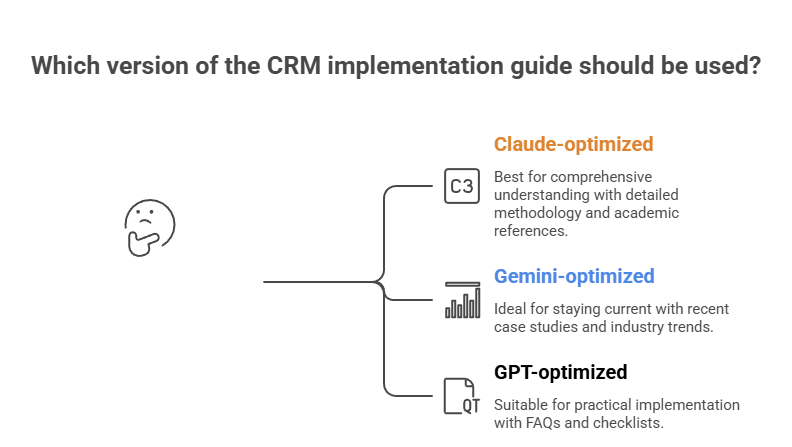
To illustrate how dramatically content performance varies across AI engines, consider this real-world example from a recent client project focused on enterprise software implementation.
We created three versions of the same core content about CRM implementation strategies:
Version A (Claude-optimized): Structured as a comprehensive guide with detailed methodology sections, extensive citations to industry research, clear section hierarchies, and formal tone. This version included data tables, statistical analysis, and academic-style references.
Version B (Gemini-optimized): Focused on recent case studies, included embedded videos and screenshots, referenced current industry trends, and maintained regular content updates with fresh statistics and examples.
Version C (GPT-optimized): Written in conversational tone addressing common implementation challenges, structured around frequently asked questions, included step-by-step implementation guides, and provided actionable checklists.
The results were striking. Claude cited Version A in 73% of relevant queries but rarely referenced the other versions. Gemini showed strong preference for Version B, particularly when users asked about current implementation trends. GPT demonstrated the most balanced approach but showed clear preference for Version C when users sought implementation guidance.
This experiment reinforced a critical insight: single-approach content optimization is no longer sufficient in the AI engine era. Successful search visibility requires understanding and accommodating the distinct preferences of each platform.
SGE Optimization in the Multi-Engine Era
Search Generative Experience (SGE) optimization has evolved beyond traditional Google optimization to encompass multiple AI engines simultaneously. The challenge lies in creating content that satisfies the diverse evaluation criteria without compromising quality or user experience.
Successful SGE optimization now requires:
- Content versioning strategies that address different AI engine preferences
- Sophisticated internal linking structures that guide AI engines to relevant content sections
- Multimedia integration that enhances rather than distracts from core messaging
- Citation strategies that satisfy academic standards while maintaining readability
- Regular content updates that maintain freshness without sacrificing evergreen value
The key insight is that SGE optimization isn’t about gaming individual systems but rather about creating genuinely valuable content that meets users’ needs across different interaction modalities.
Advanced Multi-Engine Optimization Framework
Developing an effective multi-engine optimization strategy requires a systematic approach that addresses the unique characteristics of each AI engine while maintaining content quality and user focus.
Content Architecture Strategy:
Create modular content architectures that allow for platform-specific optimization without duplicating effort. Develop comprehensive cornerstone content that can be supplemented with platform-specific elements.
Citation and Authority Building:
Implement tiered citation strategies that satisfy Claude’s academic preferences while providing the fresh references that Gemini favors and the practical examples that GPT values.
Technical Implementation:
Ensure your technical infrastructure supports the multimedia requirements for Gemini optimization while maintaining the structured data that Claude prefers and the accessibility that GPT requires.
Measurement and Iteration:
Develop measurement frameworks that track performance across multiple AI engines rather than focusing solely on traditional search metrics. Monitor how your content is cited, referenced, and synthesized across different platforms.
Practical Implementation Guide
Successfully optimizing for multiple AI engines requires systematic implementation of platform-specific strategies while maintaining content coherence and quality.
Week 1-2: Audit and Analysis
- Conduct comprehensive content audit identifying current performance across AI engines
- Analyze competitor content that performs well across multiple platforms
- Identify content gaps and optimization opportunities
- Establish baseline metrics for multi-engine performance
Week 3-4: Content Architecture Development
- Design modular content templates that accommodate different AI engine preferences
- Develop citation and reference standards that satisfy multiple evaluation criteria
- Create multimedia integration guidelines that enhance rather than distract
- Establish content update protocols for maintaining freshness
Week 5-8: Implementation and Testing
- Deploy optimized content across target platforms
- Implement tracking systems for multi-engine performance
- Conduct A/B tests comparing platform-specific optimizations
- Refine strategies based on performance data
Future-Proofing Your AI Engine Strategy
The AI engine landscape continues evolving rapidly, with new platforms emerging and existing engines updating their evaluation criteria regularly. Successful long-term optimization requires strategies that adapt to change rather than relying on static tactics.
Focus on fundamental content quality principles that transcend specific platform preferences. Create genuinely valuable content that serves user needs, maintains high standards for accuracy and authority, and provides practical value regardless of how it’s accessed or cited.
Develop agile content creation processes that allow for rapid adaptation to changing AI engine preferences without compromising content quality or user experience. This means building flexibility into your content architecture and maintaining the ability to quickly adjust optimization strategies.
The businesses that succeed in this new environment will be those that understand AI engines as sophisticated content evaluation systems rather than simple ranking algorithms. They’ll create content strategies that satisfy multiple evaluation criteria while maintaining focus on user value and business objectives.
Measuring Success Across Multiple AI Engines
Traditional SEO metrics provide insufficient insight into multi-engine performance. Successful measurement requires developing new frameworks that capture how content performs across diverse AI evaluation systems.
Key metrics for multi-engine optimization include:
- Citation frequency and context across different AI engines
- Content synthesis patterns showing how AI engines use your information
- Cross-platform search visibility for target queries
- User engagement metrics across different AI-powered interfaces
- Authority building progression as measured by AI engine citations
Develop dashboard systems that provide unified views of performance across multiple AI engines while allowing for platform-specific analysis and optimization.
The Strategic Imperative
The transformation of search through AI engines represents more than a tactical challenge – it’s a strategic imperative that will determine which businesses maintain search visibility in the coming decade. The companies that recognize and adapt to this shift early will gain significant competitive advantages.
This isn’t about abandoning traditional SEO principles but rather expanding them to encompass new evaluation criteria and user interaction modalities. The fundamental goal remains unchanged: connecting users with valuable information that serves their needs and drives business outcomes.
The multi-engine optimization approach requires investment in content quality, technical infrastructure, and measurement systems. However, the alternative – remaining optimized for yesterday’s search paradigm – presents far greater risks as AI engines continue gaining adoption and influence.
Success in this environment demands understanding that Claude, Gemini, and GPT aren’t just different ranking systems – they’re fundamentally different approaches to information evaluation and presentation. Each brings unique value propositions and requires distinct optimization strategies while serving the overarching goal of improved user experience and information accessibility.
The businesses that thrive will be those that embrace this complexity while maintaining focus on creating genuinely valuable content that serves users across multiple AI-powered interfaces. They’ll invest in understanding how these engines work, develop sophisticated content strategies that address diverse evaluation criteria, and maintain the agility to adapt as the landscape continues evolving.
The future of search visibility lies not in optimizing for any single AI engine but in creating content ecosystems that perform well across multiple platforms while serving user needs and business objectives. This represents both a significant challenge and an unprecedented opportunity for businesses willing to embrace the complexity and invest in comprehensive optimization strategies.
Glossary of Terms
- AI Engine: Artificial intelligence systems that process, evaluate, and present content to users, including Claude, Gemini, and GPT
- SGE (Search Generative Experience): Google’s AI-powered search feature that provides synthesized responses using generative AI technology
- Google AI Overviews: AI-generated summaries that appear at the top of Google search results, synthesizing information from multiple sources
- AI SERP Features: Search Engine Results Page elements powered by artificial intelligence, including AI overviews and enhanced snippets
- Citation Preferences: The specific criteria different AI engines use when selecting and referencing source content
- Multi-Engine Optimization: Content strategy that optimizes for multiple AI engines simultaneously rather than focusing on a single platform
- Featured Content: Content that AI engines select for prominent display in responses and summaries
- Search Visibility: The degree to which content appears in search results and AI-generated responses across platforms
- Content Synthesis: The process by which AI engines combine information from multiple sources into coherent responses
- Conversational Context: AI engines’ ability to understand and respond to user queries in natural, dialogue-like interactions
Further Reading