Key Takeaways:
- AI-powered growth stacks enable startups to compete with enterprise-level competitors by automating critical marketing and sales processes
- The most effective AI tools for startups focus on customer acquisition, content generation, lead scoring, and predictive analytics
- Integration priority should follow the PACE framework: Prioritize, Automate, Connect, Evolve
- Cost-effective AI solutions can deliver 3-5x ROI within the first quarter when properly implemented
- Building sustainable competitive advantage requires strategic AI tool selection aligned with defensive marketing principles
The startup landscape has fundamentally shifted. What once required armies of analysts, copywriters, and marketing specialists can now be accomplished by lean teams wielding the right AI-powered tools. Yet most startups are either overwhelmed by the sheer volume of AI solutions available or underwhelmed by tools that promise the world but deliver generic results.
After nearly two decades of building growth systems for both Fortune 500 companies and scrappy startups, I’ve witnessed a clear pattern: the companies that win aren’t necessarily those with the biggest budgets, but those that construct the most intelligent, integrated growth stacks. Today’s AI landscape presents an unprecedented opportunity for resource-constrained startups to build competitive advantage through strategic automation and intelligent decision-making.
The Foundation: Understanding AI-Powered Growth Architecture
Traditional growth stacks were built like silos—separate tools for email marketing, social media management, analytics, and customer support, often requiring manual data transfer and human interpretation. The AI-powered growth stack operates as an interconnected nervous system, where each tool not only performs its function but learns from and informs every other component.
This architectural shift creates what I call “compound intelligence”—where the collective output of your tools exceeds the sum of their individual capabilities. For startups, this means achieving enterprise-level sophistication without enterprise-level headcount or budgets.
The most successful AI-powered growth stacks I’ve implemented follow four core principles:
- Data Centralization: All customer touchpoints feed into a unified data lake
- Predictive Prioritization: AI algorithms identify and rank opportunities in real-time
- Automated Execution: High-probability actions execute without human intervention
- Continuous Learning: Every interaction improves future predictions and actions
Layer 1: Customer Intelligence and Acquisition Strategy
Your acquisition strategy becomes exponentially more powerful when backed by AI-driven customer intelligence. The goal isn’t just to acquire customers—it’s to acquire the right customers while building strategic moats around your market position.
Primary Tool Recommendation: Clay.com
Clay has revolutionized how startups approach lead generation and customer research. Unlike traditional tools that provide surface-level data, Clay aggregates information from over 75 data sources to create comprehensive customer profiles. For a startup, this means understanding not just who your prospects are, but their buying patterns, technology stack, recent company changes, and decision-making triggers.
Implementation priority: Set up Clay to automatically research and score leads based on your ideal customer profile (ICP). Create workflows that trigger when companies in your target market raise funding, hire key personnel, or show other buying signals.
Secondary Tool: Instantly.ai
While Clay identifies and enriches prospects, Instantly.ai handles the outreach at scale. What sets it apart is its AI-powered email deliverability optimization and personalization capabilities. The platform automatically adjusts sending patterns, rotates domains, and personalizes messages based on prospect data.
Cost-effective implementation: Start with their $37/month plan and gradually scale as you validate your messaging and target segments. Focus on building 3-5 highly targeted campaigns rather than broad, generic outreach.
| Tool |
Monthly Cost |
Primary Function |
ROI Timeline |
| Clay.com |
$149 |
Lead Research & Enrichment |
2-4 weeks |
| Instantly.ai |
$37 |
Email Outreach Automation |
1-3 weeks |
| Apollo.io |
$79 |
Database & CRM Integration |
3-6 weeks |
Layer 2: Content Generation and SEO Optimization
Content remains the foundation of sustainable advantage in digital marketing, but the game has changed. It’s no longer about producing more content—it’s about producing smarter content that serves both human readers and AI search engines.
Primary Tool Recommendation: Jasper.ai (Business Plan)
While many startups gravitate toward ChatGPT for content creation, Jasper’s business-focused features provide superior results for growth marketing. The platform’s brand voice training, SEO optimization suggestions, and campaign-specific templates create consistency across all content touchpoints.
Strategic implementation: Train Jasper on your brand voice using existing high-performing content, customer testimonials, and key messaging documents. Create template workflows for blog posts, email sequences, ad copy, and social media content that maintain brand consistency while allowing for topic variation.
SEO Intelligence: Surfer SEO + ContentKing
Surfer SEO’s Content Editor provides real-time optimization suggestions based on SERP analysis, while ContentKing monitors your site’s technical SEO health continuously. For startups competing against established players, this combination creates competitive strategy advantages by identifying content gaps and technical opportunities larger competitors might overlook.
Tactical approach: Use Surfer to identify low-competition, high-intent keywords in your niche. Create content clusters around these topics, ensuring each piece is optimized for both traditional search engines and AI-powered search experiences.
Layer 3: Conversion Optimization and User Experience
Converting visitors into customers requires understanding user behavior patterns that humans often miss. AI-powered conversion tools identify micro-interactions, behavioral triggers, and optimization opportunities that can dramatically impact your bottom line.
Primary Tool: Hotjar + Crazy Egg Integration
While not purely AI-native, these tools now incorporate machine learning algorithms to identify user behavior patterns and suggest optimization opportunities. Hotjar’s AI-powered insights highlight friction points in your user journey, while Crazy Egg’s heatmaps reveal how users actually interact with your pages versus how you think they do.
Implementation strategy: Install both tools across your key conversion pages. Focus initial analysis on pages with the highest traffic but lowest conversion rates. Use AI-generated insights to prioritize which elements to A/B test first.
Advanced Personalization: Dynamic Yield
For startups ready to invest in sophisticated personalization, Dynamic Yield’s AI algorithms create unique experiences for different user segments based on behavior, referral source, and engagement history.
Cost consideration: At $1,000+/month, this tool makes sense only for startups with significant traffic volume and clear personalization opportunities. Consider this a Layer 3 addition after you’ve optimized the basics.
Layer 4: Customer Relationship Management and Retention
Acquiring customers is expensive; retaining them is profitable. AI-powered CRM systems don’t just store customer data—they predict customer behavior, identify churn risks, and suggest proactive retention strategies.
Primary Tool: HubSpot with AI Add-ons
HubSpot’s AI-powered features include predictive lead scoring, automated email sequence optimization, and churn prediction algorithms. For startups, the free tier provides substantial functionality, while paid plans unlock advanced AI capabilities.
Strategic setup: Configure lead scoring based on both demographic data and behavioral signals. Set up automated workflows that trigger based on engagement drops, purchase patterns, or support ticket volume.
Customer Success Intelligence: ChurnZero
ChurnZero’s AI algorithms analyze customer usage patterns to predict churn risk weeks or months before customers actually leave. This early warning system allows proactive intervention and retention efforts.
Implementation priority: Focus on identifying the behavioral patterns that precede churn in your customer base. Use these insights to create automated intervention campaigns and success milestones.
Integration Framework: The PACE Methodology
The difference between startups that successfully implement AI-powered growth stacks and those that struggle lies in their integration approach. I’ve developed the PACE framework based on observing hundreds of implementations:
Prioritize (Weeks 1-2)
Identify your biggest growth constraint. Is it lead generation, conversion optimization, or customer retention? Your first AI tool should address your most critical bottleneck, not the shiniest new feature.
Practical steps:
- Audit your current funnel to identify the stage with the lowest conversion rate
- Calculate the potential revenue impact of improving each stage by 25%
- Select AI tools that directly address your highest-impact opportunity
Automate (Weeks 3-6)
Implement your chosen tools with a focus on automating repetitive, high-volume tasks first. Don’t try to automate creative or strategic decisions until you’ve mastered the basics.
Implementation sequence:
- Week 3: Install and configure your primary tool
- Week 4: Create basic automation workflows
- Week 5: Test and optimize automated processes
- Week 6: Scale successful automations
Connect (Weeks 7-10)
Integrate your AI tools to create compound intelligence. Data silos kill AI effectiveness—your tools should share information and insights.
Connection priorities:
- CRM integration with all customer touchpoints
- Analytics tracking across all automated processes
- Cross-tool data synchronization for unified customer profiles
Evolve (Ongoing)
Continuously optimize your AI-powered growth stack based on performance data and changing business needs. The best growth stacks evolve monthly, not annually.
Evolution metrics:
- Cost per acquisition trends
- Conversion rate improvements by channel
- Customer lifetime value increases
- Time-to-revenue acceleration
Cost-Effective Implementation Strategies
Budget constraints force creativity, and in AI tool selection, creativity often leads to better results than big budgets. Here’s how to maximize your AI investment while maintaining cash flow.
The 80/20 Approach
Most AI tools offer 80% of their value in their basic plans. Resist the urge to upgrade immediately—master the fundamentals before adding advanced features.
Monthly budget allocation for a typical early-stage startup:
- Lead generation and research: $200-300
- Content creation and SEO: $150-250
- Email marketing and automation: $100-200
- Analytics and optimization: $100-150
- CRM and customer management: $50-150
Free Tier Maximization
Many AI platforms offer generous free tiers that can support early-stage growth. HubSpot, Mailchimp, Google Analytics, and Hootsuite all provide substantial free functionality.
Strategy: Use free tiers to validate tool effectiveness before committing to paid plans. Track specific metrics that justify the upgrade cost.
Tool Consolidation Opportunities
Some platforms serve multiple functions effectively. Notion AI handles content creation, project management, and knowledge base functions. Zapier connects disparate tools without requiring expensive enterprise integrations.
Building Defensive Marketing Through AI
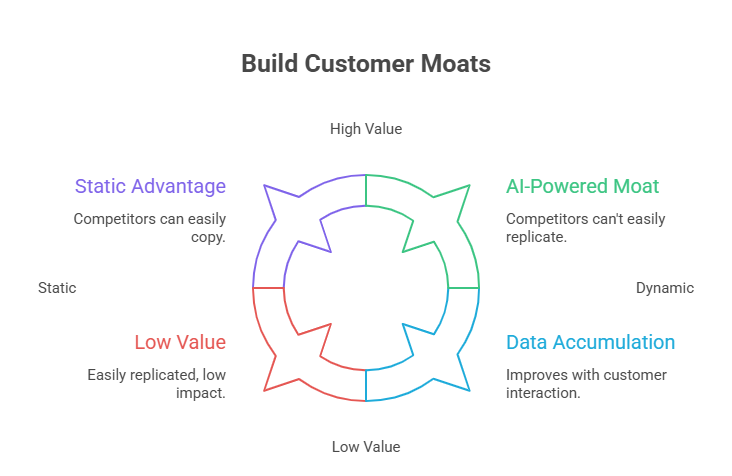
The most successful startups don’t just acquire customers—they build defensive marketing strategies that make competitive displacement difficult. AI tools excel at creating these protective moats through superior customer experience and predictive engagement.
Customer Experience Moats
Use AI to deliver customer experiences that competitors can’t easily replicate. This might include predictive customer support (anticipating problems before they arise), personalized content delivery, or dynamic pricing optimization.
Implementation: Set up AI workflows that track customer behavior patterns and trigger proactive support or engagement campaigns based on success indicators from your best customers.
Data Advantage Accumulation
Every customer interaction generates data that makes your AI tools smarter. This creates a compound advantage—the more customers you serve, the better your AI becomes at serving future customers.
Strategic focus: Prioritize AI tools that improve with usage rather than static solutions. Your customer data should become your most valuable competitive asset.
Measuring AI ROI and Growth Impact
AI tools promise significant returns, but measuring their actual impact requires sophisticated attribution modeling. Traditional marketing metrics often undervalue AI contributions because the benefits compound across multiple touchpoints.
Primary Metrics Framework
| Metric Category |
Key Indicators |
Measurement Frequency |
| Efficiency Gains |
Time saved per task, Cost per lead, Automation rate |
Weekly |
| Quality Improvements |
Lead quality scores, Conversion rate lifts, Customer satisfaction |
Monthly |
| Revenue Impact |
Customer lifetime value, Acquisition cost reduction, Revenue per customer |
Quarterly |
Attribution Modeling
Use multi-touch attribution to understand how AI tools contribute to your overall growth. Google Analytics 4’s machine learning models provide sophisticated attribution insights that help quantify AI tool ROI.
Implementation: Set up conversion tracking across all AI-powered touchpoints. Use UTM parameters and custom events to track the customer journey through your AI-optimized funnel.
Advanced Growth Frameworks for AI-Powered Startups
Once you’ve mastered the basics, advanced AI implementations can create exponential growth acceleration. These frameworks require more sophistication but deliver proportionally higher returns.
Predictive Growth Modeling
Use AI to model different growth scenarios and resource allocation strategies. Tools like Planhat or ChartMogul combined with predictive analytics can forecast growth trajectories based on current acquisition and retention patterns.
Application: Model the impact of increasing your ad spend, hiring additional sales reps, or expanding to new market segments. Use these insights to make data-driven resource allocation decisions.
Dynamic Competitive Strategy
AI-powered competitive intelligence tools like Crayon or Kompyte track competitor actions and suggest responsive strategies. This creates a dynamic competitive strategy that adapts to market changes in real-time.
Strategic value: Instead of reactive competitive responses, develop proactive competitive strategies based on predicted competitor moves and market shifts.
Future-Proofing Your AI Growth Stack
The AI landscape evolves rapidly. The tools dominating today may be obsolete in 18 months. Building a future-proof growth stack requires focusing on principles rather than specific platforms.
Technology Agnostic Principles
- Data portability: Ensure you can export data from any platform
- API-first thinking: Prioritize tools with robust integration capabilities
- Skill transferability: Focus on platforms that teach broadly applicable AI concepts
- Vendor diversification: Avoid over-dependence on any single AI provider
Emerging Technology Preparation
Stay informed about emerging AI developments that could disrupt current growth strategies. Voice search optimization, visual search, and conversational AI will likely impact growth strategies significantly over the next few years.
Preparation strategy: Allocate 10% of your AI tool budget to experimental platforms and emerging technologies. This provides early exposure to potentially game-changing innovations.
Implementation Checklist and Next Steps
Successful AI-powered growth stack implementation requires systematic execution. Use this checklist to ensure you’re maximizing your investment and minimizing implementation risks.
Week 1-2: Foundation Setup
- Audit current tools and identify integration opportunities
- Define key performance indicators for each AI tool
- Set up analytics tracking for attribution modeling
- Create data backup and export procedures
Week 3-4: Primary Tool Implementation
- Install and configure your highest-priority AI tool
- Create initial automation workflows
- Set up monitoring and alert systems
- Train team members on new processes
Week 5-8: Integration and Optimization
- Connect tools for data sharing and workflow automation
- A/B test AI-generated content and campaigns
- Optimize automation rules based on performance data
- Document processes for team scaling
Month 2-3: Scale and Iterate
- Add complementary tools to your stack
- Implement advanced features and customizations
- Create customer feedback loops for continuous improvement
- Plan next phase tool additions based on growth constraints
The AI-powered growth stack represents more than technological advancement—it’s a fundamental shift in how startups can compete and scale. Companies that master these tools early will build sustainable competitive advantages that become increasingly difficult for competitors to replicate.
The opportunity is immediate and significant. While your competitors debate whether AI is ready for business applications, you can be building compound advantages through intelligent automation and data-driven decision making. The startups that win in the next decade won’t necessarily be those with the best products—they’ll be those with the most intelligent growth systems.
Start with one tool, master its implementation, then systematically build your AI-powered growth engine. The future belongs to startups that can think like enterprises while maintaining the agility and innovation that only comes from resource constraints and ambitious vision.
Glossary of Terms
- AI-Powered Growth Stack: An integrated collection of artificial intelligence tools designed to automate and optimize customer acquisition, conversion, and retention processes
- Compound Intelligence: The exponential value created when multiple AI tools work together, sharing data and insights to produce results greater than their individual capabilities
- Competitive Advantage: A unique position or capability that allows a company to outperform competitors consistently over time
- Strategic Moats: Defensive barriers that protect a company’s market position from competitive threats
- Competitive Strategy: A comprehensive plan for gaining advantage over competitors through superior positioning, differentiation, or operational excellence
- Acquisition Strategy: A systematic approach to identifying, attracting, and converting prospects into customers
- Defensive Marketing: Marketing strategies designed to protect existing market share and customer relationships from competitive threats
- Sustainable Advantage: A competitive edge that can be maintained over long periods despite competitor attempts to replicate or overcome it
- Lead Scoring: The process of assigning numerical values to prospects based on their likelihood to convert into customers
- Predictive Analytics: The use of statistical algorithms and machine learning to identify future outcomes based on historical data
- Customer Lifetime Value (CLV): The predicted total revenue a customer will generate throughout their relationship with a company
- Churn Prediction: AI-powered analysis that identifies customers at risk of canceling or leaving before they actually do
- Attribution Modeling: The process of determining which marketing touchpoints deserve credit for conversions and sales
- Multi-touch Attribution: A method of tracking customer interactions across multiple channels and touchpoints to understand the complete conversion path
- Conversion Funnel: The series of steps prospects take from initial awareness to final purchase or desired action
Further Reading