Key Takeaways:
- Outsourced marketing talent enables companies to scale output by 200-400% without proportional budget increases through strategic use of fractional services and flexible staffing models
- The 70-20-10 talent allocation framework provides optimal balance between core capabilities, specialized expertise, and experimental initiatives
- Quality maintenance requires standardized processes, clear documentation, and tier-based service models that match talent expertise to project complexity
- Cost optimization through outsourced talent can reduce marketing expenses by 30-50% while maintaining or improving output quality when properly structured
- Successful coordination demands robust project management systems, clear communication protocols, and performance-based evaluation metrics
The marketing landscape has fundamentally shifted. Gone are the days when growth companies could simply hire their way to scale. Today’s most successful organizations are discovering that building scalable marketing operations requires a radically different approach to talent acquisition and deployment. The answer isn’t more full-time employees; it’s smarter integration of outsourced talent through strategic fractional services and flexible staffing models.
After nearly two decades of building and scaling marketing operations across enterprise and startup environments, I’ve witnessed companies achieve remarkable growth through outsourced talent strategies. The most successful implementations don’t just reduce costs; they fundamentally transform how organizations approach marketing execution, enabling output scaling that would be impossible through traditional hiring models.
The Economics of Scalable Marketing Talent
Traditional marketing scaling follows a linear cost model: double the output, double the headcount, double the budget. This approach creates unsustainable financial pressure, particularly for growth companies operating under capital constraints. The mathematics simply don’t work in today’s competitive landscape where customer acquisition costs continue rising while marketing budgets remain relatively flat.
Outsourced talent fundamentally changes this equation. Through strategic deployment of fractional services, companies can achieve 200-400% output increases with budget increases of only 50-100%. This non-linear scaling becomes possible through several key mechanisms:
- Elimination of overhead costs associated with full-time employees including benefits, training, and infrastructure
- Access to specialized expertise without long-term commitment costs
- Flexible capacity scaling that matches budget fluctuations and seasonal demands
- Reduced recruitment and onboarding expenses through established vendor relationships
The most successful implementations I’ve observed leverage a hybrid model combining core internal capabilities with strategic external partnerships. This approach provides stability while maintaining the flexibility essential for rapid scaling.
The 70-20-10 Talent Allocation Framework
Effective marketing scaling requires strategic talent allocation across three distinct categories. The 70-20-10 framework provides the optimal balance for sustainable growth:
70% Core Operations: Internal teams handling brand-critical activities including strategy development, customer relationship management, and core campaign oversight. These functions require deep organizational knowledge and benefit from full-time employee dedication.
20% Specialized Expertise: Fractional services providing advanced capabilities including SEO technical implementation, paid advertising optimization, marketing automation development, and analytics interpretation. These areas demand specialized knowledge that’s often more cost-effective to outsource than develop internally.
10% Experimental Initiatives: External consulting for testing new channels, technologies, or strategies. This allocation enables innovation without committing significant internal resources to unproven approaches.
This framework ensures organizational stability while maximizing flexibility and cost efficiency. Companies implementing this structure typically see 40-60% faster execution times on complex marketing initiatives compared to purely internal teams.
Service Models for Optimal Scaling
Not all outsourced talent operates equally. Success depends on selecting appropriate service models that align with organizational needs and growth objectives. The most effective implementations utilize a tiered approach:
| Service Tier |
Use Case |
Typical Cost Structure |
Integration Level |
| Strategic Consulting |
High-level strategy, audits, optimization |
Project-based or retainer |
Low, outcome-focused |
| Fractional Services |
Ongoing specialized execution |
Monthly retainer with defined scope |
Medium, regular collaboration |
| Dedicated Resources |
Extension of internal team |
Hourly or monthly allocation |
High, daily coordination |
| Project Specialists |
Specific deliverables or campaigns |
Fixed-price project fees |
Variable, deliverable-dependent |
The key to successful implementation lies in matching service models to specific organizational needs rather than applying a one-size-fits-all approach. High-performing companies typically utilize multiple tiers simultaneously, creating a comprehensive external talent ecosystem.
Quality Maintenance at Scale
The primary concern organizations express regarding outsourced talent centers on quality control. This concern is valid but entirely manageable through systematic approaches to vendor management and process standardization.
Quality maintenance begins with establishing clear performance standards and documentation protocols. Every outsourced engagement must include:
- Detailed scope documents outlining deliverables, timelines, and success metrics
- Brand guidelines and creative standards ensuring consistent output
- Review and approval processes that maintain oversight without creating bottlenecks
- Performance tracking systems measuring both output quality and process efficiency
The most successful quality control systems I’ve implemented utilize a three-tier review process: initial vendor review, internal stakeholder approval, and post-delivery performance evaluation. This approach ensures quality while maintaining execution speed.
Additionally, establishing long-term relationships with proven vendors creates institutional knowledge that dramatically improves output quality over time. Vendors who understand organizational culture, customer base, and strategic objectives consistently deliver superior results compared to constantly rotating providers.
Coordination Strategies for Distributed Teams
Effective coordination represents the difference between successful outsourced talent implementation and chaotic execution. The complexity increases exponentially as the number of external partners grows, requiring sophisticated management approaches.
The foundation of successful coordination lies in establishing clear communication protocols and project management systems. Every external partner must integrate into unified workflows that provide visibility and accountability.
Communication Framework:
- Weekly status meetings with standardized reporting formats
- Shared project management platforms providing real-time visibility
- Clear escalation paths for issue resolution
- Regular strategic alignment sessions ensuring continued objective alignment
Technology Integration:
- Unified project management systems accessible to all external partners
- Shared asset libraries ensuring brand consistency
- Integrated reporting dashboards providing performance visibility
- Communication platforms enabling seamless collaboration
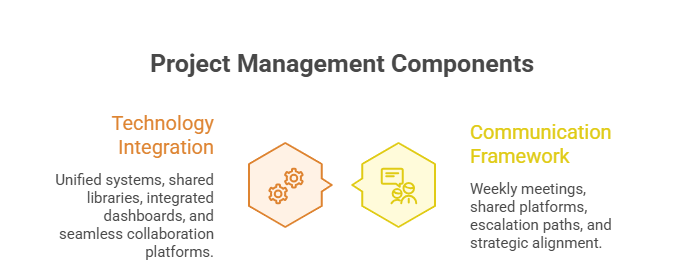
The most effective coordination strategies create seamless integration between internal teams and external partners. When properly implemented, stakeholders cannot distinguish between internal and external contributions, indicating optimal integration.
Strategic Staffing Strategy Development
Developing an effective staffing strategy requires careful analysis of organizational capabilities, growth objectives, and resource constraints. The most successful approaches begin with comprehensive capability auditing to identify internal strengths and external needs.
The strategic staffing process should follow this systematic approach:
Phase 1: Capability Assessment
Evaluate current internal capabilities across all marketing functions. Identify areas of strength that should remain internal and areas where external expertise would provide superior results or cost efficiency.
Phase 2: Growth Mapping
Project future capability needs based on growth objectives. Consider both scaling existing functions and adding new capabilities required for expanded market reach or product offerings.
Phase 3: Cost-Benefit Analysis
Compare costs and benefits of internal hiring versus external partnerships for each identified need. Factor in not just direct costs but also time-to-productivity, training requirements, and long-term retention challenges.
Phase 4: Integration Planning
Develop detailed plans for integrating external partners into existing workflows. Address communication protocols, quality control measures, and performance evaluation systems.
Phase 5: Implementation and Optimization
Execute the staffing strategy through phased implementation, allowing for optimization and adjustment based on real-world performance data.
This systematic approach ensures strategic alignment while providing flexibility for adjustment as organizational needs evolve.
Cost Management and Budget Optimization
Effective cost management in outsourced talent strategies requires sophisticated budgeting approaches that account for variable costs and performance-based pricing. Traditional fixed-cost budgeting models often fail when applied to flexible staffing arrangements.
The most successful cost management strategies utilize value-based budgeting that aligns spending with output and results rather than time-based metrics. This approach provides several advantages:
- Costs scale directly with output, maintaining consistent unit economics
- Performance incentives align vendor interests with organizational objectives
- Budget flexibility enables rapid scaling for high-performing initiatives
- Reduced financial risk through outcome-based pricing structures
Practical cost optimization techniques include:
Volume-Based Pricing: Negotiate pricing tiers that reduce unit costs as volume increases, creating economies of scale even with external partners.
Performance Bonuses: Implement bonus structures that reward exceptional results, aligning vendor incentives with organizational success metrics.
Flexible Retainers: Structure retainer agreements with variable components that can scale up or down based on business needs and budget availability.
Multi-Vendor Competition: Maintain relationships with multiple providers for similar services, enabling competitive pricing and performance comparisons.
Technology and Process Integration
Successful scaling through outsourced talent demands robust technology infrastructure that enables seamless integration and collaboration. The complexity of managing multiple external partners requires sophisticated systems that provide visibility, control, and efficiency.
The technology stack for outsourced talent management should include:
Project Management Platform: Centralized system providing task assignment, progress tracking, and deadline management across all external partners. Popular solutions include Asana, Monday.com, and Notion, each offering different advantages depending on organizational needs.
Communication Hub: Unified communication platform enabling real-time collaboration between internal teams and external partners. Slack or Microsoft Teams integration creates seamless information flow.
Asset Management System: Centralized repository for brand assets, templates, and guidelines ensuring consistency across all external outputs. Systems like Brandfolder or Frontify provide sophisticated asset organization and access control.
Performance Dashboard: Integrated reporting system providing real-time visibility into external partner performance, project status, and budget utilization. Custom dashboards using tools like Tableau or Power BI enable sophisticated performance analysis.
Performance Measurement and Optimization
Measuring performance across distributed talent networks requires comprehensive metrics that evaluate both individual contributor effectiveness and overall system performance. The most successful implementations utilize multi-layered measurement approaches.
Key performance indicators should address multiple dimensions:
Output Quality Metrics:
- Deliverable quality scores based on standardized evaluation criteria
- Revision rates and time-to-approval measurements
- Brand compliance and guideline adherence tracking
- Client or stakeholder satisfaction ratings
Efficiency Metrics:
- Time-to-delivery compared to internal benchmarks
- Cost per deliverable across different provider types
- Resource utilization and capacity optimization
- Process bottleneck identification and resolution
Strategic Impact Metrics:
- Contribution to overall marketing performance objectives
- Innovation and creative contribution measurements
- Scalability and flexibility demonstration
- Long-term relationship value and development
Regular performance reviews should occur monthly for tactical metrics and quarterly for strategic assessments. This cadence provides sufficient data for optimization while maintaining focus on long-term objectives.
Risk Management and Contingency Planning
Outsourced talent strategies introduce specific risks that require proactive management and contingency planning. The most common risks include provider dependency, quality inconsistency, communication challenges, and intellectual property concerns.
Effective risk mitigation strategies include:
Provider Diversification: Maintain relationships with multiple providers for critical functions, preventing over-dependence on single sources and ensuring continuity options.
Knowledge Transfer Protocols: Implement systematic documentation and knowledge transfer processes ensuring institutional knowledge isn’t lost when provider relationships change.
Quality Assurance Systems: Establish multi-tier quality control processes that catch issues before they impact customer-facing activities or brand perception.
Legal Protection: Develop comprehensive contracts addressing intellectual property rights, confidentiality requirements, and performance standards with clear remedy procedures.
Business Continuity Planning: Create detailed contingency plans for various scenarios including provider termination, capacity constraints, and quality issues.
Future-Proofing Your Outsourced Talent Strategy
The landscape of outsourced talent continues evolving rapidly, driven by technological advancement, changing work preferences, and economic pressures. Successful strategies must anticipate and adapt to these changes while maintaining operational effectiveness.
Key trends shaping the future of outsourced talent include:
AI-Enhanced Capabilities: External partners increasingly leverage artificial intelligence to enhance productivity and output quality. Organizations must evaluate how AI integration affects vendor selection and pricing models.
Specialized Micro-Services: The trend toward highly specialized service providers offering narrow but deep expertise creates opportunities for more targeted vendor relationships.
Global Talent Access: Improved communication technology and changing work patterns enable access to specialized talent regardless of geographic location, expanding available options significantly.
Performance-Based Models: Increasing sophistication in performance measurement enables more nuanced pricing models based on outcomes rather than time or deliverables.
Organizations implementing outsourced talent strategies today must design flexible frameworks that can adapt to these evolving trends while maintaining operational stability and performance standards.
Implementation Roadmap
Successful implementation of scalable marketing through outsourced talent requires systematic execution following a proven roadmap. Based on extensive experience across multiple industries and company stages, the following implementation sequence provides optimal results:
Months 1-2: Foundation Development
- Complete capability assessment and gap analysis
- Define service model requirements and budget parameters
- Establish vendor evaluation criteria and selection processes
- Develop initial contract templates and performance frameworks
Months 3-4: Pilot Implementation
- Select and onboard 2-3 vendors for non-critical functions
- Implement communication and project management systems
- Execute small-scale projects to test integration effectiveness
- Collect performance data and optimize processes
Months 5-6: Scaling and Optimization
- Expand successful vendor relationships and add new capabilities
- Refine coordination processes based on pilot learnings
- Implement comprehensive performance measurement systems
- Develop long-term strategic partnerships with top performers
Months 7-12: Full Integration
- Complete transition to optimized staffing model
- Establish regular review and optimization cadences
- Implement advanced cost management and performance optimization
- Plan for future scaling and capability expansion
This phased approach minimizes risk while enabling rapid learning and optimization, resulting in more successful long-term implementations.
The transformation of marketing operations through strategic outsourced talent deployment represents one of the most significant opportunities for growth companies today. Organizations that master this approach gain sustainable competitive advantages through superior cost efficiency, enhanced capabilities, and unprecedented scaling flexibility. The question isn’t whether to implement outsourced talent strategies, but how quickly you can develop the sophisticated management capabilities required to maximize their potential.
Success in this new paradigm demands more than tactical execution; it requires strategic vision, operational excellence, and continuous optimization. The organizations that commit to developing these capabilities will define the next generation of marketing excellence.
Glossary of Terms
- Fractional Services: Part-time professional services providing specialized expertise on a regular but not full-time basis, typically through monthly retainers or defined time allocations.
- Flexible Staffing: Employment approach that enables rapid scaling of workforce capacity through variable arrangements including contractors, consultants, and external partners.
- Service Models: Structured approaches to delivering professional services, including consulting, fractional services, dedicated resources, and project-based arrangements.
- Staffing Strategy: Comprehensive plan for acquiring and deploying human resources to achieve organizational objectives, encompassing both internal hiring and external partnerships.
- Value-Based Budgeting: Financial planning approach that allocates resources based on expected outcomes and value delivery rather than traditional cost categories.
- Capability Assessment: Systematic evaluation of organizational strengths and weaknesses across functional areas to identify improvement opportunities.
- Performance-Based Pricing: Compensation structure that ties payment to achievement of specific outcomes or performance metrics rather than time or effort inputs.
- Vendor Diversification: Risk management strategy involving relationships with multiple service providers to prevent over-dependence on single sources.
- Integration Framework: Systematic approach to combining internal capabilities with external resources to create unified operational effectiveness.
- Scalability Metrics: Measurements that evaluate an organization’s ability to increase output or capacity without proportional increases in costs or resources.
Further Reading