Key Takeaways:
- Poor first-party data strategy is one of the most expensive and least visible problems inside digital marketing agencies today.
- Most breakdowns happen not from lack of data, but from lack of structure, ownership, and cross-client standardization.
- Agencies that build repeatable data collection and activation frameworks dramatically outperform those running on ad hoc setups.
- Marketing ops infrastructure is the foundation that makes first-party data actually usable at scale.
- Practical systems, clear governance, and consistent auditing are non-negotiable if you want to protect client performance and agency profitability.
Why First-Party Data Is Now the Agency’s Most Critical Asset
The deprecation of third-party cookies, rising signal loss across paid platforms, and increasing consumer privacy expectations have fundamentally changed how performance marketing works. These are not emerging trends. They are present-day realities. And yet, a staggering number of digital marketing agencies are still running client campaigns on shaky data foundations that were never built to handle what the current landscape demands.
First-party data strategy is no longer a nice-to-have technical initiative sitting in a backlog somewhere. It is the connective tissue between client spend and measurable results. When that tissue is weak, everything from attribution to audience targeting to reporting becomes unreliable. And unreliable data does not just create performance problems. It erodes client trust, inflates cost per acquisition, and quietly kills agency retention rates.
The difficult truth is that most agencies recognize the problem at a surface level but struggle to address it systematically across their client portfolios. This article breaks down exactly why that is, what it costs, and how to fix it with frameworks that actually work in the real world.
The Real Cost of Getting This Wrong
Before diagnosing the problem, it is worth quantifying what poor first-party data strategy actually costs an agency and its clients. The damage shows up in several compounding ways.
On the paid media side, platforms like Meta and Google increasingly rely on your own customer data signals to optimize delivery. Conversion API implementations that are incomplete or misconfigured result in signal loss that directly inflates cost per result. In many audits of mid-market accounts, it is common to find event match quality scores sitting below 6 out of 10 on Meta, which is a clear indicator of weak first-party data feeding into the system. That weakness translates directly into higher CPMs and less efficient optimization.
On the organic and SEO side, first-party behavioral data is one of the few remaining levers agencies control fully. Without a clear strategy for collecting, segmenting, and activating it, content personalization, internal linking logic, and conversion rate optimization efforts are all flying blind.
And from a reporting standpoint, agencies with poor data infrastructure spend disproportionate amounts of time manually reconciling numbers across platforms rather than generating insight. That is margin erosion hiding in plain sight inside your marketing ops workflow.
Where First-Party Data Strategy Most Commonly Breaks Down
After working with dozens of brands across different verticals and growth stages, the failure points tend to cluster around five consistent areas.
- No single data ownership model: First-party data touches CRM, paid media, analytics, email, and dev. When nobody owns it end-to-end, it gets managed in fragments. The result is inconsistent collection, siloed activation, and zero institutional knowledge about what data the client actually has or what it means.
- Tag and tracking infrastructure that was never properly validated: Many clients inherit tracking setups from previous agencies or internal teams that were configured quickly and never audited. GA4 properties collecting duplicate events, Meta pixels firing without the Conversions API as a backup, and UTM parameters used inconsistently are all endemic issues that compound over time.
- No standardized taxonomy across clients: Agencies that manage multiple accounts without a standardized event naming convention, UTM structure, or audience segmentation logic are constantly rebuilding from scratch. This kills efficiency and makes cross-client learning nearly impossible.
- Data collection without activation planning: Collecting first-party data without a clear plan for how it will be segmented, matched, and activated across paid and owned channels is the equivalent of filling a warehouse with inventory you can never find. The data exists, but it generates no value.
- Consent and compliance treated as a checkbox: GDPR, CCPA, and evolving global privacy regulations are not just legal requirements. They directly affect what data you can collect, store, and use. Agencies that treat consent management as a one-time setup rather than an ongoing governance function are accumulating invisible liability for their clients.
What Good Marketing Ops Infrastructure Actually Looks Like
The agencies that are winning on first-party data are not necessarily the ones with the biggest tech stacks. They are the ones with the clearest systems. Here is what strong marketing ops infrastructure looks like in practice for a digital marketing agency managing multiple client accounts.
- A documented data collection matrix per client: For each client, define every touchpoint where first-party data is collected, what data is captured, where it flows, and who owns that flow. This document should be a living asset, not a one-time onboarding exercise.
- Validated event tracking with a QA protocol: Every tracking implementation should go through a standardized QA checklist before a campaign launches. This includes verifying that events fire correctly in both browser and server-side environments, that deduplication logic is in place, and that event parameters are passing accurately.
- A standardized UTM taxonomy enforced by tooling: Build a UTM builder template that enforces consistent naming conventions across all clients and channels. This sounds basic, but it is the single most common data integrity failure we see in agency audits.
- CRM-to-ad-platform data pipelines: Customer lists, purchase history, and lifecycle stage data living in a CRM are only valuable if they are flowing into your ad platforms in a structured, compliant, and regularly refreshed way. Integrations between platforms like HubSpot, Salesforce, or Klaviyo and Meta or Google Ads should be reviewed and re-validated quarterly.
- A consent management platform that actually works: CMPs like OneTrust or Cookiebot are not just compliance tools. When configured correctly, they pass consent signals downstream to your analytics and ad platforms, which affects what gets tracked and what does not. Agencies need to understand how their CMP configuration affects data collection outcomes for each client.
A Practical Decision-Making Framework for Agencies
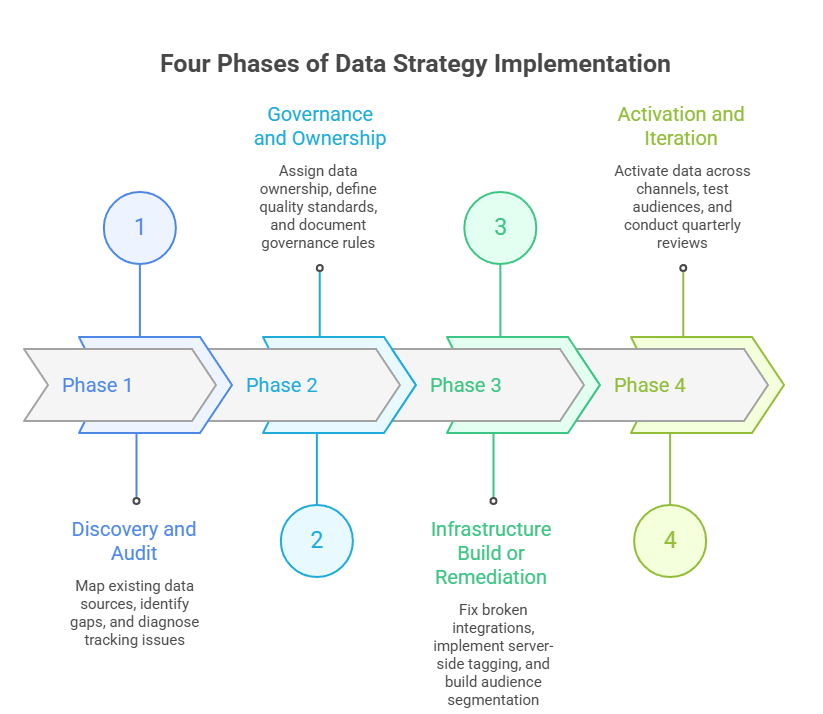
When onboarding a new client or auditing an existing one, agencies need a repeatable framework that moves first-party data strategy from abstract concept to concrete action. The following four-phase approach has proven effective across B2B and DTC client environments.
- Phase 1: Discovery and Audit. Map every existing data source, integration, and touchpoint. Identify gaps between what data the client thinks they have and what is actually being collected and stored. Use tools like Google Tag Manager preview mode, Meta’s Event Manager diagnostics, and GA4’s DebugView to surface tracking issues quickly.
- Phase 2: Governance and Ownership. Assign explicit ownership for each data stream. Define what good looks like for event match quality, data freshness, and audience size thresholds. Document the governance rules and make sure both the agency team and the client stakeholders understand them.
- Phase 3: Infrastructure Build or Remediation. Fix what is broken before building anything new. Implement or repair server-side tagging, Conversions API connections, and CRM integrations. Build the audience segmentation structure that will feed paid media, email, and personalization workflows.
- Phase 4: Activation and Iteration. Begin activating the data across channels in a structured way. Test suppression audiences to reduce wasted spend. Build lookalike audiences from high-value customer segments. Use behavioral data from GA4 to inform content strategy and on-site personalization. Set a quarterly review cadence to re-audit, refresh, and evolve the strategy.
Real-World Example: What Signal Loss Looks Like in Practice
Consider a mid-size e-commerce brand running significant monthly spend across Meta. The agency inherited the account with a basic pixel setup, no Conversions API, and a GA4 configuration that was double-counting purchase events. On the surface, the account looked like it was generating acceptable ROAS figures. But when the agency ran a proper data audit, they discovered that over 40 percent of purchase events were being reported in-platform without corresponding CRM data to validate them.
The result of that signal confusion was that Meta’s algorithm was optimizing toward a distorted conversion signal. After implementing the Conversions API, correcting deduplication logic, and passing hashed customer email addresses to improve event match quality from a score of 4.8 to 7.6, the cost per purchase dropped by 22 percent within six weeks. No creative change. No budget increase. Just cleaner first-party data feeding the algorithm what it actually needed.
This type of result is not exceptional. It is repeatable, and it is available to any agency willing to invest in getting the data infrastructure right before optimizing anything else.
How Agencies Can Productize First-Party Data Strategy
Beyond fixing problems for individual clients, forward-thinking agencies are starting to build first-party data strategy into their core service offering as a distinct, billable practice area. This is smart from both a margin and a differentiation standpoint.
Here is how to structure it:
- Offer a Data Health Audit as a standalone engagement: A structured audit that assesses tracking implementation, data flow, audience quality, and compliance posture gives new clients immediate value and gives the agency a clear baseline to work from. Price it appropriately. The insights it generates justify the investment many times over.
- Bundle data infrastructure setup into onboarding: Stop treating tracking setup as a background task. Make it a visible, documented deliverable with its own timeline and sign-off process. This sets professional expectations and protects the agency when performance questions arise later.
- Build recurring data governance into retainers: Quarterly data audits, audience refreshes, and integration health checks should be line items in ongoing client engagements, not occasional favors. They are legitimate, high-value activities that protect campaign performance over time.
- Create a cross-client benchmarking model: With proper anonymization and client consent, the aggregated first-party data insights from across your client portfolio can inform better benchmarks, smarter recommendations, and faster onboarding for new accounts in similar verticals.
The Competitive Advantage Nobody Talks About
There is a version of the digital marketing agency business where the entire value proposition is built on media buying efficiency and creative execution. That version of the business is under significant pressure right now, because the platforms are commoditizing optimization and AI is commoditizing creative production.
The version of the agency business that holds its value is the one where deep data infrastructure knowledge, proprietary audience assets, and first-party data strategy create compounding advantages that clients genuinely cannot replicate on their own. That is where differentiation lives in 2025 and beyond.
Agencies that invest now in building out their marketing ops capabilities around first-party data are not just solving a technical problem. They are building a moat. The hidden costs of poor first-party data strategy are real, measurable, and avoidable. The agencies that recognize this and act on it systematically will be the ones still growing when the landscape shifts again.
Glossary of Terms
- First-Party Data: Data collected directly from your own audience through owned channels such as your website, CRM, email list, or app. It is the highest-quality data available because it comes with consent and is directly tied to real interactions with your brand.
- First-Party Data Strategy: A structured plan that governs how first-party data is collected, stored, governed, and activated across marketing channels to drive measurable business outcomes.
- Digital Marketing Agency: An organization that provides marketing services to clients across channels including paid media, SEO, content, email, and analytics, typically managing strategy, execution, and reporting on behalf of those clients.
- Marketing Ops (Marketing Operations): The function within a marketing team or agency responsible for the technology, processes, data infrastructure, and workflows that enable marketing programs to run effectively and be measured accurately.
- Conversions API (CAPI): A Meta server-side solution that sends conversion event data directly from a server to Meta, bypassing browser-based tracking limitations and improving signal quality for ad optimization.
- Event Match Quality: A Meta metric that scores how well the customer information sent with a conversion event matches a Meta account. Higher scores mean better optimization and audience matching.
- GA4 (Google Analytics 4): Google’s current analytics platform, built on an event-based data model and designed to support cross-platform measurement including web and app.
- UTM Parameters: Tracking codes appended to URLs to identify the source, medium, campaign, and other attributes of website traffic for analytics and attribution purposes.
- Consent Management Platform (CMP): A tool that manages user consent for data collection in compliance with privacy regulations such as GDPR and CCPA, and passes consent signals to downstream analytics and advertising platforms.
- Server-Side Tagging: A tracking implementation approach where data collection logic is moved from the user’s browser to a server environment, reducing data loss from ad blockers and browser restrictions.
- Lookalike Audience: An ad targeting audience created by a platform such as Meta or Google that mirrors the characteristics of a seed audience, such as your existing customers, to find new users likely to convert.
- ROAS (Return on Ad Spend): A performance metric that measures revenue generated for every dollar spent on advertising.
- GDPR: The General Data Protection Regulation, a European Union privacy law that governs how organizations collect, store, and process the personal data of EU residents.
- CCPA: The California Consumer Privacy Act, a U.S. state privacy law that gives California residents rights over how their personal data is collected and used by businesses.
- Signal Loss: The degradation in the quality or volume of conversion data reaching ad platforms, typically caused by browser privacy restrictions, ad blockers, or incomplete tracking implementations.
- Deduplication: The process of identifying and removing duplicate data entries, particularly important in ad tracking to prevent the same conversion event from being counted multiple times across browser and server-side tracking systems.
Further Reading

 Mike VillarMarch 27, 2026