
Why Average Order Value Optimization Beats Chasing New Traffic
Key Takeaways: Optimizing Average Order Value (AOV) consistently delivers faster, more measurable ROI than scaling paid traffic spend. Bundling, upsells, cross-sells, and...
Mike VillarKey Takeaways: Marketing SOPs are not just documentation exercises. They are operational infrastructure that directly affects agency profitability and client retention. Most...
 Mike VillarApril 6, 2026
Key Takeaways:
There is a moment almost every growing digital marketing agency experiences. The client roster looks healthy. Revenue is climbing. The team is energized. Then, almost without warning, things start slipping. A deliverable goes out with the wrong brand voice. A campaign launches without proper UTM tracking. A client asks a question about last month’s results and three people give three different answers. The agency is not failing because it lacks talent. It is failing because it never built the operational backbone to support its own growth.
This is the SOP gap, and it is more common than most agency leaders are willing to admit. Marketing SOPs, or standard operating procedures, are the connective tissue of a well-run agency. They define how work gets done, who owns what, what quality looks like, and how decisions get made when leadership is not in the room. Without them, every client engagement becomes a bespoke improvisation. That might feel creative, but it is operationally unsustainable at scale.
This article is written for agencies that are serious about building systems that hold. Not theoretical frameworks, not generic templates, but practical, implementation-ready guidance rooted in what actually works across the lifecycle of a digital marketing agency.
Before diving into solutions, it is worth being honest about the damage that weak marketing ops infrastructure causes. Most agency leaders understand the cost in terms of rework and client complaints. But the deeper costs are rarely quantified.
Consider account management. When there is no SOP for client onboarding, account managers spend hours figuring out what questions to ask, what tools to set up, and what the first 30 days should look like. Multiply that by every new client across a team of five account managers and you are looking at dozens of hours of wasted productivity every single month.
Consider reporting. Without a standardized reporting SOP, every analyst builds reports differently. Clients see inconsistent data. Leadership cannot compare performance across accounts. Decisions get made on incomplete or inconsistent information.
Consider campaign launches. Without a pre-launch checklist SOP, campaigns go live with missing conversion tracking, wrong audience segments, or copy that has not been through a quality check. Each of these errors has a measurable dollar cost, either in wasted ad spend or in the human time required to fix it.
A 2023 analysis from HubSpot found that operational inefficiency is among the top five reasons digital agencies lose clients before the 12-month mark. Poor marketing ops does not just cost money. It costs relationships and reputation.
Agencies fail at building marketing SOPs for predictable reasons. Understanding these failure patterns is the first step toward avoiding them.
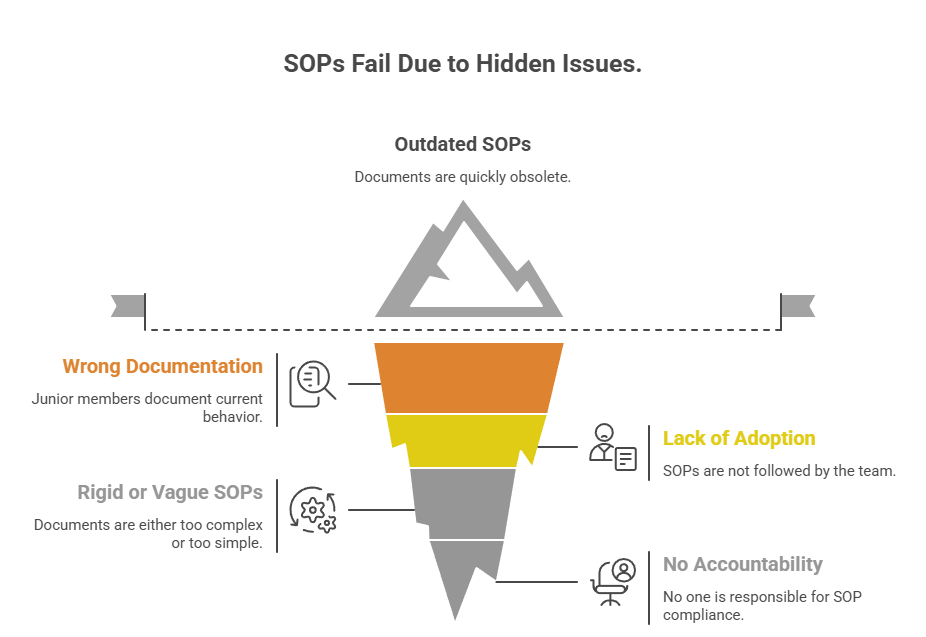
Building a sustainable SOP system for a digital marketing agency requires thinking at three levels simultaneously: strategic, operational, and tactical. Most agencies only build at the tactical level, which is why their SOPs feel disconnected from actual business outcomes.
At the strategic level, your SOPs should reflect the agency’s service model, client segmentation, and growth priorities. A boutique agency serving enterprise SaaS companies needs different operating procedures than a performance marketing shop serving e-commerce DTC brands.
At the operational level, SOPs should define how each core function works, how teams hand off work to each other, and what accountability structures look like. This is where most agencies underinvest. Cross-functional handoffs, specifically between strategy, creative, media buying, and reporting, are the most common source of errors and delays.
At the tactical level, SOPs become the day-to-day checklists, templates, and decision trees that practitioners actually use. These need to be specific enough to be actionable but flexible enough to accommodate client-specific nuances.
A practical framework for structuring this looks like the following:
The single biggest predictor of SOP adoption inside a digital marketing agency is not the quality of the documentation. It is the degree to which the people doing the work were involved in creating it.
Practitioners build better SOPs than managers. They know where the friction points are. They know what shortcuts exist, which edge cases come up repeatedly, and what information they always need but never have at the start of a project. Engaging your team in SOP creation is not just a morale strategy. It is an accuracy strategy.
A practical approach is to run SOP sprints. Bring the relevant team together for a focused 90-minute session. Start by mapping the current process as it actually happens, not as it was designed to happen. Identify every step, every decision point, every handoff. Then, as a group, identify where the process breaks down, what is missing, and what should change. Build the SOP from that conversation.
Once the SOP is drafted, embed it into your project management platform. If your agency uses Asana, ClickUp, Notion, or Monday.com, the SOP should not live in a separate document that someone has to go find. It should be the task list, the template, the checklist that populates automatically when a new project is created. This is how you operationalize compliance without relying on memory or goodwill.
While every agency’s SOP ecosystem will be customized to their service model, there are specific procedures that consistently represent the highest-leverage opportunities for improvement.
Modern marketing ops is inseparable from technology. The tools your agency uses to manage projects, communicate with clients, and execute campaigns should be configured to enforce your SOPs by default, not just support them optionally.
Consider how this works in practice. If your campaign launch SOP requires UTM parameters on every link, your project management template for campaign launches should include a task called “UTM parameter verification” with a designated assignee and a dependency that prevents the campaign go-live task from being marked complete until that step is done. The technology enforces the standard.
Similarly, if your reporting SOP requires a specific dashboard format, that format should be a locked template in your reporting tool. Analysts should not be building reports from scratch each month. They should be populating a standardized structure with client-specific data.
Agencies scaling into AI-assisted workflows need to apply this same discipline. Prompt libraries, AI output review checklists, and human-in-the-loop approval workflows are all extensions of your SOP infrastructure into new tooling. The principles are identical. The format may look different.
An SOP that does not improve outcomes is just documentation. To know whether your marketing SOPs are generating value, you need to measure them against operational and business metrics.
Useful metrics to track include:
As an agency grows from 5 clients to 25 to 50, the SOP challenges shift. What worked at smaller scale begins to break under the weight of complexity and volume.
The first major breaking point typically occurs around the 15-client mark. At this size, informal coordination stops working. The team can no longer rely on everyone being in the same room or Slack channel to catch errors. This is the point where agencies that invested in SOPs early begin to pull away from those that did not.
The second breaking point often occurs during rapid hiring phases. When an agency brings on three or four new team members in a short period, the quality of work output frequently drops, not because the new hires are underqualified, but because the knowledge transfer process is not systematized. Mature SOPs solve this by externalizing institutional knowledge.
The third breaking point is service expansion. When an agency adds a new service line, say expanding from paid media to SEO or from social media management to marketing automation, the temptation is to run that new service informally until it proves itself. This is exactly backward. New service lines need SOPs before they go to market, not after. The first few clients in a new service area set the quality standard and the internal habits. Build the SOP before you sell the service.
If your agency is starting from scratch, the task can feel overwhelming. It is not. Start with the process that causes the most pain right now. That is probably your client onboarding, your campaign launch protocol, or your reporting cycle. Pick one, run an SOP sprint with the relevant team, and build something that is good enough to use, not perfect.
Implement it for 60 days. Gather feedback. Refine. Then move to the next highest-pain process. Within six months of this approach, most agencies will have covered the critical surface area of their operations. The key is iteration, not perfection.
Assign a Director of Operations or a senior team lead as the SOP owner. Give that person a quarterly review cycle where they audit existing SOPs for accuracy, gather practitioner feedback, and prioritize updates. This keeps the system alive.
Remember that the goal of marketing SOPs is not bureaucracy. The goal is consistency that allows for creativity. When the operational scaffolding is solid, your strategists, creatives, and media buyers can focus their energy on the work that actually requires human judgment, not on figuring out the process every time from scratch.
Key Takeaways: Optimizing Average Order Value (AOV) consistently delivers faster, more measurable ROI than scaling paid traffic spend. Bundling, upsells, cross-sells, and...
Mike VillarKey Takeaways: Statistical significance is widely misunderstood and misreported in marketing tests, leading to decisions based on faulty data. Peeking at test results before...
Alvar SantosKey Takeaways: Looker Studio is the best budget-friendly option for marketing teams already embedded in the Google ecosystem, offering free access and solid connector support. Domo...
Amanda Bianca CoStart your brand's success journey today with a conversation. Share your goals and objectives with us and let's set up a discovery call.