
Why Average Order Value Optimization Beats Chasing New Traffic
Key Takeaways: Optimizing Average Order Value (AOV) consistently delivers faster, more measurable ROI than scaling paid traffic spend. Bundling, upsells, cross-sells, and...
Mike VillarKey Takeaways AI automation transforms Magento from a static platform into a dynamic, predictive e-commerce engine that anticipates customer needs and market shifts Modern...
 Mike VillarDecember 4, 2025

Key Takeaways
The e-commerce landscape has fundamentally shifted. What worked for Magento stores five years ago is now a recipe for mediocrity. Enterprise retailers clinging to traditional approaches are hemorrhaging market share to competitors who have embraced AI automation. The question isn’t whether to integrate AI into your Magento infrastructure, but how quickly you can execute without disrupting operations.
After nearly two decades in digital marketing and customer acquisition, I’ve witnessed countless enterprises make the fatal mistake of treating AI as a nice-to-have feature rather than a competitive necessity. The businesses thriving today are those that view AI automation as the central nervous system of their e-commerce operations, not a peripheral enhancement.
Traditional Magento installations operate on reactive principles. A customer searches, browses categories, and hopefully converts. This linear approach ignores the predictive capabilities that modern consumers have come to expect from their shopping experiences.
AI automation transforms Magento into a proactive platform that anticipates customer behavior, optimizes inventory allocation, and personalizes every touchpoint based on real-time data analysis. The enterprises implementing these capabilities are seeing conversion rate improvements of 25-40% within the first year of deployment.
Consider the difference between a standard product search and an AI-powered search experience. Traditional search returns results based on keyword matching and basic relevance scoring. AI-powered search incorporates customer history, seasonal trends, inventory levels, profit margins, and even social listening data to present the most commercially viable results for each individual user.
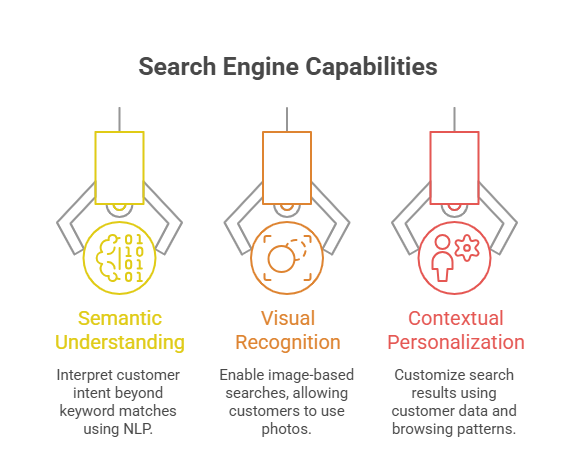
Modern search functionality must transcend basic text matching to deliver truly intelligent results. The most successful Magento implementations leverage natural language processing, visual search capabilities, and predictive intent modeling to create search experiences that feel almost telepathic.
Implementing AI-powered search requires three core components:
The technical implementation involves integrating machine learning APIs with your existing Magento search infrastructure. Elasticsearch provides the foundation, but modern AI search requires additional layers including TensorFlow or PyTorch models for semantic analysis and computer vision frameworks for visual search capabilities.
For enterprise teams, the migration strategy should begin with A/B testing AI search against traditional search on a segment of your traffic. This approach allows you to measure performance improvements while identifying any integration challenges before full deployment.
Manual merchandising is a relic of the pre-AI era. Enterprise e-commerce operations cannot scale effectively when human teams manually adjust product placements, promotional strategies, and category arrangements based on intuition rather than data-driven insights.
Automated merchandising systems analyze multiple data streams simultaneously: inventory levels, profit margins, seasonal trends, customer preferences, and competitive pricing. These systems make merchandising decisions in real-time, optimizing for whatever business objectives you prioritize.
The most sophisticated implementations incorporate trend analysis and demand forecasting to position products before demand peaks occur. This proactive approach ensures high-margin, high-demand products receive optimal visibility precisely when customer interest is rising.
| Traditional Merchandising | AI-Automated Merchandising |
|---|---|
| Weekly or monthly manual updates | Real-time automated adjustments |
| Based on historical performance | Incorporates predictive analytics |
| Limited A/B testing capability | Continuous optimization testing |
| Reactive to inventory changes | Proactive inventory positioning |
| Generic category placement | Personalized product positioning |
Implementation requires integrating machine learning models with your Magento product management system. Start by identifying key performance indicators: conversion rates, average order values, inventory turnover, and profit margins. The AI system optimizes product placement based on these metrics while learning from customer interactions to improve future decisions.
Inventory management represents one of the most immediate opportunities for AI automation ROI. Traditional inventory systems react to stockouts or overstock situations after they occur. AI-powered inventory management prevents these situations through predictive modeling and automated reordering.
The most effective systems combine multiple data sources: historical sales data, seasonal patterns, marketing campaign schedules, economic indicators, and even weather forecasts. This comprehensive approach enables AI forecasting that accounts for variables human analysts might overlook.
Modern predictive marketing campaigns can significantly impact inventory requirements. When AI systems detect increased social media mentions or search volume trends for specific products, inventory algorithms adjust purchasing recommendations before traditional demand signals appear in sales data.
For Magento enterprises, implementing intelligent inventory management involves several technical components:
The implementation roadmap should prioritize high-velocity, high-margin products where inventory optimization delivers immediate impact. Success metrics include reduced stockout incidents, decreased carrying costs, and improved cash flow from optimized inventory turnover.
Predictive analytics transforms Magento from a transaction processing platform into a strategic business intelligence system. The most successful enterprise implementations use predictive models for customer lifetime value estimation, churn prediction, and campaign planning optimization.
Customer behavior prediction enables proactive retention strategies. Instead of reacting to churned customers, AI systems identify at-risk customers based on engagement patterns, purchase frequency changes, and interaction data. This early warning system allows marketing teams to deploy retention campaigns before customers defect.
Advanced implementations incorporate social listening data to identify emerging trends and customer sentiment shifts. This external data integration provides early indicators for demand forecasting and product development priorities.
The technical architecture requires robust data pipelines connecting Magento transaction data with customer service interactions, marketing engagement metrics, and external market intelligence. Apache Kafka or similar streaming platforms handle real-time data processing while cloud-based machine learning services provide the computational power for complex predictive models.
Enterprise AI integration demands careful planning to avoid disrupting existing operations while delivering measurable improvements. The most successful migrations follow a phased approach that builds capabilities incrementally while proving ROI at each stage.
Phase 1: Data Infrastructure (Months 1-3)
Establish the data foundation necessary for AI capabilities. This phase involves cleaning existing data, implementing proper tracking mechanisms, and creating the integration points necessary for AI systems to access relevant information.
Phase 2: Customer-Facing AI Features (Months 4-8)
Deploy AI capabilities that directly improve customer experience and generate immediate ROI. Start with search enhancement and basic personalization before advancing to more complex features.
Phase 3: Advanced Automation (Months 9-12)
Implement sophisticated AI systems that optimize operations and enable predictive capabilities. This phase delivers the most significant long-term value but requires the foundation built in previous phases.
The AI technology landscape offers numerous options, but enterprise Magento implementations require solutions that meet specific criteria for scalability, integration compatibility, and performance reliability.
API Compatibility and Integration Ease
Prioritize AI solutions offering robust API documentation and proven Magento integration capabilities. The most successful implementations leverage cloud-based AI services from major providers (Google Cloud AI, AWS Machine Learning, Microsoft Azure AI) rather than attempting to build custom solutions from scratch.
Scalability and Performance Requirements
Enterprise e-commerce operations require AI systems capable of processing thousands of decisions per minute without impacting site performance. Evaluate solutions based on their ability to handle peak traffic periods and scale automatically based on demand.
Data Security and Compliance
AI systems access sensitive customer data and business intelligence. Ensure selected technologies meet regulatory requirements (GDPR, CCPA) and provide enterprise-grade security features including encryption, access controls, and audit trails.
Vendor Stability and Support
Choose AI providers with proven track records serving enterprise clients. Evaluate factors including technical support quality, update frequency, and long-term viability. Avoid bleeding-edge technologies that lack enterprise support infrastructure.
| Evaluation Criteria | Critical Requirements | Assessment Method |
|---|---|---|
| API Integration | RESTful APIs, webhook support, real-time processing | Technical proof of concept |
| Scalability | Auto-scaling, sub-second response times, 99.9% uptime | Load testing and SLA review |
| Security | SOC 2 compliance, encryption at rest and transit | Security audit and compliance verification |
| Support Quality | 24/7 technical support, dedicated account management | Reference checks and trial support evaluation |
Convincing stakeholders to invest in AI infrastructure requires demonstrating clear financial returns and strategic advantages. The most effective business cases focus on measurable improvements in key performance indicators rather than abstract technological benefits.
Revenue Impact Calculations
AI automation typically improves conversion rates, average order values, and customer lifetime value. Conservative estimates for well-implemented AI systems show:
For a Magento enterprise generating $50 million annually, these improvements represent $7.5-17.5 million in additional revenue. Even accounting for implementation costs, ROI typically exceeds 200% within the first 18 months.
Operational Cost Reductions
AI automation reduces manual labor requirements across multiple operational areas. Intelligent inventory management reduces carrying costs and stockout incidents. Automated merchandising eliminates manual product placement tasks. AI-powered customer service reduces support ticket volume.
Quantify these savings by calculating current labor costs for manual tasks that AI will automate. Include opportunity costs representing the value of redirecting human resources to strategic initiatives rather than routine operational tasks.
Competitive Advantage Valuation
Market share protection represents a significant but often overlooked component of AI ROI. Competitors implementing AI capabilities gain advantages that traditional e-commerce operations cannot match. The cost of implementing AI today is substantially lower than the cost of recovering lost market share later.
Frame this argument using campaign planning scenarios that demonstrate how AI-enabled competitors can respond faster to market changes, optimize pricing more effectively, and deliver superior customer experiences.
Successful AI integration requires dedicated resources and realistic timeline expectations. Underestimating implementation complexity leads to project delays and stakeholder disappointment, while overestimating creates unnecessary delays in capturing competitive advantages.
Technical Team Requirements
AI implementation requires specialists beyond traditional Magento developers. Essential team members include data engineers, machine learning specialists, and integration architects. For most enterprises, partnering with experienced AI implementation consultants accelerates deployment while building internal capabilities.
Budget Considerations
AI implementation costs vary significantly based on scope and complexity. Conservative budget planning should account for:
These investments typically generate positive returns within 12-18 months for enterprises with sufficient transaction volume to justify AI implementation complexity.
AI implementation success requires continuous monitoring and optimization based on measurable performance indicators. The most effective monitoring frameworks track both technical performance and business impact metrics.
Technical Performance Metrics
Business Impact Metrics
Establish baseline measurements before AI deployment to enable accurate impact assessment. Monthly performance reviews should evaluate both technical functionality and business outcomes, with quarterly strategic reviews assessing broader competitive positioning and ROI realization.
The AI landscape evolves rapidly, with new capabilities and optimization opportunities emerging continuously. Future-proofing strategies ensure your Magento implementation remains competitive as AI technologies advance.
Modular Architecture Planning
Design AI integrations using modular architectures that allow individual components to be upgraded or replaced without disrupting the entire system. This approach enables gradual adoption of new AI capabilities while protecting existing investments.
Continuous Learning Implementation
Deploy AI systems designed for continuous improvement through ongoing data analysis and model refinement. The most successful implementations treat AI as a living system that becomes more effective over time rather than a static tool.
Vendor Relationship Management
Maintain relationships with multiple AI technology providers to avoid vendor lock-in and ensure access to emerging capabilities. Regular technology reviews should evaluate new solutions and optimization opportunities.
The enterprises that thrive in the next decade will be those that view AI automation not as a project with a completion date, but as an ongoing capability that evolves with their business and market conditions. This mindset shift from implementation to continuous optimization represents the difference between AI adoption and AI mastery.
Your Magento platform represents significant infrastructure investment and business value. AI automation transforms this investment from a cost center into a competitive weapon that generates compound returns through improved customer experiences, operational efficiency, and strategic intelligence. The question facing enterprise leadership teams is not whether to implement AI automation, but how quickly they can execute without sacrificing the operational stability that their business depends on.
The frameworks and strategies outlined here provide the roadmap for this transformation. Success requires commitment to data-driven decision making, investment in appropriate technology infrastructure, and recognition that AI automation represents a fundamental shift in how e-commerce operations create value rather than a simple feature addition to existing systems.
Key Takeaways: Optimizing Average Order Value (AOV) consistently delivers faster, more measurable ROI than scaling paid traffic spend. Bundling, upsells, cross-sells, and...
Mike VillarKey Takeaways: Statistical significance is widely misunderstood and misreported in marketing tests, leading to decisions based on faulty data. Peeking at test results before...
Alvar SantosKey Takeaways: Looker Studio is the best budget-friendly option for marketing teams already embedded in the Google ecosystem, offering free access and solid connector support. Domo...
Amanda Bianca CoStart your brand's success journey today with a conversation. Share your goals and objectives with us and let's set up a discovery call.