Key Takeaways
- Community-led growth delivers 5-10x lower customer acquisition costs compared to traditional advertising channels
- Member-generated content creates authentic brand publishing opportunities that outperform traditional marketing assets
- Communities generate compound growth through network effects, unlike linear traditional marketing approaches
- Customer lifetime value increases by 300-500% when customers are part of engaged communities
- Community members become unpaid advocates, reducing reliance on expensive paid acquisition channels
The marketing landscape has fundamentally shifted. While agencies continue to pour billions into paid advertising, smart companies are discovering that communities outperform traditional marketing channels across every meaningful metric. After nearly two decades of watching customer acquisition costs skyrocket and attribution models crumble, the evidence is clear: community-led growth isn’t just an alternative strategy—it’s the superior strategy.
The Economics of Community vs Traditional Marketing
Traditional marketing operates on a simple premise: pay for attention, convert a percentage, repeat. This linear model breaks down when acquisition costs exceed customer lifetime value, which happens more frequently as digital advertising becomes saturated. The numbers tell a sobering story.
Facebook ad costs have increased 89% year-over-year, while Google Ads costs continue climbing at double-digit rates. Meanwhile, companies building communities report acquisition costs that are 5-10x lower than traditional channels. The reason is mathematical: communities create network effects where each new member increases value for existing members, generating organic growth that compounds over time.
| Metric |
Traditional Marketing |
Community-Led Growth |
| Customer Acquisition Cost |
$200-500+ per customer |
$20-50 per customer |
| Customer Lifetime Value |
Baseline |
3-5x higher |
| Retention Rate (Year 1) |
20-30% |
60-80% |
| Content Production Cost |
High (agency/internal) |
Low (community-generated) |
The superior economics emerge from community members becoming active participants rather than passive consumers. They create content, provide support, generate referrals, and extend customer lifetime value through increased engagement and reduced churn.
Why Communities Create Superior Customer Retention
Traditional marketing focuses on acquisition, treating retention as a secondary concern. This approach ignores a fundamental truth: acquiring customers is exponentially more expensive than retaining them. Communities flip this dynamic by making retention the primary growth driver.
When customers join a community, they develop social connections and derive value beyond the core product. This creates switching costs that transcend pricing or feature comparisons. Members stay because leaving means losing relationships, status, and accumulated social capital within the community.
Consider the data from successful community-driven companies:
- Slack reported that teams using their community features had 3x higher retention rates
- Peloton’s community engagement directly correlates with subscription renewal rates—engaged community members renew at 95% vs 60% for non-engaged users
- GitHub’s community contributions predict enterprise customer expansion with 89% accuracy
The retention advantage compounds over time. While traditional marketing requires continuous investment to maintain customer relationships, communities become self-sustaining ecosystems that strengthen through member interactions.
The Network Effect Growth Engine
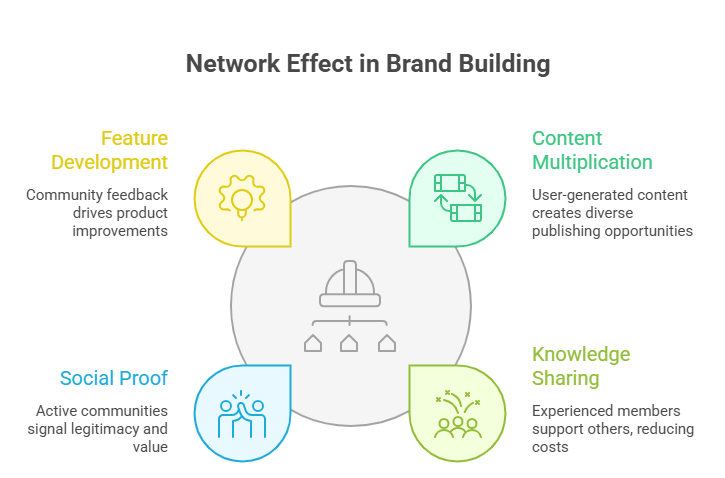
Traditional marketing scales linearly: double the ad spend, roughly double the results (until diminishing returns kick in). Communities scale exponentially through network effects, where each new member potentially creates value for all existing members.
This network effect manifests in multiple ways:
- Content multiplication: Members create brand publishing opportunities through user-generated content, reviews, tutorials, and discussions
- Knowledge sharing: Experienced members provide support, reducing customer service costs while improving satisfaction
- Social proof: Active communities signal legitimacy and value to prospective customers more effectively than traditional testimonials
- Feature development: Community feedback drives product improvements that benefit all users
The compound growth creates a sustainable competitive advantage. Competitors can copy products and marketing tactics, but they cannot replicate an established community’s network effects and social dynamics.
Framework for Building Community-Led Growth
Building successful community-led growth requires systematic approach that differs fundamentally from traditional marketing funnels. Here’s the framework that consistently delivers results:
Phase 1: Foundation Setting (Months 1-3)
Start with owned media platforms where you control the experience and data. While social media has its place, building on rented land limits long-term value creation.
- Define your community’s core value proposition beyond your product
- Identify the specific problem your community solves for members
- Choose platforms that facilitate meaningful interactions, not just broadcasting
- Establish clear community guidelines and moderation policies
- Create initial content that demonstrates the type of discussions you want to encourage
Phase 2: Seed Community (Months 3-6)
Focus on quality over quantity. Ten highly engaged members create more value than 1,000 passive followers.
- Personally invite customers who already demonstrate engagement with your brand
- Share exclusive content and early access to build perceived value
- Actively participate in discussions to model desired behavior
- Celebrate member contributions publicly to encourage continued participation
- Document and share member success stories to attract similar profiles
Phase 3: Growth Acceleration (Months 6-12)
As the community reaches critical mass, focus on systems that enable sustainable growth without proportional increases in management overhead.
- Implement member recognition programs that reward valuable contributions
- Create mentorship programs connecting experienced and new members
- Develop content strategy frameworks that guide member-generated content
- Establish metrics tracking engagement quality, not just quantity
- Build integration between community activities and product development
Successful Community-Driven Company Examples
The most valuable companies increasingly rely on community-led growth rather than traditional marketing. Here are three instructive examples:
Notion: Building Through User Evangelism
Notion grew from startup to $10 billion valuation primarily through community-driven adoption. Instead of traditional marketing campaigns, they focused on empowering users to create and share templates, tutorials, and use cases.
Their community strategy included:
- Ambassador programs that rewarded users for creating educational content
- Template galleries featuring community-created resources
- Integration with content creators through sponsorships and partnerships
- Active presence in productivity and workflow communities
The result: Notion’s customer acquisition cost is estimated at under $50 per user, while similar productivity software companies spend $200-400 per acquisition through traditional channels.
Discord: Community-First Product Development
Discord transformed from a gaming communication tool to a $15 billion platform by making community building core to their product strategy. Rather than advertising their features, they focused on enabling better communities.
Key elements of their approach:
- Product features designed specifically for community management
- Developer ecosystem enabling community customization
- Direct engagement with community leaders and moderators
- Content marketing focused on community building best practices
Discord’s growth demonstrates how aligning product development with community needs creates sustainable competitive advantages that traditional marketing cannot replicate.
HubSpot: Education-Driven Community Building
HubSpot built a $31 billion company largely through community-led growth disguised as content marketing and education. Their strategy created value for marketing professionals regardless of whether they used HubSpot’s products.
Their community-building approach:
- Free educational resources that established thought leadership
- Certification programs creating credentialed community members
- User groups and events facilitating peer connections
- Partner ecosystem enabling mutual value creation
This strategy generated qualified leads at a fraction of traditional B2B marketing costs while building a defendable moat through network effects.
Implementing Community-Led Growth in Your Organization
Transitioning from traditional marketing to community-led growth requires organizational changes beyond marketing tactics. Success demands commitment from leadership and integration across departments.
Organizational Requirements
Community-led growth works best when integrated into company operations rather than treated as a marketing campaign:
- Executive sponsorship: Leadership must understand that community building requires long-term investment with delayed returns
- Cross-functional collaboration: Product, customer success, and marketing teams must coordinate community efforts
- Resource allocation: Budget 60% of community resources on management and engagement, 40% on content and events
- Success metrics: Track engagement quality, member lifetime value, and community-driven conversions rather than vanity metrics
Technology Infrastructure
Modern community platforms enable sophisticated engagement tracking and member management:
- Community platforms with robust moderation and member management tools
- Integration capabilities connecting community activity to customer data
- Analytics systems tracking member engagement and community health metrics
- Content management systems enabling member-generated brand media
Measuring Community-Led Growth Success
Traditional marketing metrics fail to capture community value. Measuring community-led growth requires different frameworks that account for network effects and long-term value creation.
Primary Metrics
- Community-driven acquisition: New customers attributed to community referrals and word-of-mouth
- Member lifetime value: Revenue generated by community members vs non-members
- Engagement depth: Quality of member interactions and contributions
- Content multiplication: Member-generated content volume and engagement
- Support deflection: Community-resolved customer questions reducing support costs
Secondary Metrics
- Time to value: How quickly new members find value in the community
- Cross-selling effectiveness: Community members’ receptiveness to additional products
- Brand sentiment: Community discussions’ impact on overall brand perception
- Talent acquisition: Community members joining as employees or partners
The Future of Community-Led Growth
As traditional advertising channels become increasingly expensive and less effective, community-led growth will transition from competitive advantage to business necessity. Companies that build communities today will have defendable moats that competitors cannot easily replicate.
The convergence of AI tools, community platforms, and changing consumer preferences accelerates this transition. Consumers increasingly prefer authentic peer recommendations over traditional advertising, while AI enables more sophisticated community management and personalized member experiences.
Forward-thinking companies are already building competitive moats through community-driven network effects. Those that delay community investment will find themselves at permanent disadvantages in customer acquisition, retention, and lifetime value.
The choice is clear: build communities that generate compound growth through network effects, or continue paying increasing costs for decreasing returns through traditional marketing channels. The companies that choose wisely will dominate their markets for decades to come.
Glossary of Terms
- Brand Publishing: Content creation and distribution activities that build brand awareness and authority through owned media channels
- Community-Led Growth: Business growth strategy that relies on building engaged communities rather than traditional advertising channels
- Customer Acquisition Cost (CAC): Total cost of acquiring a new customer through marketing and sales efforts
- Customer Lifetime Value (CLV): Predicted revenue generated by a customer throughout their relationship with a company
- Network Effects: Phenomenon where each additional user of a product or service increases its value for existing users
- Owned Media: Marketing channels that companies control completely, such as websites, blogs, email lists, and community platforms
- User-Generated Content: Content created by customers or community members rather than the company itself
- Social Proof: Psychological phenomenon where people look to others’ actions to guide their own behavior
Further Reading