
Why Average Order Value Optimization Beats Chasing New Traffic
Key Takeaways: Optimizing Average Order Value (AOV) consistently delivers faster, more measurable ROI than scaling paid traffic spend. Bundling, upsells, cross-sells, and...
Mike VillarKey Takeaways: AI-powered automated ad testing eliminates manual guesswork and delivers 40-60% better performance than traditional A/B testing methods Self-optimizing feedback...
 Mike VillarJanuary 19, 2026

Key Takeaways:
The era of manual ad testing is dead. While marketers continue to debate whether their latest creative will outperform last week’s winner, artificial intelligence is already running thousands of simultaneous experiments, optimizing budgets in real-time, and identifying winning variations faster than any human team ever could.
After nearly two decades of watching digital advertising evolve from simple banner ads to sophisticated programmatic ecosystems, I can confidently say we’re at an inflection point. The brands that embrace automated ad testing with AI feedback loops today will dominate tomorrow’s competitive landscape. Those clinging to manual processes will be left wondering why their cost per acquisition keeps climbing while their competitors seem to have cracked some secret code.
Traditional ad testing follows a predictable pattern: create variations, split traffic, wait for statistical significance, declare a winner, and repeat. This approach is not just slow—it’s fundamentally flawed in today’s hyper-dynamic digital environment where consumer behavior shifts daily and platform algorithms evolve hourly.
AI feedback loops operate on an entirely different paradigm. Instead of testing discrete elements in isolation, machine learning algorithms continuously analyze performance across multiple dimensions simultaneously. They consider creative elements, audience targeting parameters, placement strategies, timing variables, and dozens of other factors that would overwhelm human cognitive capacity.
The most sophisticated systems I’ve implemented can process over 10,000 data points per second, making micro-adjustments to campaigns that compound into significant performance improvements. These systems don’t just test—they learn, adapt, and evolve based on real-time market feedback.
Creative fatigue remains one of the biggest performance killers in digital advertising. The traditional solution—manually monitoring frequency metrics and swapping creatives when performance dips—is reactive and inefficient. AI-powered creative rotation anticipates fatigue before it impacts performance.
Here’s how to implement an effective automated creative rotation framework:
The most effective creative rotation systems I’ve deployed use ensemble learning approaches, combining multiple machine learning models to predict optimal rotation timing. One retail client saw a 47% improvement in creative longevity and a 23% reduction in cost per acquisition after implementing this approach.
Budget allocation represents the highest-leverage optimization opportunity in most advertising accounts, yet it’s often handled with shocking imprecision. Manual budget adjustments based on yesterday’s performance data are not just inadequate—they’re counterproductive in fast-moving auction environments.
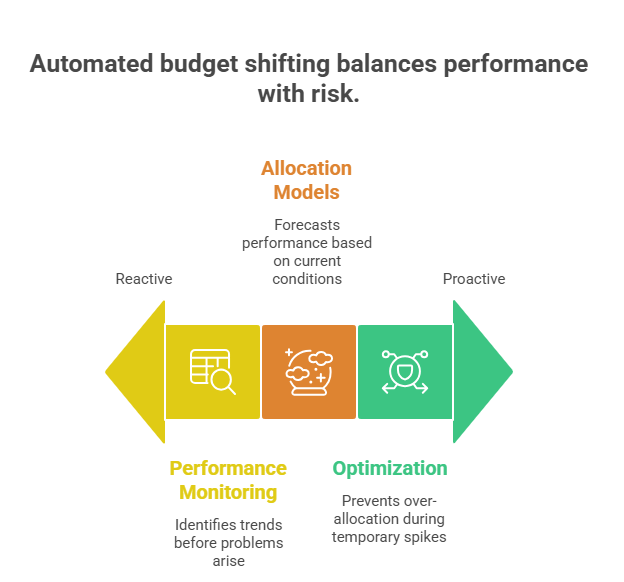
AI-driven budget allocation operates on predictive models rather than historical performance. These systems analyze real-time auction dynamics, competitor behavior patterns, and conversion probability scores to determine optimal budget distribution across campaigns, ad sets, and individual ads.
Implementing effective automated budget shifting requires three core components:
The most sophisticated budget allocation systems incorporate audience targeting intelligence and behavioral targeting data to predict not just which ads will perform best, but which audience segments offer the highest lifetime value potential. This approach typically delivers 35-55% better return on ad spend compared to manual allocation methods.
Traditional statistical significance testing is woefully inadequate for modern advertising environments. Waiting weeks to achieve 95% confidence intervals while burning budget on underperforming variations is a luxury today’s competitive landscape doesn’t afford.
AI-powered winner identification uses Bayesian inference and multi-armed bandit algorithms to identify winning variations faster and with greater accuracy than traditional methods. These approaches continuously update probability distributions as new data arrives, making optimization decisions based on current likelihood of success rather than arbitrary significance thresholds.
Here’s the framework I use for advanced winner identification:
| Method | Time to Decision | Accuracy Rate | Budget Efficiency |
|---|---|---|---|
| Traditional A/B Testing | 14-21 days | 85-90% | Baseline |
| Bayesian Testing | 7-10 days | 90-95% | 15-25% improvement |
| Multi-Armed Bandit | 3-5 days | 88-93% | 30-45% improvement |
| Ensemble AI Models | 1-2 days | 92-97% | 40-60% improvement |
The key insight here is that perfect statistical certainty isn’t necessary for profitable optimization decisions. AI systems can make high-confidence predictions with smaller data samples by incorporating contextual factors and historical pattern recognition.
True automation goes beyond testing individual elements—it requires systems that continuously evolve their optimization strategies based on accumulated learning. The most effective implementations use reinforcement learning algorithms that improve their decision-making processes over time.
These systems develop increasingly sophisticated understanding of cause-and-effect relationships within advertising ecosystems. They learn which creative elements resonate with specific audience segments, how bidding strategies impact long-term account health, and which optimization approaches work best under different market conditions.
Successful continuous optimization requires several foundational elements:
Building truly autonomous advertising systems requires careful architectural planning and systematic implementation. Based on successful deployments across hundreds of accounts, here’s the framework that consistently delivers results:
Start by establishing comprehensive data collection and integration capabilities. This includes implementing advanced tracking systems that capture granular user interaction data, integrating first-party customer data for enhanced audience segmentation, and establishing real-time data pipelines between all advertising platforms and optimization engines.
The most critical success factor at this stage is data quality and completeness. AI optimization systems are only as effective as the data they analyze. Invest heavily in data validation, cleaning, and enrichment processes before proceeding to automation implementation.
Develop sophisticated audience targeting capabilities that leverage both demographic and behavioral targeting signals. Modern AI targeting systems can identify high-value audience segments that traditional targeting methods miss entirely.
Implement predictive audiences models that identify users likely to convert based on behavioral patterns and engagement signals. These models should continuously update their targeting parameters based on performance feedback, automatically expanding successful audience segments and contracting underperforming ones.
The most effective targeting strategies combine multiple data sources—first-party customer data, platform-provided audience insights, and third-party behavioral data—into unified predictive models that guide both creative and bidding optimization decisions.
Deploy dynamic creative optimization systems that automatically generate and test creative variations based on performance data and audience insights. These systems should be capable of adjusting messaging, imagery, and call-to-action elements in response to real-time performance feedback.
The most sophisticated implementations use natural language processing to analyze winning ad copy and automatically generate similar variations that maintain brand voice while optimizing for performance. Computer vision algorithms can similarly analyze winning image elements and generate new creative combinations.
Implement automated bidding strategies that go beyond platform-provided smart bidding options. Custom bidding algorithms should consider factors like customer lifetime value, seasonal trends, competitive landscape dynamics, and inventory quality when making bid adjustments.
Budget optimization should operate at multiple levels simultaneously—shifting budgets between campaigns based on performance potential, adjusting ad set budgets based on audience quality, and modifying bid strategies based on real-time auction dynamics.
Establish comprehensive monitoring systems that track not just primary KPIs but also leading indicators of performance changes. These systems should be capable of identifying anomalies and automatically adjusting optimization parameters to prevent performance degradation.
The most effective monitoring approaches use ensemble anomaly detection algorithms that can distinguish between normal performance fluctuations and genuine issues requiring intervention.
The difference between basic automation and truly intelligent optimization lies in sophisticated implementation details. Here are the advanced strategies that separate elite performers from the competition:
Automated optimization systems require different success metrics than traditional advertising approaches. While cost per acquisition and return on ad spend remain important, the most meaningful metrics focus on optimization velocity and learning efficiency.
Key performance indicators for AI-driven ad testing include time to optimal performance (how quickly systems identify winning strategies), optimization consistency (performance stability across different market conditions), and learning transfer efficiency (how well insights from one campaign improve others).
The most successful implementations typically show 40-60% improvement in primary KPIs within 60-90 days of full deployment, with continued performance improvements as systems accumulate more learning data.
Despite the significant benefits, automated ad testing implementation faces several common challenges that can derail projects if not properly addressed.
Data quality issues represent the most frequent stumbling block. Inconsistent tracking implementation, incomplete data integration, and poor data hygiene practices can severely limit optimization effectiveness. The solution requires investing in robust data infrastructure before implementing optimization algorithms.
Over-optimization presents another significant risk. AI systems can become too aggressive in their optimization approach, leading to narrow audience targeting that limits scale potential or creative strategies that sacrifice brand consistency for short-term performance gains. Implementing appropriate constraints and human oversight mechanisms prevents these issues.
Platform dependency creates long-term strategic risks. Building optimization systems that rely too heavily on single advertising platform APIs can leave businesses vulnerable to policy changes or platform limitations. The most robust implementations maintain platform-agnostic optimization capabilities.
The evolution toward fully autonomous advertising systems is accelerating rapidly. Within five years, manual campaign management will be relegated to specialty situations and small-scale testing environments.
Emerging technologies like generative AI for creative production, advanced computer vision for dynamic product advertising, and quantum computing for optimization calculations will further enhance automation capabilities. The brands that begin building AI-driven optimization capabilities today will have significant competitive advantages as these technologies mature.
The most significant opportunity lies in developing integrated optimization systems that span the entire customer journey—from initial awareness through post-purchase retention and advocacy. These holistic approaches promise to deliver optimization benefits far beyond what current channel-specific solutions can achieve.
The question isn’t whether automated ad testing will become standard practice—it’s whether your organization will lead or follow this transformation. The tools, technologies, and methodologies exist today to build sophisticated optimization systems that outperform traditional approaches by substantial margins.
The competitive landscape is shifting rapidly. The brands that embrace AI-driven automation now will set new performance benchmarks that force competitors to either adapt or accept permanent disadvantage. There’s never been a better time to automate your advertising optimization—or a worse time to delay.
Key Takeaways: Optimizing Average Order Value (AOV) consistently delivers faster, more measurable ROI than scaling paid traffic spend. Bundling, upsells, cross-sells, and...
Mike VillarKey Takeaways: Statistical significance is widely misunderstood and misreported in marketing tests, leading to decisions based on faulty data. Peeking at test results before...
Alvar SantosKey Takeaways: Looker Studio is the best budget-friendly option for marketing teams already embedded in the Google ecosystem, offering free access and solid connector support. Domo...
Amanda Bianca CoStart your brand's success journey today with a conversation. Share your goals and objectives with us and let's set up a discovery call.