
Why Average Order Value Optimization Beats Chasing New Traffic
Key Takeaways: Optimizing Average Order Value (AOV) consistently delivers faster, more measurable ROI than scaling paid traffic spend. Bundling, upsells, cross-sells, and...
Mike VillarKey Takeaways: AI-controlled campaign distribution requires fundamentally different creative testing approaches compared to traditional manual optimization Signal quality becomes...
 Josh EvoraJanuary 21, 2026

Key Takeaways:
The creative testing landscape has been fundamentally disrupted. What worked in the era of manual campaign optimization is not just outdated—it’s actively counterproductive when AI systems control ad distribution. After nearly two decades of watching digital marketing evolve, I can confidently say we’re experiencing the most significant shift in how we approach creative testing since the introduction of programmatic advertising.
Traditional creative testing relied on human intuition, manual bid adjustments, and linear attribution models. Today’s AI-optimized campaigns operate in a completely different paradigm where algorithms make thousands of micro-decisions per second, optimizing across variables we can’t even see. This reality demands a complete rethinking of how we structure, measure, and iterate on creative assets.
When AI systems control campaign distribution, they fundamentally alter the creative testing equation. Unlike human media buyers who make predictable optimization decisions, AI algorithms operate on multi-dimensional optimization matrices that consider factors far beyond our traditional metrics.
The most critical shift lies in understanding that AI doesn’t just optimize for conversion volume—it optimizes for signal quality. A creative that generates 100 conversions with strong predictive signals will often receive more distribution than one generating 150 conversions with weak signals. This changes everything about how we design and interpret creative tests.
Consider this practical example: A B2B software company recently discovered that their highest-converting creative (based on immediate conversions) was actually being deprioritized by Google’s AI systems. The reason? The conversions it generated had poor downstream value signals. Users converted quickly but had low engagement scores, short session durations, and high bounce rates. The AI recognized this pattern and shifted budget toward creatives that generated users with stronger long-term value indicators.
This scenario illustrates why traditional creative testing frameworks fail in AI environments. We can’t simply measure immediate conversion rates and declare victory. We must understand how our creative assets influence the entire customer journey and how those signals feed back into AI optimization decisions.
In AI-optimized campaigns, signal quality has become the primary currency of creative performance. But what exactly constitutes high-quality signals, and how do we design creative tests to optimize for them?
High-quality signals share several characteristics: they’re predictive of long-term value, they occur with sufficient frequency to enable machine learning, and they correlate strongly with business outcomes. The challenge for creative testing lies in identifying which creative elements drive these signal types.
Through extensive campaign analysis, I’ve identified five signal quality indicators that consistently influence AI distribution decisions:
To optimize creative for these signals, we must move beyond surface-level metrics and dive deep into user behavior patterns. This requires sophisticated attribution modeling that captures the full customer journey, not just last-click conversions.
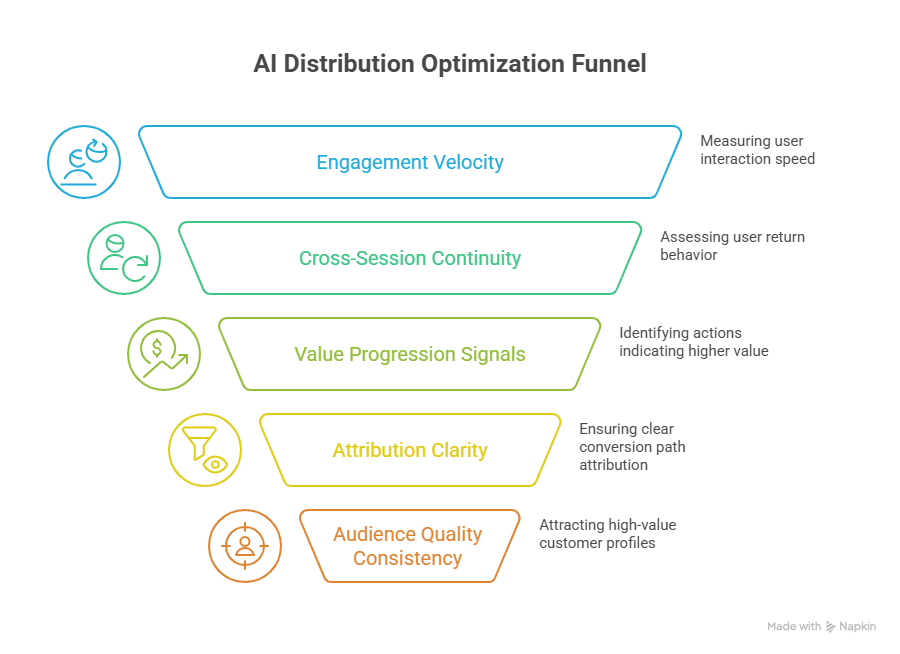
After developing and refining creative testing approaches across hundreds of AI-optimized campaigns, I’ve distilled the essential components of an effective framework. This isn’t theoretical—it’s battle-tested methodology that accounts for the realities of AI-controlled distribution.
Traditional creative tests focus on comparing conversion rates between variants. AI-optimized creative tests must focus on signal generation patterns. This requires a fundamental shift in how we structure experiments.
Instead of asking “Which creative converts better?”, we ask “Which creative generates signals that AI systems value most highly?” This question leads to different test designs, measurement approaches, and optimization decisions.
Practical implementation starts with signal mapping. Before launching any creative test, map out the complete signal ecosystem for your campaigns. Identify every action users can take, every data point collected, and every feedback loop that influences AI decision-making.
For an e-commerce client, this mapping revealed that AI systems were heavily weighting micro-engagement signals like product page scroll depth, image interactions, and filter usage. Creative variants that drove these behaviors consistently received more distribution, even when their immediate conversion rates were lower.
AI systems operate across the entire customer journey, making optimization decisions based on multi-touch attribution data that often remains invisible to marketers. Our creative testing framework must account for this reality.
Effective multi-touch attribution for creative testing requires three layers of measurement:
The key insight here is that creative impact extends far beyond the initial conversion. A creative that generates a conversion today might influence purchasing behavior six months later. AI systems recognize these patterns even when our attribution models don’t.
To address this, implement expanded attribution windows for creative testing. Instead of measuring performance over 7-30 days, extend measurement periods to 90-180 days. This reveals how different creative approaches influence long-term customer behavior patterns.
AI-optimized campaigns rarely operate in isolation. Users move between platforms, devices, and channels in complex patterns that influence AI optimization decisions across the entire ecosystem. Creative testing must account for these cross-platform dynamics.
This requires analytics integration that goes beyond basic conversion tracking. We need unified measurement systems that capture how creative performance on one platform influences results on others.
A practical example: A SaaS company discovered that their Facebook creative variants significantly influenced Google Ads performance. Users exposed to certain Facebook creatives showed higher engagement rates with Google Ads, leading to improved AI optimization on both platforms. Traditional testing would have missed this cross-platform impact entirely.
To implement cross-platform creative testing:
Designing creative tests for AI-optimized campaigns requires adherence to specific principles that account for how machine learning systems process and respond to creative variations.
AI systems need sufficient data to make optimization decisions, but they also need that data quickly. Traditional creative testing often prioritizes statistical significance over learning velocity, leading to test durations that exceed AI optimization cycles.
The solution lies in dynamic sample size calculation that accounts for AI learning patterns. Instead of fixed test durations, implement adaptive testing periods that balance statistical confidence with AI system requirements.
For most AI platforms, this means:
AI systems optimize at granular levels, making micro-adjustments based on individual creative elements. Our testing framework must match this granularity while maintaining statistical validity.
Instead of testing complete creative variations, focus on individual elements: headlines, images, call-to-action buttons, color schemes, and copy variations. This approach generates more actionable insights and provides AI systems with clearer optimization signals.
Implement this through systematic creative deconstruction:
AI optimization happens in real-time, but traditional creative testing relies on post-hoc analysis. This disconnect leads to missed optimization opportunities and suboptimal results.
Effective AI creative testing requires real-time feedback loops that communicate test results directly to optimization algorithms. This means integrating testing data with AI system inputs, not just campaign reporting.
Practical implementation involves:
Moving beyond basic principles, advanced creative testing for AI campaigns requires sophisticated implementation techniques that account for the complexities of modern digital marketing ecosystems.
Modern AI platforms offer dynamic creative optimization (DCO) capabilities that automatically combine creative elements based on performance data. Our testing framework must work synergistically with these systems, not against them.
This requires test designs that feed directly into DCO algorithms. Instead of testing static creative variations, we test creative components that AI systems can dynamically combine and recombine based on user context.
The approach involves creating comprehensive creative component libraries with associated performance data. AI systems then use this data to generate optimal creative combinations for specific user segments and contexts.
| Creative Component | Test Variables | AI Integration Method | Measurement Focus |
|---|---|---|---|
| Headlines | Length, tone, benefit focus | Dynamic text insertion | Engagement velocity |
| Images | Product focus, lifestyle context, color palette | Automated image selection | Visual engagement signals |
| Call-to-Action | Action words, urgency indicators, value propositions | Button optimization algorithms | Conversion progression rates |
| Landing Pages | Layout, content flow, conversion paths | Dynamic page assembly | Post-click behavior quality |
AI systems don’t just optimize creative performance in isolation—they optimize creative-audience combinations. This requires testing frameworks that account for how different creative approaches perform across various audience segments.
Advanced creative testing must incorporate audience variables as primary factors, not secondary considerations. This means designing experiments that test creative performance across multiple audience segments simultaneously.
The methodology involves:
Traditional performance measurement falls short in AI-optimized creative testing. We need evolved measurement approaches that capture the full impact of creative decisions on AI system performance.
Standard creative testing metrics like click-through rate and cost-per-conversion provide incomplete pictures of creative performance in AI environments. We need metrics that reflect how AI systems actually evaluate and optimize creative assets.
Key AI-centric metrics include:
These metrics require sophisticated measurement systems that integrate with AI platform APIs and capture data beyond standard conversion tracking.
Traditional attribution models were designed for human decision-makers operating with limited information. AI systems have access to vast data sets and can identify complex attribution patterns that standard models miss.
Effective creative testing requires attribution modeling that matches AI system capabilities. This means moving beyond last-click or even multi-touch attribution toward probabilistic attribution models that account for AI decision-making processes.
Advanced attribution for creative testing involves:
Transitioning from traditional creative testing to AI-optimized frameworks requires systematic implementation. Based on extensive experience with enterprise clients, here’s the practical roadmap for implementation:
Begin with comprehensive audit of current creative testing practices and AI platform capabilities. This phase focuses on establishing measurement infrastructure and identifying optimization opportunities.
Develop customized testing frameworks based on your specific AI platforms, audience characteristics, and business objectives.
Launch initial AI-optimized creative tests with comprehensive monitoring and optimization protocols.
Expand successful testing approaches across all campaigns while continuously optimizing based on AI system evolution.
Having guided numerous organizations through this transition, I’ve observed consistent pitfalls that undermine AI creative testing effectiveness. Understanding and avoiding these issues is crucial for framework success.
The most common mistake is continuing to evaluate AI creative performance using traditional metrics. Click-through rates, immediate conversion rates, and cost-per-acquisition provide incomplete pictures of creative effectiveness in AI environments.
Organizations must resist the temptation to judge AI creative tests by familiar metrics. Instead, focus on AI-centric performance indicators that reflect how algorithms actually evaluate and optimize creative assets.
AI systems require time to learn from creative variations and optimize distribution accordingly. Many organizations end tests too early, before AI systems have sufficient data to make informed optimization decisions.
Ensure test durations align with AI learning cycles, typically 21-30 days for most platforms. This allows sufficient time for AI systems to identify patterns and optimize creative distribution.
Creative performance on one platform significantly influences results on others, but many testing frameworks ignore these interactions. This leads to suboptimal creative decisions and missed optimization opportunities.
Always consider cross-platform creative impact when designing tests and interpreting results. What works on Facebook might enhance or detract from Google Ads performance.
AI technology evolves rapidly, and creative testing frameworks must adapt accordingly. Future-proofing requires building flexibility into your testing approaches and staying ahead of platform developments.
Key considerations for future-proofing include:
The creative testing landscape will continue evolving as AI systems become more sophisticated. Organizations that build adaptive, forward-thinking frameworks will maintain competitive advantages in increasingly AI-driven marketing environments.
Success in AI creative testing requires abandoning comfortable traditional approaches and embracing the complexity and opportunity of AI-optimized campaigns. The frameworks outlined here provide the foundation for this transition, but continuous adaptation and optimization remain essential for long-term success.
Key Takeaways: Optimizing Average Order Value (AOV) consistently delivers faster, more measurable ROI than scaling paid traffic spend. Bundling, upsells, cross-sells, and...
Mike VillarKey Takeaways: Statistical significance is widely misunderstood and misreported in marketing tests, leading to decisions based on faulty data. Peeking at test results before...
Alvar SantosKey Takeaways: Looker Studio is the best budget-friendly option for marketing teams already embedded in the Google ecosystem, offering free access and solid connector support. Domo...
Amanda Bianca CoStart your brand's success journey today with a conversation. Share your goals and objectives with us and let's set up a discovery call.