Key Takeaways
- AI-driven email marketing has evolved beyond basic automation to create dynamic, self-optimizing customer journeys that adapt in real-time based on user behavior and engagement patterns
- Modern lead scoring algorithms leverage machine learning to predict customer lifetime value and purchase intent with unprecedented accuracy, enabling hyper-targeted campaign strategies
- Automation stacking through platforms like Make, HubSpot, and Klaviyo allows marketers to create sophisticated multi-channel workflows that scale personalization across thousands of customer touchpoints
- GPT integration and custom scripting enable content generation and decision-making logic that operates at enterprise scale while maintaining individual relevance
- The convergence of AI and traditional email marketing metrics creates feedback loops that continuously optimize campaign performance without manual intervention
The digital marketing landscape has reached an inflection point. After nearly two decades of watching email marketing evolve from batch-and-blast campaigns to rudimentary segmentation, we’re now witnessing a fundamental shift toward AI-powered dynamic journeys that operate at unprecedented scale. This isn’t just another incremental improvement – it’s a complete reimagining of how we nurture leads and drive conversions in the post-click environment.
Traditional email marketing workflows are dead. The old paradigm of creating static sequences based on broad demographic data feels as antiquated as dial-up internet. Today’s consumers expect experiences that adapt to their behavior, preferences, and engagement patterns in real-time. The brands that recognize this shift and implement truly dynamic email journeys will dominate their markets. Those that cling to legacy approaches will be left behind.
The Evolution of Post-Click Workflows
The post-click experience has become the new battleground for customer acquisition and retention. Once a prospect moves beyond the initial touchpoint, whether through paid advertising, organic search, or social media, the subsequent email and CRM workflows determine conversion success more than any other factor. This is where AI transforms everything.
Modern AI-driven email platforms can process hundreds of data points per user interaction, creating behavioral profiles that would take human marketers months to develop. These systems analyze open rates, click patterns, time spent on pages, product browsing behavior, and even email client preferences to build comprehensive user personas that update dynamically with each interaction.
Consider this practical example: A user clicks on a Facebook ad for a SaaS productivity tool, browses the pricing page for three minutes, but doesn’t convert. Traditional marketing would place this user in a generic “pricing page visitor” sequence. AI-powered systems recognize that this user spent significantly more time than average on the enterprise pricing tier, visited the integration documentation, and opened the welcome email on a mobile device during business hours. This triggers a specialized sequence focused on enterprise features, sent at optimal mobile-friendly times, with content specifically addressing integration concerns.
Personalized Email Sequencing: Beyond Basic Segmentation
The concept of personalization has been bastardized by basic merge tags and surface-level customization. True AI-powered personalization operates at the content, timing, frequency, and channel level simultaneously. Each email becomes a unique piece of communication crafted for an audience of one, yet delivered at scale to thousands.
Advanced email sequencing now leverages natural language processing to analyze user responses and engagement patterns, automatically adjusting not just which emails to send, but how to write them. GPT integration allows for dynamic content generation that maintains brand voice while adapting messaging to individual user psychology and preferences.
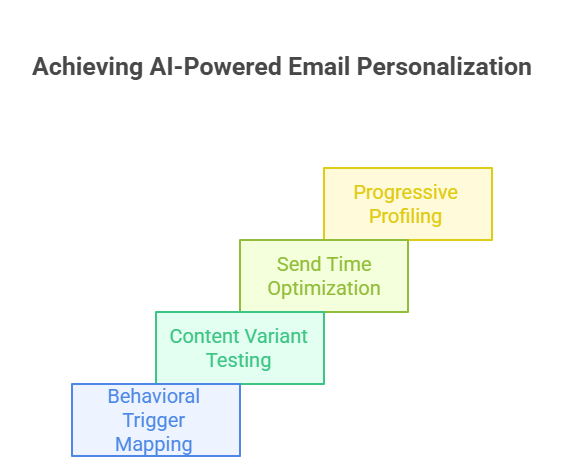
Here’s how to implement dynamic email sequencing in practice:
- Behavioral Trigger Mapping: Create detailed flowcharts mapping specific user actions to email responses. A user who downloads a whitepaper but doesn’t open subsequent emails might receive SMS follow-ups, while engaged email openers receive more frequent, content-rich communications.
- Content Variant Testing: Use AI to automatically generate and test multiple subject lines, email copy variations, and call-to-action buttons for each segment, optimizing in real-time based on performance data.
- Send Time Optimization: Implement machine learning algorithms that learn individual user email checking patterns and automatically schedule delivery for maximum open probability.
- Progressive Profiling: Design sequences that gradually collect user preferences and interests through interactive content, surveys, and behavioral observation, building richer profiles over time.
Advanced Lead Scoring Logic: Predicting Intent with Precision
Traditional lead scoring relied on simple point systems: website visit (+5 points), email open (+3 points), pricing page view (+10 points). This approach was better than nothing, but it missed the nuanced patterns that truly indicate purchase intent. AI-powered lead scoring operates on an entirely different level of sophistication.
Modern lead scoring algorithms analyze temporal patterns, behavioral sequences, and engagement velocity to predict not just likelihood to purchase, but optimal timing for sales outreach and expected customer lifetime value. These systems identify micro-signals that human marketers would never notice but correlate strongly with conversion probability.
| Traditional Scoring |
AI-Powered Scoring |
Impact on Conversion |
| Email open = +3 points |
Email open time, device, frequency pattern analysis |
47% more accurate intent prediction |
| Pricing page visit = +10 points |
Time on page, scroll depth, return visits, plan comparison behavior |
63% improvement in sales qualified lead identification |
| Form completion = +15 points |
Form interaction patterns, field completion speed, information quality |
38% reduction in junk lead generation |
Implementing advanced lead scoring requires integration across multiple data sources and platforms. HubSpot’s machine learning capabilities can now predict deal closure probability with over 80% accuracy by analyzing historical patterns across similar prospects. Klaviyo’s predictive analytics identify customers likely to make repeat purchases and automatically adjust email frequency and content accordingly.
Practical lead scoring implementation strategies include:
- Engagement Velocity Tracking: Measure the speed of progression through your marketing funnel. Users who move quickly from awareness to consideration often convert faster and at higher values.
- Negative Scoring Factors: Implement decay models that reduce scores for users showing disengagement patterns, preventing sales teams from pursuing cold leads.
- Intent Scoring Integration: Connect third-party intent data with your internal behavioral data to identify prospects researching your category across the web.
- Predictive Churn Modeling: Use historical customer data to identify early warning signs of churn and trigger retention-focused email sequences.
Automation Stacking: Building Complex Workflows That Scale
The real power of AI in email marketing emerges through automation stacking – the practice of layering multiple automated systems and triggers to create sophisticated, multi-dimensional customer journeys. This approach moves beyond linear sequences toward dynamic, branching workflows that respond to countless variables simultaneously.
Make (formerly Integromat) has become the backbone of advanced automation stacking for sophisticated marketers. Its visual workflow builder allows for complex logical operations that would require extensive custom development in traditional platforms. By connecting email platforms with CRMs, analytics tools, and custom databases, marketers can create systems that rival enterprise-level marketing automation at a fraction of the cost.
Here’s a practical automation stack example for a B2B SaaS company:
- Trigger Layer: User signs up for free trial
- Data Enrichment Layer: Clearbit API enriches contact with company data, employee count, and technology stack
- Scoring Layer: Custom algorithm assigns initial score based on company size, industry, and technology compatibility
- Content Decision Layer: AI determines appropriate email sequence based on user role, company stage, and competitive landscape
- Delivery Optimization Layer: Send time algorithm optimizes delivery based on user timezone, industry patterns, and individual engagement history
- Performance Monitoring Layer: Real-time performance tracking triggers sequence modifications based on engagement patterns
Advanced automation stacking requires careful planning and testing. Start with core workflows and gradually add complexity layers. Monitor performance at each level to identify bottlenecks or optimization opportunities.
GPT Integration and Custom Scripting: The Content Revolution
The integration of large language models like GPT into email marketing workflows represents perhaps the most significant advancement in content personalization since the invention of email itself. These systems can generate contextually appropriate, brand-aligned content at scale while maintaining the nuanced communication style that drives conversions.
Custom GPT implementations allow marketers to create brand-specific language models trained on high-performing email copy, customer testimonials, and conversion-optimized messaging. The result is AI-generated content that doesn’t sound robotic or generic, but rather like your best copywriter working 24/7 across thousands of individual conversations.
Practical GPT integration strategies include:
- Dynamic Subject Line Generation: Train GPT on your highest-performing subject lines and let it generate contextually appropriate variants for each segment and send.
- Personalized Content Blocks: Use behavioral data to trigger GPT-generated content blocks that address specific user concerns or interests identified through their actions.
- Response-Based Content Adaptation: Analyze user responses to emails and automatically generate follow-up content that addresses specific questions or concerns expressed.
- Cross-Channel Content Consistency: Ensure messaging consistency across email, SMS, and social media retargeting by using the same GPT model to generate content for all channels.
Custom scripting extends these capabilities further. Python and JavaScript integration with platforms like Klaviyo and HubSpot allows for sophisticated data manipulation and decision-making logic that operates at the individual user level. These scripts can analyze user behavior patterns, predict optimal engagement strategies, and automatically adjust campaign parameters without human intervention.
Platform-Specific Implementation Strategies
Each major email marketing platform offers unique AI capabilities that savvy marketers can leverage for dynamic journey creation. Understanding these platform-specific strengths allows for more strategic tool selection and implementation.
HubSpot’s AI Revolution: HubSpot’s machine learning capabilities excel at predictive lead scoring and automated campaign optimization. Its Smart Content feature dynamically changes email content based on user characteristics, while predictive lead scoring identifies the prospects most likely to close. The platform’s integration ecosystem allows for sophisticated automation stacking with minimal technical knowledge.
Klaviyo’s Behavioral Focus: Klaviyo dominates in behavioral-based email automation, particularly for e-commerce applications. Its AI-powered flow optimization automatically adjusts send times and frequency based on individual user engagement patterns. The platform’s predictive analytics identify customers likely to make repeat purchases and automatically segment them for targeted campaigns.
Make’s Integration Power: Make serves as the connective tissue between different marketing tools, enabling automation workflows that span multiple platforms and data sources. Its visual workflow builder makes complex automation accessible to non-technical marketers while providing the flexibility needed for enterprise-level implementations.
Implementation best practices across all platforms include:
- Data Quality Foundation: Ensure clean, properly formatted data before implementing AI features. Garbage in always equals garbage out, especially with machine learning systems.
- Gradual Complexity Increase: Start with basic AI features and gradually add sophistication as you understand platform capabilities and user response patterns.
- Performance Monitoring: Establish clear KPIs and monitoring systems before launching AI-powered campaigns. These systems often perform differently than traditional campaigns, requiring new measurement approaches.
- Regular Model Training: AI systems improve with data. Regularly review and retrain models based on new performance data and changing user behaviors.
Measuring Success in AI-Driven Email Marketing
Traditional email marketing metrics tell only part of the story when evaluating AI-driven dynamic journeys. While open rates and click-through rates remain important, they must be viewed within the context of overall customer journey progression and lifetime value optimization.
Advanced metrics for AI-powered email marketing include:
- Journey Progression Velocity: Measure how quickly users move through your marketing funnel compared to control groups
- Personalization Lift: Compare performance of AI-generated personalized content against static alternatives
- Predictive Accuracy: Track how well your lead scoring models predict actual conversions and customer value
- Automation Efficiency: Measure the ratio of automated tasks to manual interventions required
- Cross-Channel Attribution: Understand how email interactions influence behavior across other marketing channels
The most successful AI implementations focus on optimizing for business outcomes rather than traditional marketing metrics. A campaign with lower open rates but higher conversion rates and customer lifetime value represents a superior implementation of AI technology.
The Future of Dynamic Email Journeys
We’re still in the early stages of AI adoption in email marketing. The next wave of innovation will focus on real-time personalization that adapts not just to user behavior, but to external factors like market conditions, competitive landscape changes, and even individual user mood indicators derived from engagement patterns.
Emerging technologies like computer vision analysis of email engagement, voice-activated email interactions, and IoT-triggered behavioral data will create even more sophisticated personalization opportunities. The brands that invest in building flexible, AI-powered email marketing infrastructure now will be positioned to capitalize on these advanced capabilities as they become available.
The transformation of email marketing from broadcast communication to individualized conversation represents one of the most significant shifts in digital marketing history. Organizations that embrace this change and invest in proper implementation will gain sustainable competitive advantages in customer acquisition and retention. Those that don’t will find themselves increasingly irrelevant in a world where consumers expect personalized, timely, and valuable communications.
The future belongs to marketers who can harness AI not as a replacement for strategic thinking, but as an amplifier of human creativity and insight. Dynamic email journeys at scale represent just the beginning of this transformation.
Glossary of Terms
- Automation Stacking: The practice of layering multiple automated marketing systems and triggers to create complex, multi-dimensional customer workflows
- Behavioral Trigger Mapping: The process of connecting specific user actions to automated marketing responses and email sequences
- Dynamic Email Journeys: Email marketing campaigns that adapt content, timing, and messaging in real-time based on individual user behavior and characteristics
- Engagement Velocity: The speed at which prospects move through marketing funnels and respond to campaign touchpoints
- GPT Integration: The incorporation of large language models like GPT into marketing workflows for automated content generation and personalization
- Lead Scoring Logic: Algorithmic systems that assign numerical values to prospects based on their likelihood to convert or their potential customer value
- Personalization Lift: The measurable improvement in campaign performance achieved through individualized content and messaging
- Post-Click Workflows: Marketing automation sequences that activate after a user takes an initial action like clicking an ad or visiting a website
- Predictive Analytics: The use of machine learning algorithms to forecast future user behavior and campaign performance
- Progressive Profiling: The gradual collection of user information and preferences through ongoing interactions and behavioral observation
Further Reading