
Why Average Order Value Optimization Beats Chasing New Traffic
Key Takeaways: Optimizing Average Order Value (AOV) consistently delivers faster, more measurable ROI than scaling paid traffic spend. Bundling, upsells, cross-sells, and...
Mike VillarKey Takeaways: Content briefs are one of the most underestimated operational assets in a digital marketing agency, and their failure is rarely about creativity. It is almost always...
 Josh EvoraMarch 16, 2026

Key Takeaways:
Ask any experienced content strategist at a digital marketing agency what causes the most friction in their day-to-day workflow, and the answer is rarely “bad writers” or “difficult clients.” More often than not, the root cause traces back to one deceptively simple document: the content brief.
Content briefs are supposed to be the contract between strategy and execution. They are the document that tells a writer, designer, or video producer exactly what the finished piece needs to accomplish, who it is for, what it should say, and how it should perform. Done well, they are the single most powerful tool for maintaining quality and consistency across a high-volume content operation. Done poorly, they are the source of endless revision cycles, misaligned deliverables, unhappy clients, and shrinking margins.
The uncomfortable truth is that most agencies know their content brief process is broken. They just do not audit it until the damage is already done. A client churns. A campaign underperforms. A content team burns out from constant rewrites. Only then does someone sit down and ask: “Where did this go wrong?”
This article is about getting ahead of that moment. It is a practical, agency-focused guide to auditing your content briefs before the problems compound, and building the systems that prevent them from recurring.
Before diving into what a good audit looks like, it is worth quantifying what a bad brief process actually costs. Most agencies underestimate this because the damage is distributed across multiple touchpoints and rarely shows up as a single line item.
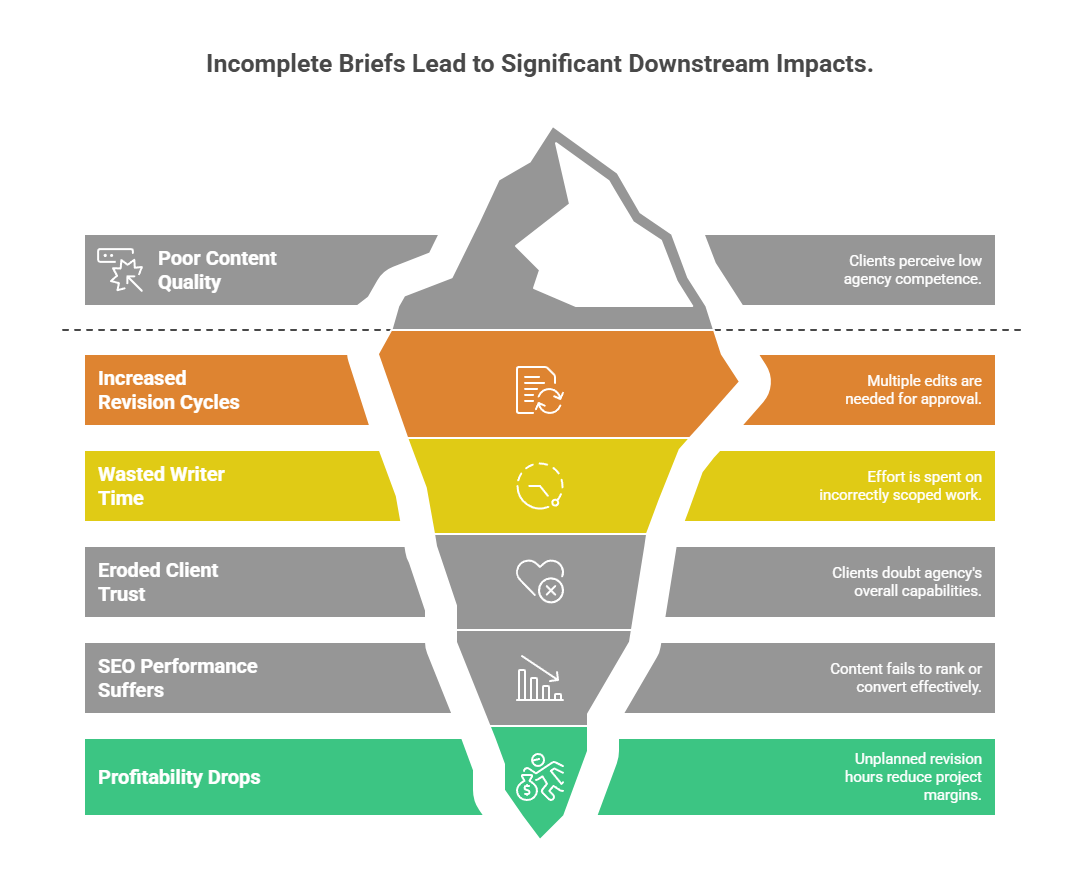
Consider a mid-size digital marketing agency managing 12 to 20 active client accounts, each requiring anywhere from 4 to 20 pieces of content per month. If even 30% of those briefs are incomplete, unclear, or misaligned with client expectations, the downstream impact is significant:
One analysis of agency operations frequently cited in content strategy circles estimates that poorly scoped content work accounts for up to 25% of lost billable time in agencies that lack standardized brief templates. Whether your numbers land at 10% or 30%, the principle holds: this is a margin problem disguised as a quality problem.
To audit effectively, you need to know what you are looking for. After nearly two decades of working across agency environments, from scrappy startups to enterprise-level operations, the failure points tend to cluster around five consistent areas.
This is the most common and most damaging failure point. In many agencies, content briefs are whatever the strategist or account manager decides to put together that day. Sometimes it is a half-page email. Sometimes it is a detailed Google Doc. Sometimes it is a Slack message with a link to a competitor article and the note “write something like this but better.”
Without a standardized template, every brief is a new interpretation of what a brief should be. Writers spend time guessing intent. Strategists spend time answering clarifying questions that should have been addressed upfront. Quality becomes entirely dependent on who wrote the brief, not on the strength of the system.
These are related but distinct disciplines. A brief that focuses exclusively on target keywords without clearly defining the audience segment, the stage of the buying journey, and the specific pain point being addressed will produce content that ranks for the right terms but converts nobody. Conversely, a brief that is rich in audience psychology but lacks proper keyword mapping and search intent alignment will produce content that resonates but never gets found.
The best content briefs treat these as two parallel tracks that must both be represented. Audience and intent on one side. Keyword and SEO architecture on the other.
In fast-moving agency environments, briefs are often written, sent to a writer, and never revisited. But a brief is not a static artifact. It should be updated when client priorities shift, when new keyword data becomes available, or when a previous piece of content performs unexpectedly well or poorly. Treating briefs as disposable documents means the agency never learns from its own work.
Who approves a brief before it goes to the writer? In many agencies, the answer is: no one, formally. The brief gets created by a strategist and sent directly to production. There is no review step, no client sign-off checkpoint, and no quality gate. This creates a situation where a fundamental misunderstanding about scope, tone, or direction does not get caught until the first draft comes back. At that point, everyone is frustrated and significant time has already been spent.
A content brief for a long-form SEO blog post is structurally different from a brief for a paid social ad, a landing page, or a nurture email sequence. Yet many agencies use a single generic template for everything. The result is briefs that are technically complete but contextually wrong, missing the platform logic, format requirements, or distribution strategy that the channel demands.
An audit is not a criticism exercise. It is a diagnostic process. The goal is to identify where your current system breaks down so you can build something more reliable in its place. Here is a practical framework agencies can apply immediately.
Start by collecting 20 to 30 content briefs from the past 90 days, spanning multiple clients and content types. Include briefs for pieces that performed well and briefs for pieces that required heavy revision or failed to meet client expectations. You want a representative cross-section, not just the best or worst examples.
Create a scoring rubric with 10 to 15 criteria. Each criterion should be answered with a simple yes, partial, or no. Below is a recommended starting framework:
Score each brief and calculate an average per client account and per content type. This immediately surfaces where your system is weakest.
This is the most revealing step of any content brief audit. Pull the performance data for the content produced from your sample briefs. Look at organic traffic, engagement metrics, conversion rates, and client satisfaction scores. Then map that data back to the brief quality scores.
In the vast majority of cases, you will find a direct correlation: higher-quality briefs produce better-performing content with fewer revision cycles. This correlation becomes your business case for investing in brief standardization.
The people closest to the briefs have the most useful intelligence. Ask your writers: what information is almost never in the briefs you receive but should be? Ask your strategists: what questions do writers ask you most often after receiving a brief? These conversations surface the specific gaps in your current process faster than any document review can.
Document exactly how briefs are currently created, reviewed, and distributed in your agency. Who initiates the brief? Who provides the research? Who approves it? How does it reach the writer? How long does each step take? This process map will likely reveal redundancies, gaps, and single points of failure that are not obvious until you see the full picture laid out.
An audit is only valuable if it leads to action. Here is how to build a content brief system that holds up across multiple clients, content types, and team members.
Develop distinct templates for each major content type your agency produces. At minimum, this should include templates for long-form SEO articles, landing pages, social media ad copy, email sequences, and video scripts. Each template should be built around the checklist criteria outlined above, but formatted for the specific demands of that content type.
Store these templates in a centralized, version-controlled location. Tools like Notion, Airtable, or even a well-organized Google Drive folder can work well. The key is that every team member, across every client account, is working from the same master library.
One of the most effective improvements a digital marketing agency can make is moving content brief creation out of email and into a structured project management workflow. Platforms like Asana, Monday.com, ClickUp, or Teamwork allow you to build brief creation as a formal task with required fields, assigned owners, and built-in approval steps.
This does two things: it makes brief completion a trackable, accountable step in the production process, and it prevents content from moving to the writing stage until the brief has been properly completed and approved.
Every content brief should have one owner responsible for its completion and at least one approver before it moves to production. In most agency structures, the content strategist or SEO lead should own the brief. The account manager or client services lead should be the approver, since they carry the relationship context and can flag misalignments before they reach the client.
For high-stakes content such as campaign launch pages or pillar SEO articles, consider adding a client-side approval step for the brief itself, separate from the content draft approval. This is a simple change that dramatically reduces the risk of major directional misalignment later in the process.
This is where marketing ops becomes a strategic lever. Build brief quality scoring into your agency’s operational reporting. Track average brief quality scores by client, by content type, and by strategist. Include brief quality as a variable in your content performance analysis. Over time, this creates an evidence base that links brief quality directly to client outcomes, making the business case for continued investment in the process self-reinforcing.
Marketing ops teams that treat brief quality as a measurable KPI rather than a subjective judgment create a culture of continuous improvement that compounds over time. You stop having the same conversations about the same problems every quarter.
Consider a scenario that plays out in agencies regularly. A growing agency is managing content for eight B2B SaaS clients. Each client requires between six and ten blog posts per month plus supporting ad copy. The team is producing roughly 70 to 80 pieces of content per month, and revision rates are climbing. The account managers are fielding complaints about content feeling generic or missing the mark.
When the agency conducts a brief audit, they discover the following:
The agency responds by building a brief template specific to B2B SaaS blog content, conducting a one-day training session for all strategists on search intent mapping, and adding a formal brief approval step to their ClickUp workflow. Within 60 days, revision rates drop by roughly 40%. Client satisfaction scores improve. And strategists report spending significantly less time answering writer questions because the answers are now in the brief.
No new hires. No new tools. Just a better process built on an honest audit.
For agencies with a significant SEO practice, the content brief is also a critical SEO asset. Search engines, and increasingly AI-powered search systems, reward content that demonstrates clear topical authority, genuine depth, and strong alignment between user intent and content structure. None of that happens by accident. It happens because a well-constructed brief gave the writer the architecture they needed to produce something substantive.
Briefs that include proper semantic keyword clusters, related entity mapping, suggested header structures, and intent-matched calls to action produce content that performs measurably better in organic search. According to Moz and other leading SEO authorities, content that is tightly aligned with search intent and structured around topical depth consistently outperforms content optimized narrowly around single keywords.
For agencies investing in generative engine optimization and AI search discoverability, the stakes are even higher. Large language models and AI-powered answer engines favor content that is authoritative, well-structured, and demonstrates clear expertise. A content brief that does not account for these signals is leaving performance on the table.
| Brief Format | Strengths | Weaknesses | Best For |
|---|---|---|---|
| Single-page summary | Fast to create, easy to digest | Often lacks depth and SEO context | Short social or ad copy |
| Full structured template | Comprehensive, consistent, auditable | Takes longer to complete | Long-form SEO content, landing pages |
| Competitor analysis brief | Strong strategic context | Can over-index on mimicry rather than differentiation | Competitive keyword battles |
| Client-provided brief | Direct from source, minimal interpretation | Often incomplete, lacks SEO and strategy layer | Highly specialized niche content |
| AI-assisted brief | Fast, scalable, data-enriched | Requires human review for accuracy and brand alignment | High-volume content programs |
Sometimes an audit reveals that patching the existing system is not enough. If your brief process lacks a foundation entirely, if there are no templates, no approval gates, no ownership structure, and no connection to performance data, then incremental fixes will only go so far. In that case, the right decision is to rebuild the system from the ground up using the framework outlined above.
This does not need to be a months-long initiative. A focused two-week sprint, led by your head of content strategy or marketing ops lead, with input from writers and account managers, is often enough to produce a first version of a standardized brief system that is meaningfully better than what exists today. Iteration refines it from there.
The agencies that resist this investment typically do so because they believe it will slow down production in the short term. It will, slightly. But the compound gains in quality, efficiency, and client retention that follow a well-executed brief system rebuild make that short-term friction entirely worth it.
Content briefs are not glamorous. They do not show up in case studies or award submissions. But they are the infrastructure on which everything your agency produces is built. Get them right, and the rest of the operation becomes dramatically more efficient, more consistent, and more profitable. Get them wrong, and no amount of talent or creative energy will compensate for the confusion they create.
Auditing your briefs is not a sign that something is broken. It is a sign that you are running a serious operation, and you are committed to making it better.
Key Takeaways: Optimizing Average Order Value (AOV) consistently delivers faster, more measurable ROI than scaling paid traffic spend. Bundling, upsells, cross-sells, and...
Mike VillarKey Takeaways: Statistical significance is widely misunderstood and misreported in marketing tests, leading to decisions based on faulty data. Peeking at test results before...
Alvar SantosKey Takeaways: Looker Studio is the best budget-friendly option for marketing teams already embedded in the Google ecosystem, offering free access and solid connector support. Domo...
Amanda Bianca CoStart your brand's success journey today with a conversation. Share your goals and objectives with us and let's set up a discovery call.